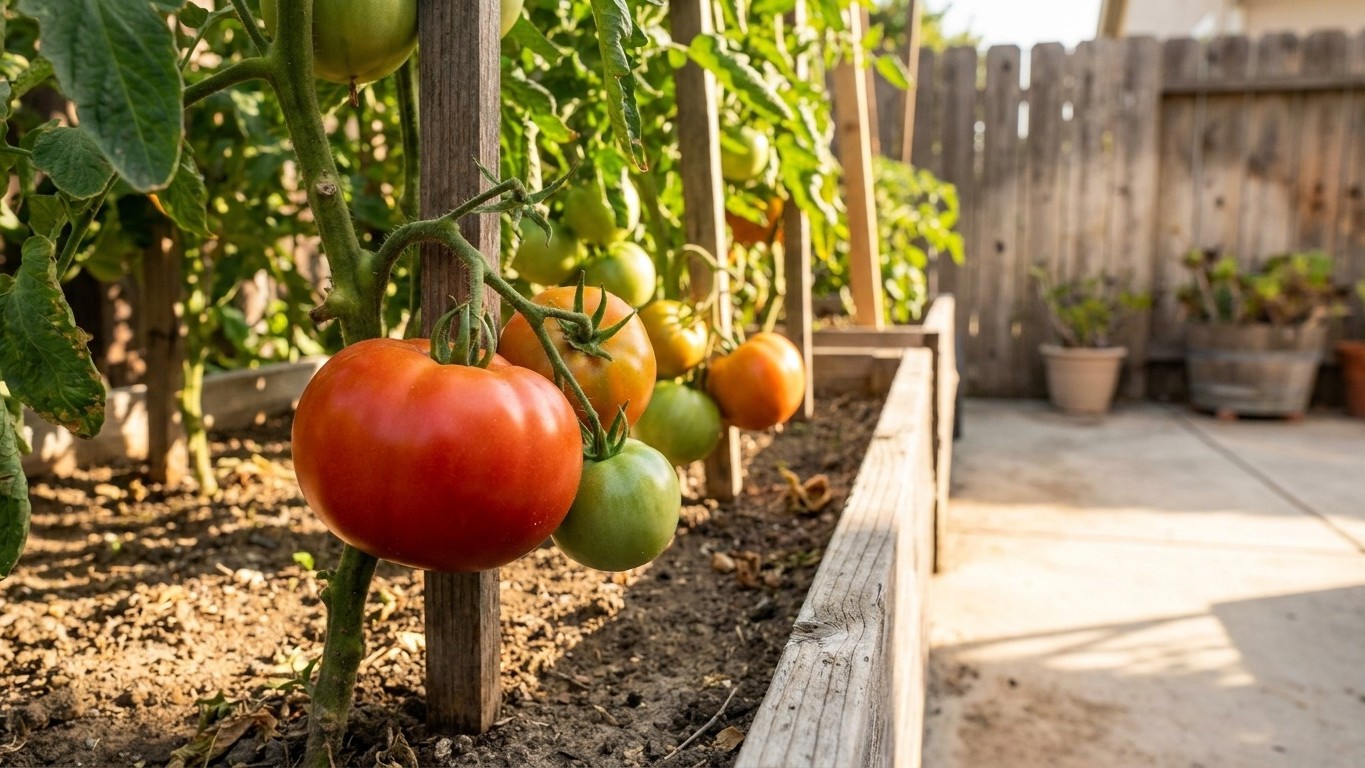

California’s tomato calendar depends entirely on where you garden. In Los Angeles, NOAA’s 1991-2020 climate normals show zero days at or below 32°F in thirty years of records, with the frost-free season listed as the full 365 days, so there is no last-frost date to count back from at all. Farther north, in the Central Valley and up into the Sierra foothills, freezes still happen on a very different clock. Check whether your own garden is one of the frost-free ones before you plan around a frost date that may not exist there.
When to plant Tomatoes in California

Los Angeles basin gardeners often wait for a last frost date before setting out tomatoes, the way every seed packet instructs. But the coastal and Southern California climate NOAA measures here has no frost to wait out. What sets your planting date instead is soil temperature under direct sun and how fast nights are warming — check two inches down with a thermometer. Move inland to the Central Valley or Sierra foothills, though, and that frost date returns, and matters.
Coastal and Southern California: no frost date to work around
For a frost-free garden, the earliest planting date is set by soil temperature and how quickly nights warm, not by freeze risk. Most gardeners in the Los Angeles basin start seed indoors in late winter, six to eight weeks before they intend to set plants out, then harden the seedlings off over seven to ten days by moving them outside for a few hours at a time before leaving them out overnight. Transplant once the coldest spring nights have passed and the soil has had a chance to warm under direct sun. A thermometer pushed two inches into the bed is a better guide than the calendar. Because the season never truly closes here, many gardeners also start a second round of seedlings in mid-summer for a fall crop, timed so plants are already fruiting before the shorter, cooler days of late autumn slow pollination.
The frost-free reading applies specifically to the Los Angeles station NOAA measured. Coastal San Diego and much of the Southern California basin share a similar frost-free pattern, but that does not carry north. If you garden anywhere else in the state, treat this figure as a description of one climate zone, not a statewide rule.
Northern California, the Central Valley and the Sierra: plant around your local frost date
Move away from the coast and the picture reverses completely. The Central Valley, the foothills and anywhere at elevation see real winter freezes, and tomato planting there has to respect a genuine last-frost date the way it would in most of the country. The general method is the same everywhere frost matters: start seed indoors roughly six to eight weeks before your area’s average last frost, harden seedlings off over a week to ten days, and do not set plants in the ground until frost danger has passed and nights have settled into a reliably mild range. For a region as large and varied as inland California, get the actual local average from your county’s University of California Cooperative Extension office rather than guessing from a statewide map. For comparison, a short-season, hard-frost climate like the one covered in Growing Tomatoes in Colorado forces the whole crop to mature between two fixed frost dates, a constraint most California gardeners never have to solve.
If you garden in more than one part of the state, or you’re moving from a mountain valley to a coastal lot, our California guides page rounds up region-by-region timing for other crops so you’re not applying one city’s frost data to a garden three climate zones away.
Soil and site preparation
Tomatoes want a minimum of six to eight hours of direct sun a day, and in most of California you can give them more than that without trouble since the crop’s main limit here is heat stress, not lack of light. Pick the sunniest, most open spot in the yard and keep it away from walls that reflect extra heat onto the plants during the hottest stretch of summer.
Fixing texture and drainage before you plant
Soil across California ranges from heavy clay in older valley neighborhoods to fast-draining sandy loam near the coast, and tomatoes struggle in both extremes if you don’t correct for it. Clay holds water long enough to suffocate roots and encourage the fungal wilts covered later in this guide, while sandy soil drains so fast that nutrients wash through before roots can use them. Work two to three inches of finished compost into the top eight to ten inches of the bed two to three weeks before you plant, giving it time to settle rather than turning it in the same day you set transplants. If drainage is genuinely poor, a raised bed or mounded row solves it faster than trying to amend heavy clay in place.
Spacing and bed layout
Space determinate varieties around 24 inches apart and give indeterminate, vining types closer to 30 to 36 inches, with rows far enough apart to get a hose or your own shoulders through once plants fill in. Crowded plants stay damp longer after watering, and that damp, still air is exactly what lets early blight and other leaf fungi take hold. Set a cage or stake in the hole at planting time rather than after roots have spread, so you don’t sever them driving a stake in later.
Varieties that suit California
Because Los Angeles effectively has no frost window to fit inside, the usual days-to-maturity-versus-season-length math doesn’t apply the way it does elsewhere. NOAA’s frost-free season of 365 days in Los Angeles means even the slowest tomato on this list finishes with room to spare. The real question is which weeks of the year you want that variety fruiting, since fruit set drops off once the hottest stretch of summer sets in and picks back up as it cools. In the Central Valley and other frost-bound parts of the state, the math still matters the traditional way: subtract a variety’s days-to-maturity, counted from transplant, from the number of frost-free weeks your county extension office reports, and you’ll see whether a long-season paste tomato has time to ripen before the first fall freeze.
Short-season and cherry types
For a fast payoff or a fall planting squeezed into a shorter window, lean on the quickest cultivars. Sakura reaches maturity in about 55 days from transplant and carries intermediate resistance to nematodes plus high resistance to tomato mosaic virus and two races of fusarium wilt, useful in older vegetable beds where those soil pathogens build up over years. Sun Gold matures in about 57 days, is indeterminate, and resists tobacco mosaic virus and fusarium wilt race 1. Supersweet 100 runs about 60 days and adds resistance to verticillium wilt on top of fusarium race 1. All three are cherry types, which matters for fruit set too: smaller fruit tends to keep setting through marginal heat stretches better than large slicers do.
Full-season slicers and paste tomatoes
For slicing tomatoes and sauce paste, the longer-season cultivars are worth the wait where the season allows it. Celebrity Plus (78 days, determinate) and Big Beef Plus (72 days, indeterminate) both carry intermediate nematode resistance plus high resistance to gray leaf spot and tomato mosaic virus, a useful combination in coastal gardens where humidity keeps foliar disease pressure up. Cherokee Purple (72 days) and Brandywine (78 days) are old heirloom slicers with no listed disease resistance, so they ask for cleaner soil and more attentive watering than the hybrids. For sauce, San Marzano II (78 days) and Amish Paste (85 days) are the classic paste types, while Amalfi (68 days, determinate) and Granadero (75 days, indeterminate, resistant to verticillium wilt and tomato mosaic virus) finish faster if your season runs short.
Catalogue days-to-maturity are counted from the transplant date, not from seed, and they shift by a week or two either direction depending on how warm the season runs. Treat the figures below as a comparison between varieties, not a guarantee.
| Variety | Days to maturity | Habit | Notable resistance |
|---|---|---|---|
| Sakura | 55 | Indeterminate | Nematodes (I), Tomato Mosaic Virus (H), Fusarium 1,2 (H) |
| Sun Gold | 57 | Indeterminate | Tobacco Mosaic Virus (H), Fusarium 1 (H) |
| Supersweet 100 | 60 | Indeterminate | Verticillium Wilt (H), Fusarium 1 (H) |
| Juliet | 60 | Indeterminate | Late Blight (I), Early Blight (I) |
| Jasper | 60 | Indeterminate | Late Blight (H), Early Blight (I) |
| Amalfi | 68 | Determinate | Nematodes (I), Late/Early Blight (I) |
| Big Beef Plus | 72 | Indeterminate | Nematodes (I), Gray Leaf Spot (H), Tomato Mosaic Virus (H) |
| Cherokee Purple | 72 | Indeterminate | None listed |
| Granadero | 75 | Indeterminate | Nematodes (I), Verticillium Wilt (H), Tomato Mosaic Virus (H) |
| Tiren | 75 | Indeterminate | Verticillium Wilt (H), Tomato Mosaic Virus (H), Fusarium 1 (H) |
| San Marzano II | 78 | Indeterminate | None listed |
| Celebrity Plus | 78 | Determinate | Nematodes (I), Gray Leaf Spot (H), Tomato Mosaic Virus (H) |
| Brandywine | 78 | Indeterminate | None listed |
| Amish Paste | 85 | Indeterminate | None listed |
What to plant alongside
Basil and marigolds get planted next to tomatoes so often that people assume the pairing has been proven in trials, but the evidence is thinner than the tradition. French marigolds are one of the few companion claims backed by real research: they release compounds from their roots that suppress root-knot nematodes in the soil, which matters directly for a bed that hasn’t had resistant varieties in it before. Basil planted alongside tomatoes has no comparable evidence behind the old claim that it improves flavor, but it fills the same sunny bed without competing hard for water, and it draws the same pollinators already working the tomato flowers.
Good neighbors
- Borage: draws bees and other pollinators to a bed that otherwise relies on wind and insects already visiting.
- Nasturtium: pulls aphids toward itself as a decoy planting, keeping them off tomato foliage.
- Alliums (onions, garlic, chives): shallow-rooted, low-competition neighbors some gardeners credit with confusing pest insects by scent, though the evidence is anecdotal rather than tested.
- Carrots or lettuce as a living mulch: shade the soil around the base of the plant and reduce water loss without competing for the same root depth.
What to keep away
Skip planting tomatoes near corn: the corn earworm and the tomato fruitworm are the same insect, and putting both crops side by side just gives it a bigger buffet. Keep tomatoes away from potatoes and other nightshade relatives too, since they share several of the same soilborne wilts and foliar blights, and a disease that shows up in one can move straight into the other. Heavy feeders like corn and squash planted too close will also pull nitrogen and water away from tomato roots at exactly the point the fruit needs it.
Watering, feeding and support
Consistency matters more than volume. Water deeply and infrequently rather than a little every day, aiming to soak the top eight to ten inches of soil and letting the surface dry before watering again. Shallow, frequent watering trains roots to stay near the surface where they dry out fast, and it’s exactly the pattern behind the blossom end rot and fruit cracking covered in the next section.
Mulch, drip and the water bill
A two to three inch layer of straw, shredded bark or dried leaves over the root zone cuts evaporation dramatically and keeps soil temperature more even through hot afternoons, which matters everywhere in California given how much of the state gardens under some form of water restriction or drought-year concern. Drip irrigation or a soaker hose laid under the mulch delivers water straight to the root zone instead of wetting the foliage, which also keeps humidity down around the leaves and reduces fungal disease pressure. Set it on a timer if you can, since the biggest cause of blossom end rot is an irregular watering schedule, not a shortage of calcium in the soil.
Feeding through the season
Work compost into the bed at planting as covered above, then hold off on additional fertilizer until the first flower clusters appear. Heavy nitrogen early produces a lot of dark green leaf growth at the expense of flowers and fruit. Once fruit starts to set, switch to a fertilizer lower in nitrogen and higher in potassium and phosphorus, feeding every three to four weeks through the main fruiting stretch.
Staking, caging and pruning
Determinate varieties like Celebrity Plus and Amalfi stay compact and usually need only a standard cage. Indeterminate types keep growing and fruiting until the weather stops them, and they need a sturdier stake or cage plus some ongoing management. Pinch out the small suckers that form in the crotch between the main stem and each side branch on indeterminate plants to keep the plant from turning into an unmanageable tangle, but don’t strip so many leaves that fruit sits exposed to direct sun and develops sunscald.
Common problems

Most tomato failures trace back to water, heat or one of a handful of pests that show up in nearly every California garden sooner or later. Learning to read the symptom saves a season.
Blossom end rot and cracking
A flat, sunken, leathery patch on the bottom of the fruit is blossom end rot, caused by inconsistent watering interrupting calcium delivery to the fruit rather than a lack of calcium in the soil itself. Deep, regular watering and a solid mulch layer fix it far more often than a calcium spray does. Cracking, whether in rings around the top of the fruit or splits down the side, comes from the same root cause: a dry stretch followed by a heavy watering or a sudden rain swells the fruit faster than the skin can stretch.
Wilts, leaf curl and poor fruit set
Leaves that curl upward and feel leathery are usually a heat response and not a disease at all, especially on plants that are otherwise green and growing. It looks alarming but rarely costs yield. A plant that wilts despite moist soil, especially with yellowing that starts on one side or on the lower leaves first, points to verticillium or fusarium wilt, two soilborne fungi that persist in garden soil for years once established. This is exactly why the disease-resistance codes on the varieties listed earlier in this guide matter: Sun Gold, Supersweet 100, Sakura, Tiren and Granadero all carry high resistance to one or both. Poor fruit set with plenty of flowers but few tomatoes is almost always heat: blossoms drop or fail to pollinate during the hottest, stillest days of summer, and set resumes once the weather breaks.
Pests to watch for
- Tomato hornworm: a large green caterpillar that strips foliage overnight, easiest to find at dusk with a flashlight.
- Aphids: small, soft-bodied insects clustered on new growth and the undersides of leaves, often tended by ants for their honeydew.
- Whiteflies: tiny white insects that scatter in a cloud when you brush the foliage, common in warm, dry conditions.
- Spider mites: near-invisible pests that show up as fine speckling and webbing on leaves during hot, dry stretches.
- Tomato fruitworm: bores directly into the fruit, the same species that damages corn as the corn earworm.
None of these pests is unique to California, and which one dominates in your specific county varies by year and by microclimate. Checking the undersides of leaves once a week catches most of them before the damage is severe enough to matter.
Pests that actually show up in California
Not every pest on California’s vegetable garden list bothers tomatoes. Cucumber beetles feed on squash, melons and other cucurbits and mostly leave tomato plants alone, and earwigs do more damage to seedlings and strawberries than to an established tomato patch. The pests worth watching for on tomatoes specifically come from the UC Agriculture and Natural Resources Master Gardener Program’s list of common vegetable garden problems and pests, and a handful of them show up in nearly every California yard sooner or later.
The brown garden snail (Cornu aspersum) and common garden slugs leave ragged holes in leaves and chewed patches on fruit touching the soil, along with the telltale slime trail. Both feed at night and on foggy, overcast days, and in the mild coastal gardens of Southern California they can stay active all year rather than slowing down in winter. Handpicking after dark and iron phosphate bait around the base of the plant work better than anything sprayed on the foliage.
Hornworm damage builds fast: a plant that looked fine yesterday is stripped of leaves and dotted with dark green droppings overnight. Both species recorded in California, Manduca sexta and Manduca quinquemaculata, peak in midsummer and throw a smaller second wave in late summer. A flashlight check at dusk and handpicking, or Bt sprayed on the foliage for a bad infestation, clears them out.
Aphids, including melon aphid, cluster on new growth and the undersides of leaves, leaving a sticky residue that turns into sooty mold. They are a minor nuisance most of the summer but build into a real problem in September and October as plants slow down and new tender growth becomes scarce. A hard spray of water knocks most colonies down; ladybugs and lacewings usually finish the job.
Stink bugs (consperse, harlequin and southern green) and leaffooted bugs both cause the same cloudy, discolored patches under the skin of ripening fruit, feeding through the fruit wall without leaving an obvious wound. Tomato fruitworm bores a clean hole straight into the fruit near the stem. Spider mites show up as fine stippling and webbing on leaves during hot, dry stretches. Whiteflies scatter off the plant when disturbed and leave the same sticky honeydew as aphids. Root-knot nematodes work underground, stunting and wilting the plant while swelling its roots into knots, and once established in a bed they persist for years, which is another reason the resistance codes on a seed packet are worth reading before you plant.
Harvest and end of season
Pick tomatoes once they’ve reached full color for the variety and give slightly to a gentle squeeze. A fruit that’s still hard with only a blush of color will keep ripening off the vine on a kitchen counter, out of direct sun. Never refrigerate a tomato you plan to eat fresh, since cold temperatures break down the texture and dull the flavor within a day or two. If a fruit cracks or splits, use it right away rather than storing it, since the open skin invites rot fast.
Green tomatoes at the end of the run
In frost-free parts of the state, plants don’t die back on their own the way they do elsewhere, but production slows sharply once nights turn consistently cool and short days limit ripening. Pull remaining green fruit once new fruit set has essentially stopped for the year rather than waiting on vines that are no longer productive, and either ripen them indoors or use them green for frying and pickling. In frost-prone regions, the calculation is more urgent: a killing frost ends the season outright, so pick everything, ripe or not, once a freeze is close, based on your local extension office’s frost guidance or your own experience with the site. Compare that hard stop to Growing Tomatoes in New York, where the first fall frost forces an abrupt end to harvest most years. California’s frost-free coast rarely faces that same deadline, but its interior valleys and mountain gardens do.
Local help
For county-level planting dates, soil testing and pest identification specific to your part of the state, contact your University of California Cooperative Extension office through UC ANR. County advisors can confirm your local frost pattern: a frost-free reading like Los Angeles’s, or an actual average last-frost date if you garden inland or at elevation, plus run a soil test before you commit to a full bed of amendments.
Where to Go From Here
Everything above depends on where in California you’re gardening, so the details are worth working out for your own yard rather than guessing. Start with the planting calendar, which counts backward from heat rather than cold — a coastal spot like Los Angeles has no spring frost date to count from at all, since the thirty-year record shows none, and it’s nighttime temperatures climbing too high that actually stop pollen from setting fruit. Once your dates are set, the variety guide explains why days-to-maturity numbers matter less on the coast than you’d think, since a paste tomato needing 85 days and a cherry needing 55 both have all the season they need where frost never enters the picture. And because that same lack of hard frost shapes which insects stick around all year instead of dying off, the pest guide lays out which bugs actually show up on California tomatoes, based on the same freeze record — zero days a year in Los Angeles — that drives the planting and variety decisions in the first place.
Common questions
Can I really plant tomatoes any time of year in Los Angeles?
Close to it. NOAA’s climate normals show no measurable frost risk there, so nothing stops you from setting plants out most of the year. The practical limit is summer heat stalling fruit set and, in winter, cool enough nights that growth slows to a crawl even without a freeze.
Why did my tomato plant stop setting fruit in the middle of summer?
Heat is the most likely cause, not a disease or pest. Once a stretch of hot days and warm nights sets in, blossoms drop or fail to pollinate, and fruit set picks back up once temperatures ease. Keep watering and feeding on schedule so the plant is ready to set fruit again as soon as conditions allow.
Do I need to protect my tomatoes from frost if I live near the coast?
In the Los Angeles area specifically, no: NOAA’s records show effectively zero freeze risk there. That doesn’t automatically apply to every coastal or southern mile of the state, and it definitely doesn’t apply inland, so check your own site’s history rather than assuming a coastal location is frost-free by default.
What’s a good tomato for a small container or patio garden in Southern California?
Cherry types handle container life best because they need less root volume and keep producing through marginal weather. Sakura, Sun Gold and Supersweet 100 are all indeterminate cherry varieties that do well trained up a small stake or cage in a large pot.
My inland garden got hit by a late frost after I already transplanted. What now?
Check the stems the next morning. If they’re still firm and green under a blackened top, the plant will often push new growth back out. If the stem itself has gone soft and dark, replace the plant, since a fresh transplant will usually catch up within a few weeks given how much growing season remains once frost risk clears.