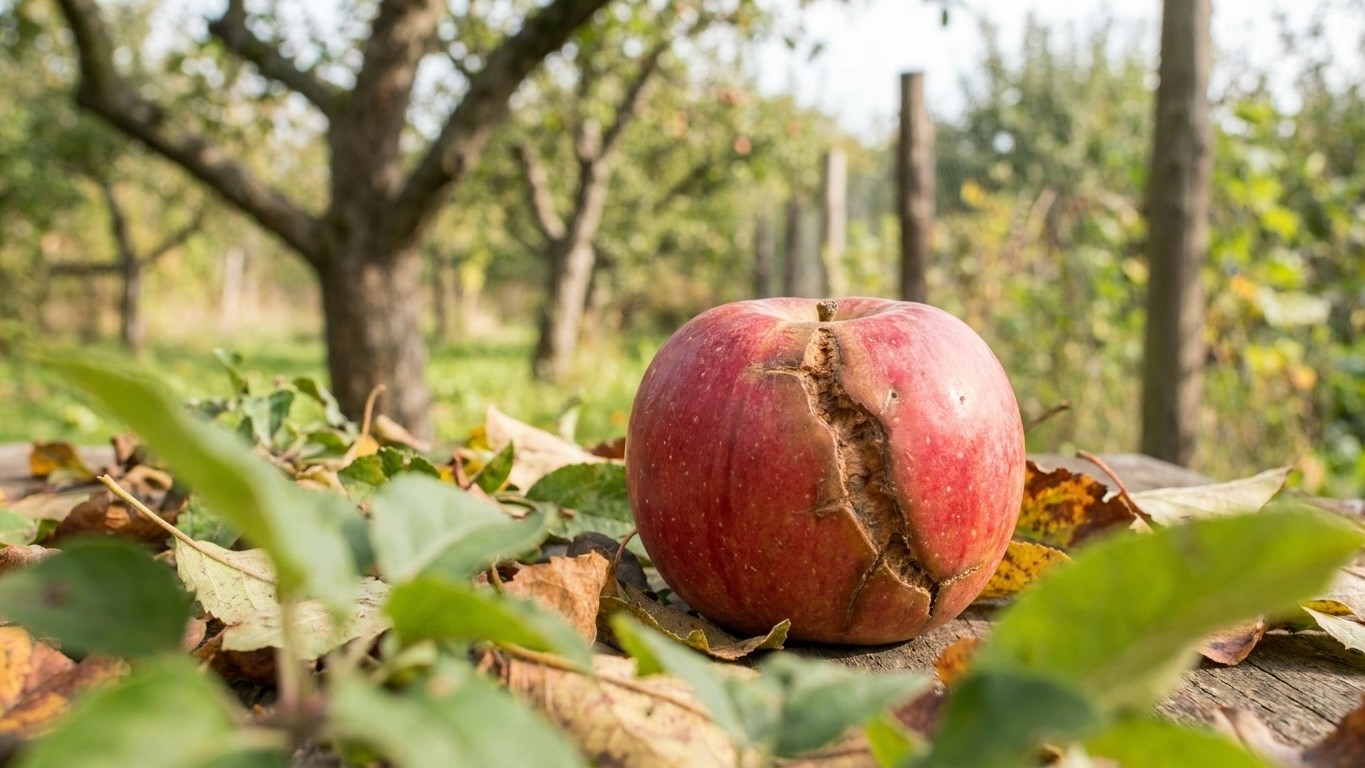

In Minnesota, apple harvest isn’t tied to a date on the calendar. It’s tied to variety and to how each tree reads the season: early types finish by late summer, the main crop comes off through September, and the latest keepers hang on right up against the region’s first fall frost. What happens after picking varies just as much. Some apples are done within a few weeks. Others, bred for exactly this climate, hold for months in cold, humid storage.
When apples are ready to pick in Minnesota
Ripeness on an apple tree shows up as a set of physical signals, not a page on a calendar: the background skin color shifts from green toward yellow, the seeds inside turn from white to brown, and the fruit separates from the spur with a gentle twist instead of a tug. Growers who want more certainty cut a fruit and run an iodine starch test, which shows how much of the fruit’s starch has already converted to sugar. None of that depends on the month. It depends on the tree, the variety, and the weather that season.
What does depend on the calendar, and sets the outer boundary for the whole harvest, is the arrival of fall frost. In the Twin Cities area, using Minneapolis as the reference station, the first fall frost lands between October 11 and October 23 (NOAA NCEI 1991-2020 Climate Normals, 32°F freeze probability, 30-70% band). That’s the window in which any late-hanging fruit needs to be off the tree, since a hard freeze damages both flesh and storage quality. On the other end, the last spring frost in this same reference area falls between April 17 and April 30, which marks when blossoms are no longer at serious risk from a freeze.
Those two windows only describe the mild south of the state. Northern Minnesota, away from the moderating effect of the Twin Cities metro and the Mississippi River corridor, runs two to three weeks tighter at both ends: spring frost risk lingers later into May, and fall frost arrives correspondingly sooner. A grower in International Falls or along the Iron Range should treat any date built off the Minneapolis normals as too generous by two to three weeks in both directions, and should plan for a shorter harvest window on the tree overall.
Inside that season, early varieties typically finish in late summer, well ahead of any frost concern. Mid-season varieties come off through September. The latest-ripening varieties are the ones actually competing with the first-frost window, and growers of those types watch the forecast closely once October arrives. University of Minnesota Extension publishes variety-specific growing guidance for home orchardists in the state, which is the right first stop for a planting-specific timeline rather than a generic one.
Which ones keep, and which must be eaten
Not every apple is built for the same fate. Some varieties are bred for a short, sweet window right off the tree. Others are bred, quite deliberately, to sit in cold storage and still taste good in February. Minnesota has a long history with the second kind, mostly because the University of Minnesota’s apple breeding program has spent decades developing cultivars that hold up under this state’s storage conditions, not just its winters.
A rough guide by variety
| Variety | Typical position in the season | Storage character |
|---|---|---|
| Zestar! | Early season | Best eaten soon; softens within a few weeks |
| Honeycrisp | Early to mid season | A better keeper than most early apples; holds for a couple of months under cold, humid conditions |
| SweeTango | Early to mid season | Similar profile to Honeycrisp; best used within a couple of months |
| Sweet Sixteen | Mid season | Best fresh; doesn’t hold long in storage |
| Haralson | Mid to late season | A classic Minnesota keeper; holds for months in a cold cellar |
| Honeygold | Mid to late season | Holds reasonably well through winter |
| Keepsake | Late season, near first frost | Bred specifically for long storage; one of the longest-keeping varieties available here |
| Fireside | Late season | Long-storing; flavor mellows over weeks in cold storage |
The pattern isn’t a coincidence. Late-season varieties, the ones ripening closest to that October 11 to October 23 first-frost window, tend to be the ones built for long storage. Early apples, picked in late summer while the weather is still warm, don’t need that same staying power because they’re meant to be eaten while the season is still going. If the goal is a stocked cellar through a Minnesota winter, the late-ripening, University of Minnesota-bred keepers like Haralson, Keepsake, and Fireside are the ones worth planting or seeking out at an orchard.
Storing them through a Minnesota winter
Good storage starts with picking. Apples destined for months in a cellar should be picked slightly firmer and a touch earlier than apples meant for the counter, since they’ll keep ripening in storage. Bruised or nicked fruit should be set aside for immediate use, not stored, because damaged skin is where rot gets a foothold and spreads to whatever sits next to it.
The target storage environment is cold and humid: close to freezing but not below it, with enough moisture in the air that the fruit doesn’t shrivel. A basement corner, an unheated but insulated room, or a traditional root cellar all work if they hold a steady temperature in that range. What doesn’t work as reliably in this state is an unheated garage or an uninsulated outbuilding. The mean daily minimum temperature in the coldest month, using Minneapolis as the reference station, is 8.8°F (NOAA NCEI Climate Normals, 1991-2020). That’s the figure that matters for anything left in an unconditioned space over winter, apples included: a garage with no insulation will regularly sit well below freezing for stretches of the coldest months, and a hard freeze inside the storage space damages the fruit just as it would on the tree. Storage spaces need enough insulation, or enough shared wall with a heated structure, to stay above freezing even when outside air drops toward that 8.8°F average minimum.
Beyond temperature, spacing and airflow matter more than most people expect. Apples stored touching each other, or piled deep in a single container, ripen and rot faster because one soft or damaged fruit releases ethylene gas that accelerates aging in everything around it. Laying fruit in single layers, in ventilated crates or wrapped individually in paper, slows that chain reaction. Checking stored fruit every couple of weeks and pulling anything gone soft keeps one bad apple from taking down the rest of the batch, which is where that old saying actually comes from.
What goes wrong here
The most common failure in Minnesota apple growing isn’t a tree that can’t survive the winter. Minneapolis’s 8.8°F average minimum in the coldest month (NOAA NCEI, 1991-2020) sits well within the range that most apple cultivars sold in this state are bred to handle; hardiness generally isn’t the limiting factor here the way it would be farther north or at higher elevation. Winter chill, the separate question of whether a tree gets enough sustained cold to break dormancy and flower properly, is also rarely in short supply in Minnesota. If anything, this state has more chill accumulation than most low-chill varieties even need.
The real risk runs the other direction. A warm stretch in late March or early April can push a tree toward bloom before the region’s last spring frost date has passed. The Minneapolis-area normal for that last frost is April 17 to April 30 (NOAA NCEI, 1991-2020), and a tree that flowers into that window, rather than after it, risks losing its blossoms to a freeze and with them the whole season’s crop. This is the opposite problem from the low-chill trade-off seen in milder climates, where varieties bloom early because they need so little cold. Here, the danger comes from ordinary MN cultivars responding to an unusually warm early spring rather than to the calendar. Choosing varieties known to bloom on the later side, and not rushing to remove protective mulch or wraps the moment a warm week arrives, does more to protect a crop here than chasing an early start.
Farther north, growers face the tighter version of both windows at once: a shorter frost-free season squeezed from both ends, with less margin for a late-hanging variety to finish ripening before the first fall freeze arrives.
Common questions
Can apple trees survive a Minnesota winter without extra protection?
Most cultivars sold for this climate are bred to handle the region’s cold. Minneapolis’s average minimum of 8.8°F in the coldest month (NOAA NCEI, 1991-2020) falls within the tolerance of standard hardy varieties, so winter survival generally isn’t the limiting issue. Young trees in their first couple of winters, and trees in the coldest pockets of northern Minnesota, benefit from trunk wrap and mulch regardless.
How much earlier should northern Minnesota growers plan their harvest?
Two to three weeks earlier at the fall end, and two to three weeks later at the spring end, compared with the Minneapolis-area normals. The 1991-2020 NOAA NCEI frost windows describe the mild south of the state; the north runs a noticeably tighter season on both sides.
Do late-season apples always taste better after storage?
Some do. Varieties like Fireside are known to mellow in flavor over weeks in cold storage. That’s not universal, though, and it’s a reason to pick late-ripening keepers slightly firm rather than dead ripe, giving them room to finish developing in the cellar rather than on the counter.
Where can a Minnesota grower get variety-specific planting advice?
University of Minnesota Extension maintains guidance for home orchardists at extension.umn.edu, and it’s the most relevant starting point for questions specific to a particular county or planting site rather than the state-wide averages covered here.