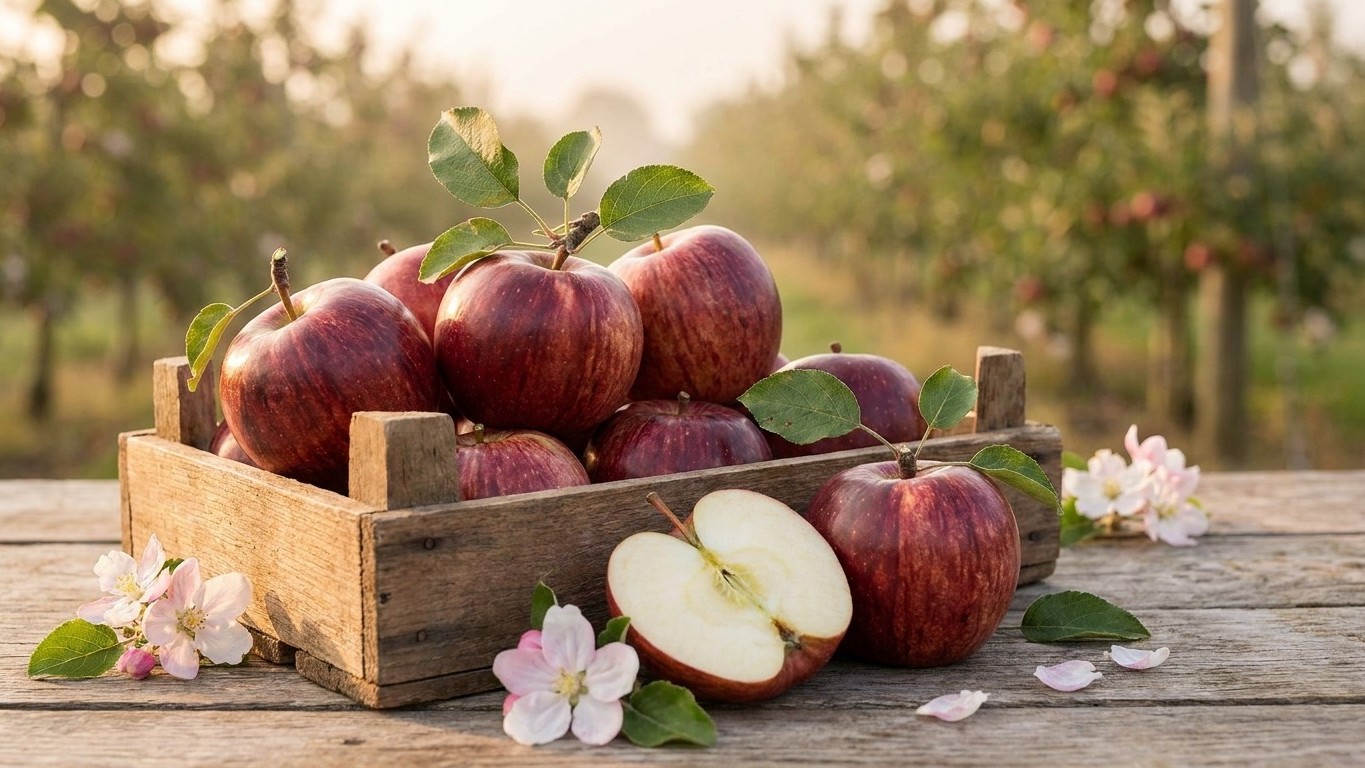

Utah apples are ready when their stage says so, not the calendar: skin color shifting, seeds turning brown, fruit twisting free of the spur. Around Salt Lake City, that stage typically lands between late August and mid-October, bounded by the region’s spring and fall freeze dates. Early varieties keep two to four weeks; late, dense-fleshed types hold for months in cold, humid storage. Elevation and region shift both the timing and the answer.
When apples are ready to pick in Utah
The calendar is a rough guide at best. What decides harvest day is the fruit’s own stage: background skin color shifting from green to yellow or cream, seeds turning from white to brown, and the apple releasing from the spur with a gentle upward twist rather than a hard pull. Cut one open a week before you think it’s ready. Clear, colorless flesh around the core means wait; a slight starchy-to-sweet shift means go.
Those stages play out inside a growing season bounded by frost. Around Salt Lake City, the reference station used by NOAA (USW00024127) shows the last spring freeze landing somewhere between April 12 and April 29, and the first fall freeze arriving between October 18 and October 29, a roughly six-month window from bud break to the point trees shut down for winter. Early-season varieties finish ripening with weeks to spare inside that window. Late-season varieties are still hanging, sometimes deliberately, into the first cool nights of October, because a touch of cold after color change deepens flavor in some cultivars without freezing the fruit outright.
That six-month frame is a valley number, not a statewide one. Cache Valley and the benches above Salt Lake sit higher and colder, so both frost dates move: spring frost lingers later, fall frost arrives sooner, and the safe harvest window narrows. No local figures for those specific stations are published here, so growers there should treat the Salt Lake dates as a starting point to adjust colder, not copy directly. Washington County, around St. George, sits lower and milder, stretching the season the other direction. Again, no station-specific frost dates for that area appear in the sourced data used here. The practical takeaway is that a St. George harvest generally runs earlier than a Salt Lake City harvest for the same variety, not later.
None of this replaces watching the tree. A hot, dry August can push sugars and color ahead of a typical year; a cool, wet one delays both. The safest approach is picking one or two test apples starting a week before the date you’d expect based on variety and region, then adjusting from there rather than committing the whole tree to a single day.
Which ones keep, and which must be eaten
Harvest timing and storage life travel together. Varieties that ripen earliest, at lower sugar and higher acid, tend to break down fastest in storage. Varieties that finish last, often with thicker skin and denser flesh, are usually the ones selected to hold.
Early apples picked in Utah’s earliest window at valley elevations rarely last past a month even under good refrigeration. They’re built for the counter, not the cellar. Mid-season varieties buy a few extra weeks. Late-season varieties, the ones still on the tree as the first fall freeze approaches in mid-to-late October around Salt Lake, are the only realistic candidates for winter-long storage.
| Ripening group | Typical picking window (valley elevation) | General keeping quality in cold storage |
|---|---|---|
| Early-season | Late July to mid-August | A few weeks; best eaten fresh or processed quickly |
| Mid-season | Late August to mid-September | Four to eight weeks with refrigeration |
| Late-season | Late September into October, close to the first fall freeze | Several months in cold, humid storage |
The practical rule for a Utah harvest: pick early and mid-season fruit knowing it’s a short-term supply, and reserve the late-pick apples, harvested closest to the October 18 to October 29 freeze window, for what you want in the kitchen come February. Mixing early apples into long-term storage boxes is one of the more common ways good fruit goes to waste. One soft, leaking apple accelerates decay in everything around it, a chain reaction some growers still call the “one bad apple” problem, and it isn’t folklore.
Bruising during picking shortens shelf life regardless of variety. An apple dropped even a foot onto a hard surface develops a bruise that turns to rot within days, so harvest by hand into a soft-lined container rather than shaking branches or letting fruit fall.
Storing them through a Utah winter
Apples keep best just above freezing, in the low-to-mid 30s Fahrenheit, with high humidity to keep the skin from shriveling. A basement, a cool closet against an exterior wall, or an insulated garage all work in most of Utah’s populated valleys. What doesn’t work reliably is an uninsulated shed or an attached but unheated garage in the coldest months.
Here’s the number that matters for that decision: at the Salt Lake City reference station, the average daily minimum temperature during the coldest month of the year is 24.2°F. That’s a mean, not a record low, meaning on a typical night in the coldest stretch of winter, an unheated outbuilding with no thermal mass can sit below freezing for hours. Apples tolerate a light chill, but repeated hard freezes turn the flesh mealy and brown from the inside, damage that isn’t obvious until you cut one open weeks later. Storage locations should stay reliably above freezing even on the coldest nights, which usually rules out anywhere without some insulation or a heat source nearby, like a shared wall with a heated part of the house.
Humidity matters almost as much as temperature. Apples stored in an open cardboard box in a dry basement lose moisture through the skin and go soft within weeks, even at the right temperature. Wrapping fruit individually in newspaper, or storing in perforated plastic bags, slows that moisture loss considerably. A layer of damp, not wet, sand or sawdust in a storage bin does the same job root cellars have handled for generations.
Check stored apples every couple of weeks and pull any that are softening or showing brown spots. One decaying apple releases ethylene gas that speeds ripening, and eventually rot, in everything stored near it. For variety-specific storage guidance beyond general temperature and humidity rules, Utah State University Extension is the state’s land-grant extension service and the reference point for localized fruit-growing questions, though not every variety or region has published storage-duration data specific to Utah conditions.
What goes wrong here
The single biggest risk to a Utah apple crop isn’t winter cold, it’s a warm stretch in early spring followed by a return to frost. Around Salt Lake City, the last spring freeze can land as late as April 29 in some years and as early as April 12 in others, a two-and-a-half-week spread that makes any bloom before mid-April a gamble. Apple blossoms are damaged a few degrees below freezing, and a tree that flowers early, whether because of a warm March or because it’s a low-chill variety, is exposed to exactly the frost window this data shows as still active.
This is where two separate questions get confused. Winter hardiness is about survival: whether the tree itself lives through the coldest night of the year. At 24.2°F average minimum for the coldest month in Salt Lake City, ordinary temperate apple varieties are in no danger on that count alone; hardiness only becomes the limiting factor at higher, colder elevations like the benches above the valley or mountain valleys further north, where no station-specific figures are published here. Winter chill is a different filter entirely: whether the tree accumulates enough cold to flower normally, and in most of Utah, cold winters supply that in surplus.
The trade-off shows up mainly in the state’s mildest pockets, generally the lower-elevation parts of Washington County around St. George. A tree that needs less winter chill to break dormancy will flower earlier, and earlier flowering in Utah means flowering closer to, or before, that April frost window rather than safely after it. For most of the state, the safer choice is a variety with a higher chill requirement and a later bloom habit, precisely because it pushes flowering past the point where a late freeze is still statistically live. No local source in this data set publishes chill-hour totals for St. George specifically, so growers there are better served asking Utah State University Extension directly than guessing at a number.
Common questions
What month should I pick apples in Utah?
There’s no single month that fits every variety or every region. Around Salt Lake City, harvest generally falls between late August and mid-October, with early varieties finishing first and late varieties hanging until close to the first fall freeze in the October 18 to October 29 range. Higher, colder parts of the state shift that window later in spring and earlier in fall; warmer, lower parts shift it the other way.
How long do stored apples actually last in Utah?
It depends entirely on the ripening group. Early-season apples hold a few weeks at most, even refrigerated. Mid-season varieties last four to eight weeks. Late-season varieties, picked closest to the first fall freeze, can hold for several months in cold, humid storage.
Can I store apples in an unheated garage over winter?
It’s risky in most of Utah. The average daily minimum during the coldest month in Salt Lake City is 24.2°F, cold enough that an uninsulated space can sit below freezing for hours on a typical winter night. Repeated hard freezes turn apple flesh mealy and brown. An insulated space, or one that shares a wall with heated living space, is a safer bet.
Does Utah get enough winter chill for apple trees to flower properly?
In most of the state, yes; cold winters supply more accumulated chill than almost any variety needs. The exception is the mildest, lowest-elevation pockets like the St. George area, where chill accumulation runs closer to the margin. No local source publishes chill-hour totals for that specific area, so growers there should check with Utah State University Extension before choosing a variety.