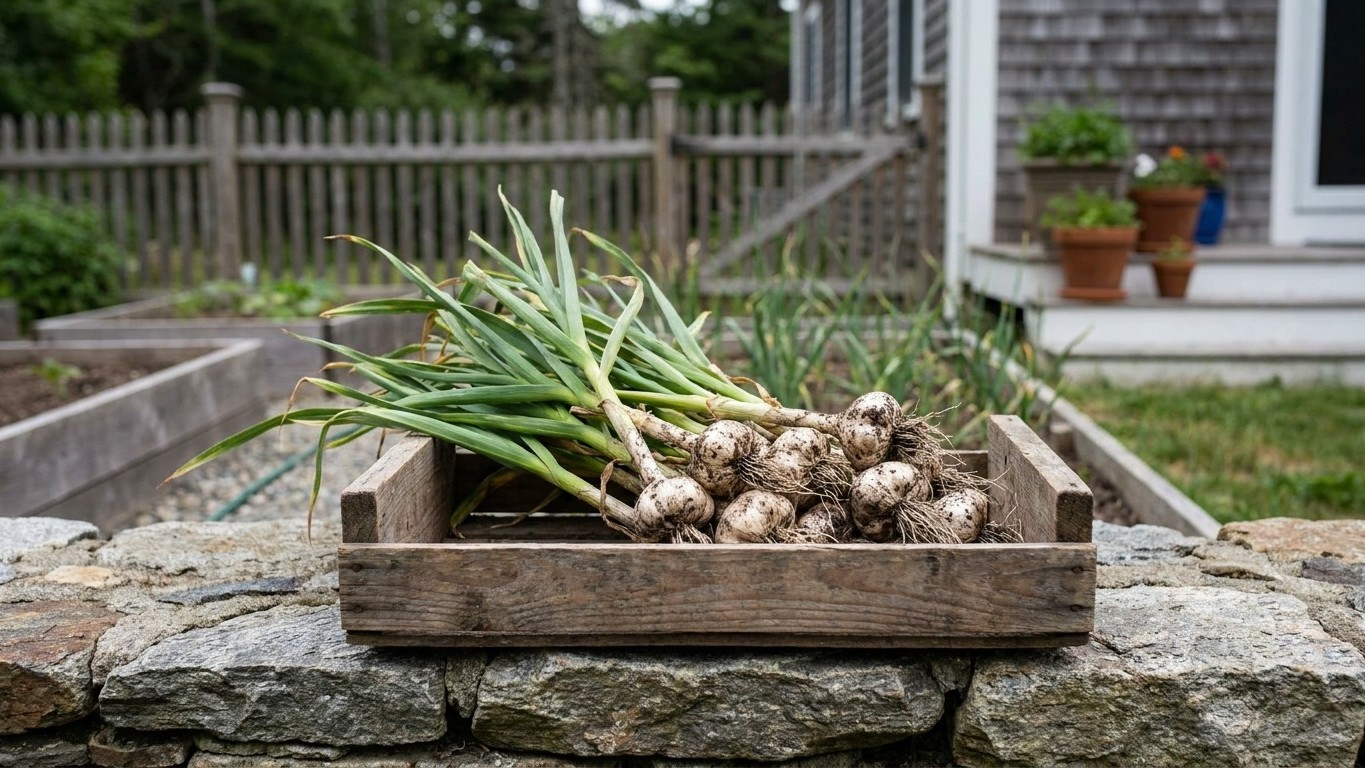

Garlic in West Virginia usually comes out of the ground between late June and mid-July, once the bottom third to half of the leaves have browned off and about five or six green leaves remain up top. Pull one test bulb before you commit the whole bed. Then plan on two to four weeks of curing in a shaded, breezy spot before you trim it, brush it off, and put it away for winter.
When garlic is ready to lift in West Virginia
Garlic planted in West Virginia goes into the ground the previous autumn, typically ahead of the first fall frost window. That window falls between October 18 and November 1, based on NOAA’s 1991-2020 Climate Normals for the Charleston station. That date is a midpoint, not a guarantee. In roughly half of all years, the first freeze arrives later than that range, and in higher-elevation counties across the state, frost shows up noticeably earlier than it does in a river valley like Charleston’s. Growers up around Pocahontas or Randolph County should treat their local frost history as separate from the valley numbers, not a match for it.
Once that fall-planted clove roots in and goes dormant for winter, it resumes growth the following spring and spends early summer bulking up underground. The signal that it’s done isn’t a date on the calendar. It’s the leaves. As the bulb finishes filling out, the lower leaves yellow and then brown, working their way up the stalk. Extension guidance generally points growers toward digging when roughly 40 to 60 percent of the leaves have died back, leaving five or six green ones standing. Pull too early and you get small, immature cloves with thin wrappers that won’t hold through winter. Wait too long, past the point where nearly all the foliage has collapsed, and the bulb’s protective wrapper starts splitting open in the soil, which invites rot and cuts your storage life short.
The safest way to check is to sacrifice one bulb. Loosen the soil with a fork well away from the stem, since yanking on the leaves can snap the neck off a bulb that’s otherwise ready. Brush off the dirt and look at the cloves. They should be plump and fully formed, with distinct wrappers separating each clove, not a solid, undifferentiated mass. If it looks right, dig the rest of the row that day or the next, ideally when the soil is dry rather than right after a rain.
Because elevation and local microclimate shift the calendar so much across the state, a firm calendar date isn’t reliable guidance here. West Virginia University Extension Service is the resource to check for county-level planting and harvest guidance if you want something calibrated to your specific area rather than a statewide average.
Curing it, and where to hang it here
Curing is what turns a freshly dug bulb, still full of moisture, into something that will keep for months. The process is simple in theory: get air moving around the bulbs in a spot that’s warm, dry, and out of direct sun, and leave them alone for two to four weeks. What’s harder in West Virginia is finding that spot in late June and July, when the state’s humidity tends to run high and afternoon storms roll through the valleys and hollows regularly.
Don’t wash the bulbs. Shake off loose soil and leave the roots and tops attached during curing, since cutting them right after harvest opens a wound that invites rot before the bulb has had a chance to seal itself. Lay the garlic in a single layer on screens or racks, or tie it in small bundles and hang it, stems up, somewhere with real airflow. A closed, still garage in mid-summer traps heat and humidity together, which is close to the worst combination for curing garlic. A covered porch with a cross breeze, or a shed with the doors propped open, tends to work better.
Picking a curing spot
| Location | Airflow | Humidity risk | Notes |
|---|---|---|---|
| Screened porch | Good | Low to moderate | Usually the best option if it stays shaded |
| Open shed, doors propped | Good | Moderate | Watch for rain blowing in on humid days |
| Closed garage | Poor | High | Add a box fan or the bulbs may mold before curing finishes |
| Attic | Poor to moderate | High (heat-driven) | Summer heat often runs too high for slow curing |
A box fan pointed at the bundles, running on low for a few hours a day, makes up for a lot of West Virginia’s summer humidity if your only real option is a garage or basement stairwell. Give the cure the full two to four weeks even if the bulbs look done sooner. You’ll know it’s finished when the outer wrappers are papery and dry and the neck, if you squeeze it, feels tight rather than damp or spongy.
Storing it through a West Virginia winter
Once curing is done, trim the roots down to a stub and cut the tops back to an inch or two above the bulb, unless you’re braiding softneck varieties, in which case the tops stay on. Brush off any dry soil left clinging to the wrappers, but don’t scrub or wash the bulbs. That papery skin is the only real barrier standing between your garlic and the mold spores and bacteria in the air around it.
Storage conditions matter as much as curing did. Garlic keeps longest somewhere cool, dark, and dry, generally in the range that most storage guidance describes as ideal for cured bulb crops, with moderate humidity and steady temperatures rather than swings. Older West Virginia homes with a below-grade basement or a root cellar dug into a hillside often hold that kind of steady, cool condition naturally, without any equipment running. A finished, heated basement won’t do the job nearly as well, since the goal is closer to a cold pantry than a living space.
Mesh bags, loose baskets, or old pillowcases all work better than sealed plastic containers, because garlic needs to breathe. Trapped moisture inside a sealed bag is one of the fastest ways to turn a winter’s worth of stored garlic into a moldy mess by January. Check on stored bulbs every few weeks through the winter and pull any that have gone soft or started sprouting green shoots, since one bad bulb can spread rot to its neighbors in a crowded basket.
If you’re saving cloves to replant, set aside your largest, healthiest bulbs specifically for that purpose rather than planting whatever’s left over in spring. Those cloves go back in the ground the following fall, timed the same way as your original planting, ahead of that first frost window for your local elevation rather than the valley-based NOAA date if you’re up in the mountains.
What goes wrong here
Most storage failures trace back to a decision made weeks earlier, not something that happens in the pantry itself. Harvesting too late, after the foliage has mostly collapsed, leaves bulbs with split or loose wrappers that dry out fast and let in rot organisms during storage. Harvesting too early does the opposite kind of damage: the cloves haven’t finished sizing up, the wrappers are thin, and the bulbs shrivel faster than a properly matured one would.
Curing in a spot with poor airflow is the other common culprit. A closed, humid garage or a damp basement corner slows the drying process down enough that mold gets a foothold in the neck of the bulb before it ever seals up. By the time you notice a soft spot at the top, the damage is usually already spreading downward into the cloves.
WVU Extension documents a specific set of garden pests for this territory, and while most of them target leafy greens, beans, and nightshades rather than garlic bulbs directly, a heavily infested garden bed can stress plants across the board and leave bulbs smaller or thinner-skinned than they should be going into harvest. The documented list includes aphids and whiteflies, asparagus beetles, cabbage worms, Colorado potato beetle, corn earworm, cucumber beetles, flea beetles, harlequin bug, Japanese beetle, slugs, and tobacco hornworm. Slugs in particular can be an issue in a wet West Virginia spring, since they thrive in the same damp mulch that garlic beds often get topped with.
Storing garlic in the refrigerator is a mistake worth calling out specifically. The cold, humid environment inside a fridge tricks cloves into thinking winter has passed, and they’ll sprout green shoots within weeks rather than staying dormant for months in a cool, dry basement.
Common questions
Can I harvest garlic in West Virginia in June?
In a warm spring or at lower valley elevations, some plantings are ready by late June. Leaf die-back, not the calendar, is the real signal, so check a test bulb rather than assuming a specific date applies to your garden.
Do I need to wash garlic before curing it?
No. Washing introduces moisture right when the bulb needs to dry out, and it can push soil bacteria into small nicks in the wrapper. Brush off loose dirt by hand and leave the rest for after curing.
How long does properly cured garlic last in storage?
It depends heavily on variety and how well curing and storage conditions were managed, and no single duration applies across the board. A cool, dark, dry spot with good airflow gets you the longest possible window; check bulbs regularly and use up any that start softening first.
What if my curing spot is too humid?
Add a box fan and run it for several hours a day, and move bulbs to the driest room available, even if that means a spare bedroom instead of a garage or basement. Airflow matters more than any single ideal humidity number.