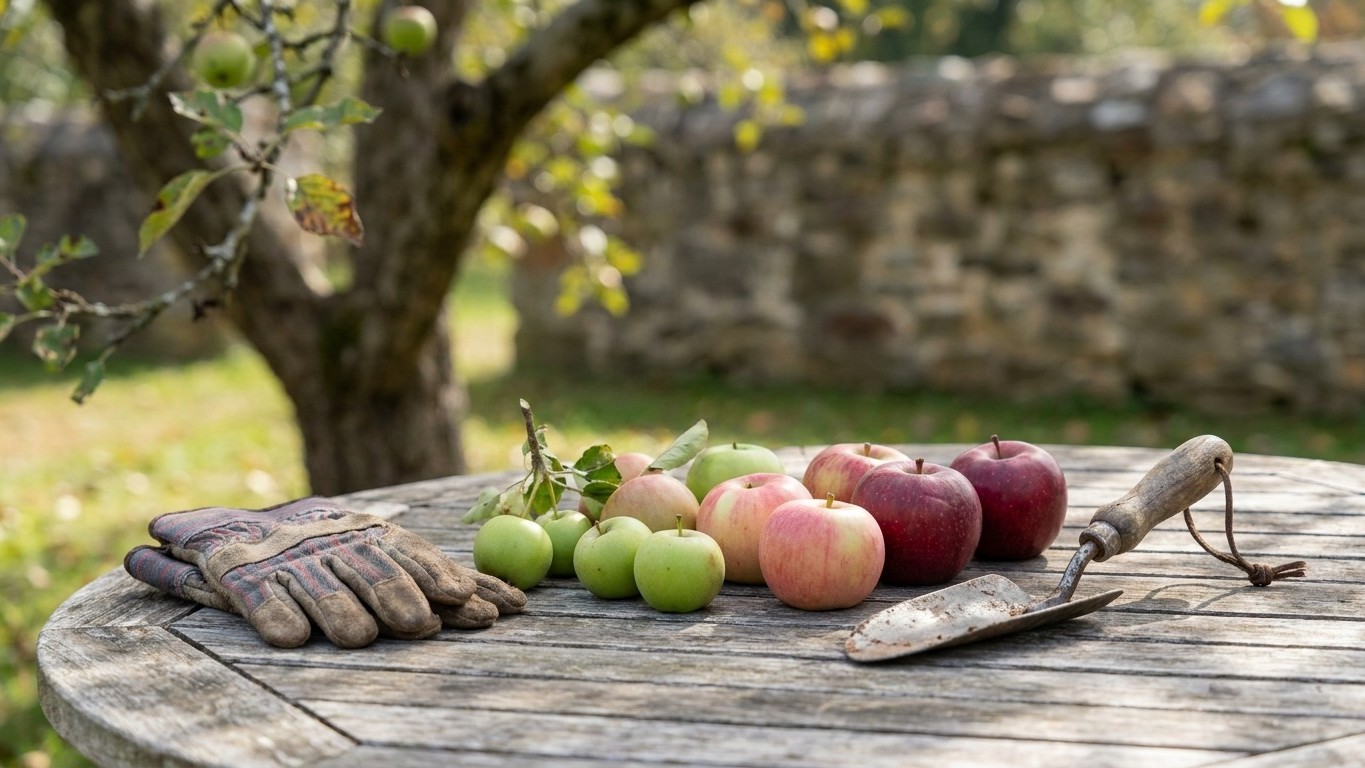

In Wyoming, apples are picked by stage, not date. Most trees near Cheyenne and similar elevations come ready between late August and the third week of September, timed to finish before the first fall frost (September 24 to October 5, per NOAA NCEI). Firm, late-season fruit picked at full maturity can hold three to five months in cold storage. Soft, early varieties won’t outlast a few weeks. What follows explains the mechanism behind that window, and what shifts it at higher elevation.
When apples are ready to pick in Wyoming
Ripeness on an apple tree shows up as a set of signals working together: background skin color shifting from green to yellow, seeds turning brown, and the fruit separating from the spur with a gentle upward twist rather than a tug. None of that is tied to a specific week on a calendar. It’s tied to accumulated warmth since bloom, and in Wyoming that clock runs on a short track.
At the reference station used for this territory (USW00024018), the last spring frost falls between May 7 and May 18, and the first fall frost arrives between September 24 and October 5. That’s roughly 130 frost-free days at an elevation near 6,000 feet. Every variety grown here has to bloom, set fruit, and finish ripening inside that stretch, or it doesn’t get harvested at all before frost damages the crop still hanging.
Two different filters decide what survives that stretch, and they’re not the same thing. Winter hardiness is about whether the tree itself lives through the cold season. In Cheyenne, the mean daily minimum of the coldest month sits at 18.1°F (NOAA NCEI, 1991-2020 Climate Normals). That figure, not the record low on a bad night, is what a rootstock and scion combination has to tolerate every single winter without dying back. Winter chill is a separate question entirely: it’s the accumulated cold hours a tree needs before it can flower properly in spring. A tree can be hardy enough to survive January and still flower poorly, or too early, if its chill requirement doesn’t match the local pattern.
That second filter creates a real trade-off here. A low-chill variety breaks dormancy on relatively little accumulated cold, which means it flowers early. In most regions that’s an advantage. In this territory it’s a liability, because early bloom lands squarely inside the May 7 to May 18 frost window, and a single freeze at that point can wipe out the season’s fruit set. The safer choice on this territory is a variety with a higher chill requirement and later, hardier bloom, even though that means giving up the head start a low-chill tree would offer elsewhere. Trading a few weeks of earlier flowering for a crop that actually survives to harvest is the right call here.
Elevation changes all of this. Cheyenne sits near 6,000 feet, which is the reference point for the frost dates above. Lower basins elsewhere in the state, and higher mountain valleys elsewhere, will run on different frost calendars. No source used for this page documents those separately, so treat the numbers here as specific to the Cheyenne-elevation reference and adjust expectations if you’re gardening well above or below that line.
Which ones keep, and which must be eaten
The compressed season does more than decide when picking happens. It decides which apples can finish ripening at all before the first fall frost closes the window, and that in turn decides which ones are worth storing versus which ones need to be eaten or processed right away.
Very late storage varieties, the ones bred to ripen in November in milder climates, simply don’t have enough season here to reach full maturity before the September 24 to October 5 frost arrives. What’s left as realistic storage candidates are firm, mid-season varieties that finish ripening in September, ahead of that frost line, with enough density in the flesh to hold up in cold storage for months rather than weeks. Soft, early-ripening apples that come off the tree in July or August are a different category entirely. Their cell structure breaks down fast once picked, and refrigeration slows that process without stopping it.
Rough categories by keeping ability
| Category | Ripens relative to Wyoming’s frost window | Typical storage life |
|---|---|---|
| Early, soft-fleshed | July to August, well ahead of frost | 2 to 4 weeks, best eaten or processed fresh |
| Mid-season, firm | September, finishing before the Sept 24 to Oct 5 window | 2 to 4 months in cold storage |
| Late, dense-fleshed | Must fully ripen by late September or risks frost damage before maturity | 4 to 5 months if full maturity was reached |
That last row is where a lot of disappointment happens. A late variety that hasn’t fully finished ripening when a hard frost hits doesn’t store well even if it survives the freeze physically. The starch hasn’t fully converted, the texture is off, and rot sets in faster than it would in a properly matured apple. Picking a late variety a few days too early, out of nervousness about the frost date, trades a small amount of ripeness for a much shorter storage life. Judging by the seed color and separation test described above, rather than by the calendar, is what protects that storage window.
Storing them through a Wyoming winter
Cold-climate storage is, in principle, a free resource here. Apples keep best somewhere in the low-to-mid 30s Fahrenheit with high humidity and low light, and much of Wyoming’s winter air sits well below that range without any mechanical help. The catch is that “well below” can mean actually freezing, not just cold enough. With the coldest month’s mean daily minimum at 18.1°F in Cheyenne, an uninsulated space that mirrors outdoor air will drop apples into freezing temperatures on a routine basis, not on an unlucky night. Frozen apple flesh turns mealy and breaks down fast once it thaws, so the goal isn’t the coldest available space. It’s a space that stays cold but doesn’t cross into freezing.
A few practical points make the difference between a good root cellar season and a wasted crop:
- Keep storage temperatures in the low 30s to low 40s Fahrenheit rather than letting an unheated space track the outdoor low directly.
- Maintain high humidity, since apples stored in dry air shrivel even when the temperature is right.
- Store apples away from potatoes, onions, and other ethylene-sensitive produce, and away from ethylene-producing fruit, to slow softening.
- Wrap individual fruit in paper or separate them in single layers to keep one rotting apple from spreading damage.
- Check stored fruit every few weeks through winter and pull anything showing soft spots before it affects the rest.
An insulated garage corner, a basement stairwell, or a purpose-built root cellar all work on the same principle: enough of the outside cold gets in to chill the fruit, but not so much that it freezes solid on the coldest nights of a Cheyenne winter.
What goes wrong here
Most storage failures on this territory trace back to a decision made months earlier, not a mistake in the cellar. A late frost landing anywhere in the May 7 to May 18 window catches blossoms on any variety that broke dormancy early, and a damaged bloom means no fruit to store at all that year, regardless of how good the storage setup is. That risk is highest on low-chill varieties, which is exactly why they’re a poor match for this territory even though they’re popular choices elsewhere.
On the other end of the season, a first fall frost arriving on the early side of the September 24 to October 5 range can catch a late variety before it’s fully ripe. The fruit survives the freeze but goes into storage under-matured, and it won’t hold for the months a properly ripened apple would.
Winter itself takes out marginal trees. A rootstock or variety not rated to tolerate a mean daily minimum near 18.1°F in the coldest month can suffer graft-union damage or outright dieback over a single hard winter, even if it produced a fine crop the season before. That’s a hardiness failure, distinct from the chill-and-bloom-timing issue described earlier, and it shows up as a tree that simply doesn’t leaf out the following spring.
Elevation adds a layer this page can’t resolve with a single number. The frost dates and coldest-month figure here are tied to the Cheyenne-elevation reference station. Gardeners at meaningfully different elevations elsewhere in the state should expect their own frost calendar to shift, and no source used here breaks that out region by region. For localized guidance on varieties and timing beyond what’s documented here, the University of Wyoming Extension is the relevant contact point.
Common questions
Can I tell an apple is ripe just by its color?
Color helps but isn’t the whole picture. Background skin color turning from green to yellow or cream, combined with brown seeds and easy separation from the spur, is a more reliable combination than red blush alone, which can develop before the fruit is actually mature.
Do I need two apple trees to get fruit in Wyoming?
Most apple varieties need cross-pollination from a different variety blooming at the same time. Given the narrow frost-free window here, choosing two varieties with matching, later bloom timing matters more than it would in a longer growing season.
Will a low-chill apple variety survive a Wyoming winter?
Winter survival and bloom timing are separate questions. A low-chill variety can be hardy enough to survive the cold and still flower too early, walking straight into the May 7 to May 18 frost window and losing its blossoms before fruit ever sets.
How do I know if my storage space is too warm or too cold?
A thermometer left in the storage space for a few days, checked at different times, is the only reliable way to know. Aim for a range that stays cold without dropping to freezing overnight, since Wyoming’s outdoor lows in the coldest month can sit well below that line if the space isn’t insulated.