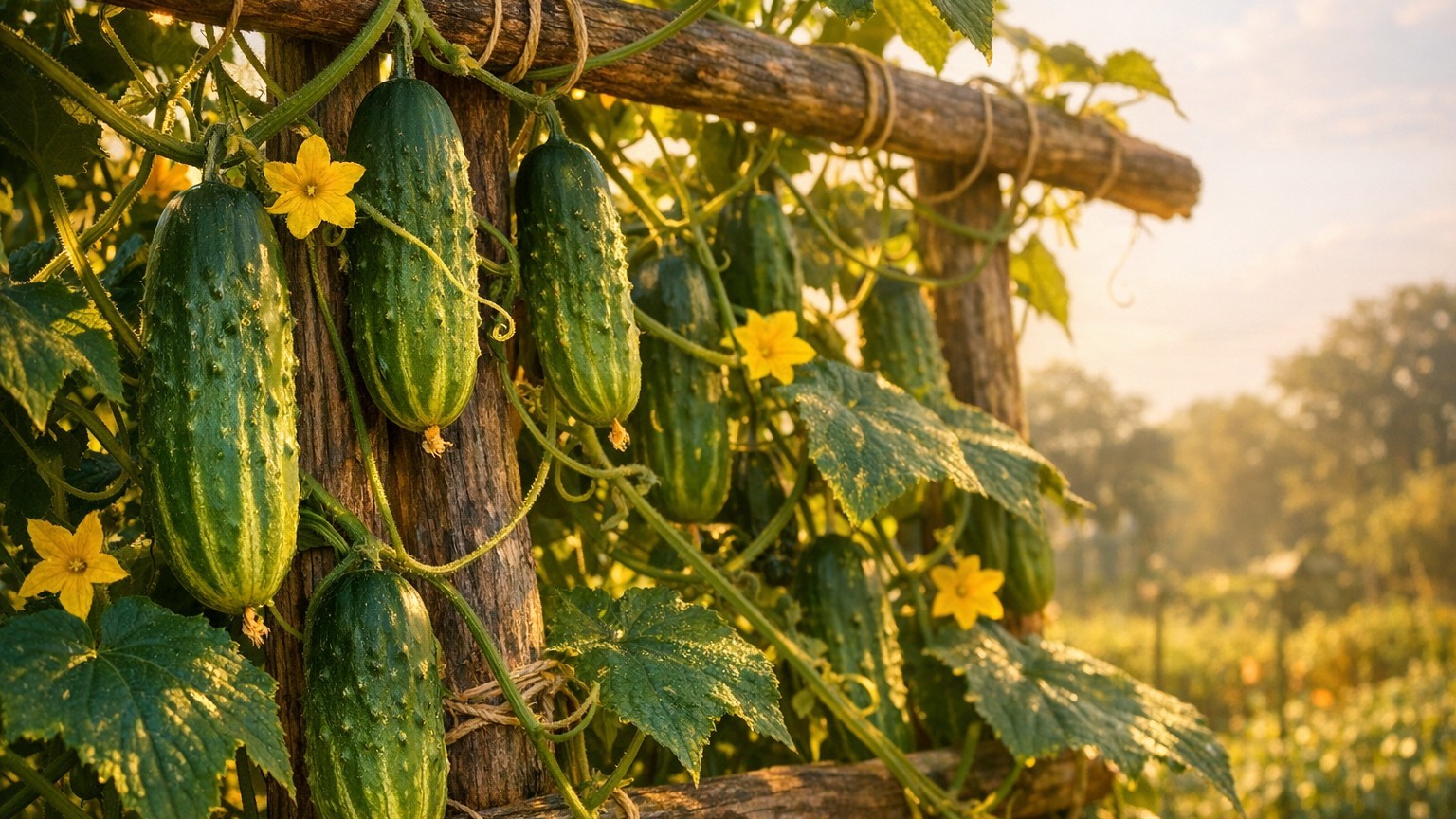

The type that works in Northwest Territories is fast, compact, and grown under some form of cover: bush or short-vine cucumbers, ideally parthenocarpic and burpless. The mean frost-free window runs from May 25 to September 18, and the reference station logs zero days a year above 90F. That combination rules out long-season slicing types and rewards anything bred to set fruit quickly in cool air.
The short answer for Northwest Territories
Start with the numbers, because they make the decision for you. The mean last spring frost at the Yellowknife A station is May 25, and the mean first fall frost is September 18. That looks like a 116-day season on paper. It isn’t a guarantee of 116 frost-free days, though: a mean date is a 50/50 point, so in about half of all years frost arrives later in spring or earlier in fall than these dates. Treat the window as the midpoint of a range, not a promise.
Layer on the heat data and the picture gets tighter still. The reference station records 0.0 days a year at or above 90F. Cucumbers are a warm-season vine crop that wants sustained heat to push vine growth, flowering, and fruit set. Without any real heat spike, growth stays slow and steady rather than fast, so every day of the short season matters more than it would somewhere with a hotter summer stretch.
Add the Canadian hardiness zone, 1b at the reference city, and you’re looking at one of the coldest zones the Canadian system records for a place gardeners actually try to grow warm-season vegetables. None of that means cucumbers are impossible here. It means the type decision should favor speed and protection over size and yield potential.
| Cucumber type | Typical need | Fit for this territory |
|---|---|---|
| Long-season slicing (heirloom style) | Long stretch of steady warmth | Poor: rarely finishes before fall frost risk |
| Full-size trellised vining | Extended warm season, tall support | Weak outdoors; better under cover if attempted |
| Bush, compact habit | Shorter season, less space | Good match for a short, cool summer |
| Pickling type | Generally quicker to first harvest | Good match, especially direct in raised beds |
| Parthenocarpic / burpless | Sets fruit without pollinators, suits tunnels | Strong fit for cover-grown crops here |
The territory’s own agriculture service is the place to confirm which of these types has actually been trialled locally rather than assumed from the numbers alone; that’s covered further down this page.
What will not work here

Some choices fail here for reasons specific to this climate, not because cucumbers are generally hard.
- Long-season slicing cucumbers bred for a long stretch of real heat. With zero days above 90F at the reference station, there’s no heat surge to compress a long maturity window into the available frost-free stretch.
- Direct seeding into unwarmed outdoor soil on the calendar date alone. Because May 25 is a mean, not a safe date, seed or transplants put out right at that date face roughly even odds of a later frost in any given year.
- Full-size trellised vining varieties that expect an uninterrupted warm run to fill out a tall structure. In a zone 1b climate, growth stalls in cool stretches, and a trellis crop that stalls partway rarely catches back up before September frost.
- Fruit left to sprawl on bare, damp soil. Summer rainfall here is modest (about 4.3 inches across June, July and August, with June the driest month at 1.14 inches), but with no heat load to dry the surface quickly, that moisture lingers longer than the rainfall number alone suggests. Fruit sitting directly on wet ground is exposed to rot and mildew for longer stretches than in a hotter climate with the same rainfall.
None of these failures come from a bad variety choice on their own. They come from matching a plant’s expectations (heat, time, dry conditions at the fruit) to a climate that offers none of the three in abundance.
What changes across Northwest Territories
A territory this size is not one garden, and the numbers above belong to one place: the Yellowknife A reference station, sitting at Canadian hardiness zone 1b. Northwest Territories stretches from communities south of the 60th parallel up past the treeline toward the Arctic coast, spanning a huge range of latitude, and in places, elevation. A community farther south may run measurably milder than Yellowknife; one north of the treeline will run colder, with an even shorter safe window than the one described on this page.
This page cannot tell an individual reader which zone their own yard falls into, and it would be a mistake to guess from a general sense of “north” or “south” within the territory. Natural Resources Canada maintains the plant hardiness map for exactly this purpose, built from seven climate variables rather than one, and it’s searchable by location at planthardiness.gc.ca. Anyone gardening outside Yellowknife itself should check that map before assuming the dates and heat figures above apply directly to their own community.
The practical takeaway is to treat everything on this page as the picture at one reference point, then adjust toward more caution (later starts, more cover, shorter-season types) the farther a garden sits from that point in latitude or elevation. There is no single frost date or heat number for the whole territory, only a range.
Where to check this for your own county
Northwest Territories doesn’t use counties, but the same logic applies at the community level: a territorial figure is a starting point, and a local one from where you actually garden will beat it every time. The Government of Northwest Territories runs an agriculture service through its Department of Industry, Tourism and Investment, reachable at iti.gov.nt.ca/en/services/agriculture.
Two things are worth looking for there specifically. First, any local planting calendar tied to a community closer to where the garden actually sits, since Yellowknife’s frost dates and zone 1b rating won’t match a community that runs warmer or colder. Second, any list of cucumber types or varieties that have actually been trialled in the territory’s growing conditions, whether in open ground, cold frames, or high tunnels, since that kind of field record beats a general reasoning-from-numbers approach every time.
This page has done the reasoning from climate normals: mean frost dates, a zero-heat-day summer, low rainfall, and a harsh hardiness zone. That reasoning points toward fast, compact, cover-grown types. A territorial agriculture office, or a community-level source, can confirm or correct that reasoning against what actually grows there year after year. Treat this page as the starting hypothesis, not the final word for any one garden.
Checking this against your own garden
Every date and figure on this page comes from a weather station, not from the actual soil a reader is planting into, and the soil should have the final say. Three things are worth watching directly, without any special equipment.
Soil warmth by feel comes first. Push a bare hand a few inches into the bed in spring; cucumbers stay stalled in soil that still feels cold to the touch, no matter what the calendar says about the mean frost date having passed. Waiting for the soil to feel genuinely warm, not just frost-free, is a better signal than any single date.
The first flush of male flowers comes next. Cucumbers typically open small male flowers before the female flowers that actually carry fruit behind the bloom. Watching for that first flush tells a gardener the plant has shifted into reproductive growth, which in a short-season climate is the moment to judge whether there’s realistically enough season left for fruit to follow.
The first true leaves, appearing after the initial seed leaves, are the third marker. Their timing, measured against when the seed actually went in the ground, shows how fast the plant is really growing in that specific spot, in that specific year, regardless of what a regional average predicts. A slow first-true-leaf stage is an early, honest signal that the season ahead may run tighter than usual.