
Bare-root roses go in the ground while still dormant, from mid-February through March in central Arkansas, and container roses follow once the last frost risk has passed, typically by early April. Fall planting works too, finishing at least six weeks before the first freeze. The exact dates shift by more than two weeks depending on where in the state you garden.
When to plant Roses in Arkansas
Arkansas doesn’t have one planting calendar, it has several, and the gap between them matters more for roses than for most garden plants because bare-root stock, container stock, and fall transplants each answer to a different clock. For central Arkansas, NOAA’s 1991-2020 climate normals put the 32°F freeze risk window at March 12 to March 28, based on station USW00013963 near Little Rock. That’s the band where a hard freeze still has real odds of showing up. Northern Arkansas and the higher ground of the Ozarks and the Ouachitas run later than that, sometimes by two or three weeks, because elevation and cold-air drainage delay spring warming.
Bare-root roses are the exception that actually likes this cold window. Nurseries ship them dormant, with no leaves to freeze, so the right move is to plant them in late winter, ideally four to six weeks before that March 12-28 frost band closes out, so roots start establishing in cool, moist soil before the plant breaks bud. Soak the roots for a few hours before planting, and get them in the ground as soon as the soil can be worked, not after.
Container-grown roses are a different story because they’re often already leafing out when you buy them, and new growth has none of the cold tolerance of dormant canes. NOAA’s 32°F data marks where the last hard freeze usually falls, but the more useful figure for anything with soft new growth is the 36°F light-frost threshold, and NWS Little Rock puts that at April 3 in spring and October 31 in fall. A rose leafing out in a nursery pot can take real damage from a 36°F night even when a 32°F freeze isn’t in the forecast, so treat April 3 as the safer green light for moving potted roses into open ground in central Arkansas, later still if you’re north or up in elevation.
Almost nobody starts roses from seed at home, and that’s worth saying plainly: seed-grown roses rarely come true to the parent variety, and many take three to five years to bloom, so the “start indoors, harden off, transplant” routine that works for tomatoes doesn’t really apply here. What does map onto that process is acclimating a greenhouse-raised container rose to outdoor conditions. If you buy one that’s been growing under glass, give it four or five days in a sheltered spot with a few hours of direct sun before it goes into full exposure, the same hardening-off logic gardeners use for transplants, just applied to a shrub instead of a seedling.
Fall planting is the other real option, and in some ways it’s kinder to the plant. Set container roses out by mid-September so roots have eight to ten weeks to establish before the first fall frost, which NOAA’s data places between November 7 and November 20 for the Little Rock area. Roses planted that early settle in over a cool, wet fall and often outgrow spring-planted stock by the following summer.
Soil and site preparation
Roses want six hours of direct sun at minimum, and morning sun matters more than afternoon sun because it dries dew off the foliage early, which cuts down on the fungal problems that thrive in lingering leaf wetness. A site with good air movement, not hemmed in tight against a fence or a wall on all sides, does the same job.
Drainage is the other non-negotiable. Roses tolerate a wide range of soil textures, from the sandy loams of the Delta to the heavier clay common across much of the state, but they won’t tolerate standing water around the crown. If a test hole filled with water takes more than a few hours to drain, raise the bed six to eight inches rather than fighting the native soil.
Work compost or aged manure into the planting bed two to three weeks before you plant, not the same day, so the amendment has time to start integrating into the soil structure rather than sitting as a separate layer around the roots. Dig the hole wide, at least twice the diameter of the root ball, and only as deep as the roots need, since a rose planted too deep sulks for a season while it works to find the right depth on its own.
Spacing runs from about eighteen inches for compact shrub types up to four feet or more for vigorous climbers and old garden roses, and it’s worth erring generous. Air gets between plants that are properly spaced, and that airflow does more to prevent blackspot and powdery mildew over a humid Arkansas summer than any spray program.
Varieties that suit Arkansas
The trait that matters most for a rose growing through an Arkansas summer isn’t bloom color, it’s disease resistance, specifically resistance to blackspot, which thrives in the state’s humid, wet-leaf conditions from June through September. A rose that defoliates from blackspot by midsummer is a rose that stops blooming, so resistance is the first filter, not an afterthought.
Heat tolerance runs a close second. Many older hybrid tea varieties, bred in cooler climates, stall out or bleach in Arkansas’s July and August heat, while shrub roses bred for broad adaptability tend to keep producing. Own-root roses, grown on their own roots rather than grafted onto rootstock, also have an edge here: if winter cold or a mower nick kills the top growth, an own-root plant regrows true to variety, while a grafted rose that dies back to the graft union comes back as rootstock, not the rose you bought.
Widely available classes and what they’re good for
| Rose type | Disease resistance | Bloom habit | Best use |
|---|---|---|---|
| Knock Out series (shrub) | Strong against blackspot | Repeat, all season | Low-maintenance hedges, borders |
| Drift series (groundcover) | Good | Repeat, compact | Front-of-bed color, small spaces |
| Griffith Buck shrub roses | Bred for hardiness and disease tolerance | Repeat, moderate | Cold-exposed sites, own-root plantings |
| Hybrid tea | Variable, often needs a spray program | Large single blooms, repeat | Cut flowers, formal beds |
| Climbing roses | Variable by cultivar | Once or repeat, depending | Trellises, fences, arbors |
None of this comes from a state institution’s variety list, it’s a matter of matching plant habit to the pressures Arkansas summers put on a rose: heat, humidity, and blackspot. If a nursery tag mentions disease resistance or “landscape shrub rose,” that’s usually a signal the breeding targeted exactly these conditions.
What to plant alongside
Roses share bed space reasonably well with plants that don’t compete hard for water and nutrients at the same root depth, and a few genuinely earn their spot:
- Catmint or lavender at the front of the bed draws pollinators and its strong scent can mask the chemical cues aphids use to find rose buds.
- Alliums such as chives are commonly claimed to repel aphids, though the evidence for this is thin and mostly anecdotal rather than tested; they’re worth planting for their own sake, not as pest control.
- Low groundcovers like creeping thyme shade the soil surface, which helps hold moisture and keeps weeds down without competing much for water at rose root depth.
- Clematis paired with a climbing rose on the same support shares the structure without crowding the rose’s root zone if planted a couple of feet away.
Skip planting roses close to boxwood or other dense, shallow-rooted shrubs, which compete hard for surface moisture and can host some of the same fungal spores that cause blackspot to linger in a bed. Keep roses well away from areas where you’ve had heavy blackspot pressure in other plants, since fallen infected leaves are a real source of reinfection. And be skeptical of any companion planting claim that promises to eliminate a pest outright, most of what works does so by drawing pollinators or crowding out weeds, not by chemically repelling insects.
Watering, feeding and support
Roses want about an inch to an inch and a half of water a week, delivered as a deep soak rather than frequent shallow sprinkles, which encourages roots to grow down instead of staying shallow and heat-stressed. Watering at the base rather than overhead keeps foliage dry, and dry foliage is the single biggest factor in avoiding fungal disease over a humid Arkansas summer.
A two- to three-inch layer of mulch, pulled back a couple of inches from the crown, holds that moisture in and moderates soil temperature swings. It also suppresses the weeds that would otherwise compete for the same water and nutrients.
Feed roses as growth resumes in early spring, then again after each bloom flush through the growing season, since repeat-blooming varieties are essentially recharging for the next round every time they finish flowering. Stop feeding roughly six to eight weeks before the first fall frost, which for the Little Rock area falls between November 7 and November 20, because late-season fertilizer pushes soft new growth that has no time to harden off before cold arrives.
Climbers and tall shrub roses need support tied in as they grow rather than after they’ve flopped, since canes trained early develop a structure that holds up under the weight of a full bloom flush. Prune in late winter, just before new growth breaks, cutting out dead, crossing, and weak canes and shaping the rest to an open center that lets light and air into the middle of the plant. On grafted roses, watch for suckers growing from below the graft union, thin and different-looking from the rest of the canes, and remove them at the point of origin as soon as you spot them, since they’re rootstock growth stealing energy from the variety you actually planted.
Common problems
Blackspot is the problem Arkansas rose growers run into most, and it shows up as circular black spots on leaves, usually the lower ones first, surrounded by a yellowing halo before the whole leaf drops. Warm, humid weather with wet foliage drives it, which describes a typical Arkansas summer night pretty well. Watering at the base, spacing plants for airflow, and cleaning up fallen leaves through the season all cut down on the spores that keep the cycle going.
Powdery mildew looks different, a dusty white coating on new leaves and buds that can curl and distort the growth it covers. It favors warm days and cool, humid nights, so it tends to show up as the season transitions in spring and again in fall. Improving airflow and avoiding overhead watering in the evening both help.
Botrytis blight turns flower buds gray and mushy, especially after a stretch of wet weather, and it’s most common on tightly-petaled varieties that hold moisture between the petals. Removing affected buds promptly and avoiding overhead watering during wet spells limits how far it spreads.
Cane dieback, where a cane blackens and dies back from the tip, usually traces to a pruning cut left too far from a bud, a canker infection entering through a wound, or occasionally winter cold damage. Cut back into healthy white pith below the damage and make cleaner cuts going forward.
Yellowing leaves with the veins still green, known as chlorosis, generally points to an iron deficiency tied to alkaline soil pH rather than a disease at all. A soil test is the only way to confirm it, and correcting soil pH does more long-term good than any leaf spray.
Poor bloom, a rose that just won’t flower much, is often a light problem in disguise, too much shade from a tree that’s grown in over the years, or it’s a feeding problem, too much nitrogen pushing leafy growth at the expense of flowers.
Pests that actually show up in Arkansas
The University of Arkansas Division of Agriculture’s extension service lists aphids, whiteflies, scale insects, stink bugs, squash vine borer, squash bugs, and Japanese beetles among the insects home gardeners deal with most in summer. Of that group, aphids, Japanese beetles, whiteflies, and scale insects are the ones that actually target roses. Squash vine borer and squash bugs go after cucurbit crops like squash and pumpkins, not roses, so if you’re only growing roses you can largely set those two aside, though it’s worth knowing they’re active in the same yard.
Aphids show up first, clustered soft-bodied and pale green on new growth and unopened buds, often as early as the first warm weeks of spring and continuing through summer. A firm blast of water from the hose knocked them off, repeated every few days, and insecticidal soap handles heavier infestations without hammering the pollinators visiting nearby blooms.
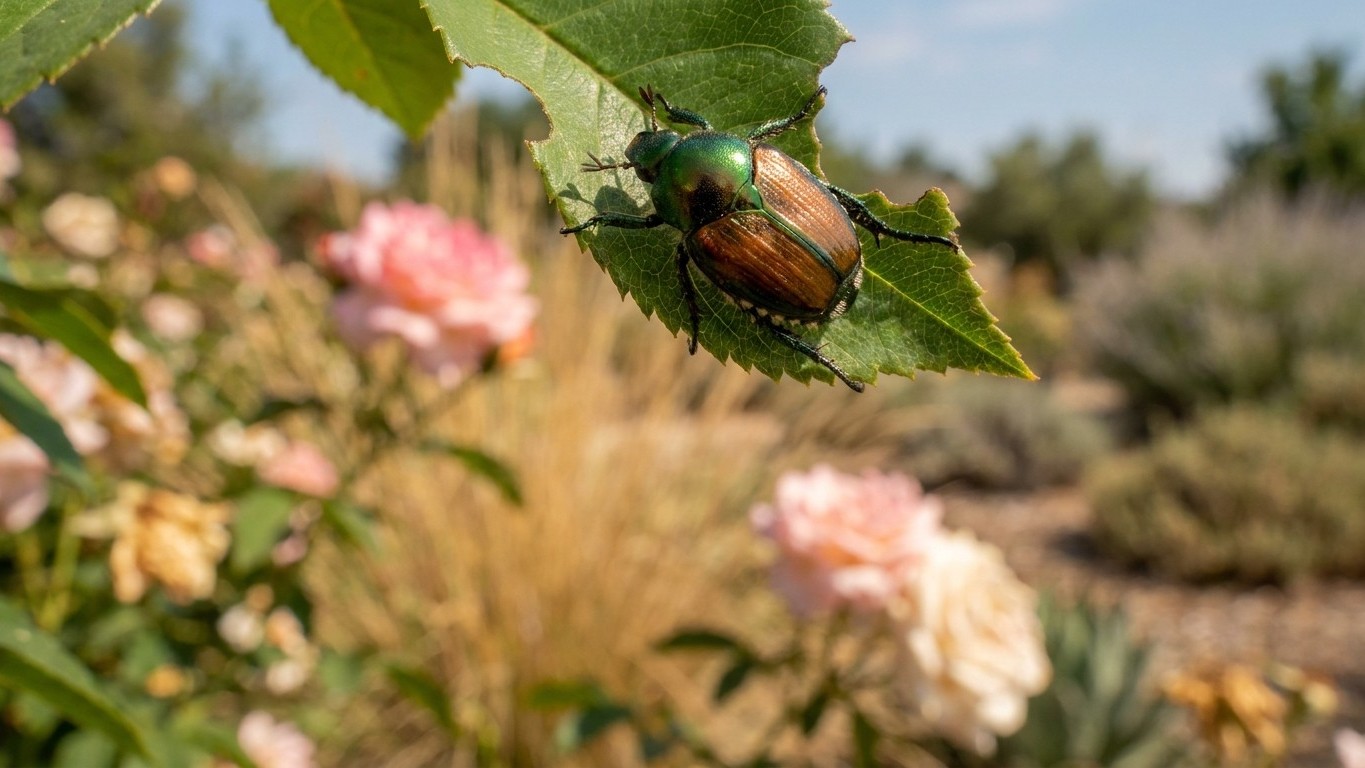
Japanese beetles are the summer headline pest, with the extension service placing peak activity from June through August. They skeletonize leaves down to the veins and chew ragged holes straight through open blooms, feeding in daylight in groups that make them easy to spot. Handpicking into a jar of soapy water in the cool of early morning, when they’re sluggish, is the control that actually works, since pheromone traps tend to draw in more beetles from the neighborhood than they catch.
Whiteflies cluster on the undersides of leaves and lift off in a small pale cloud when the plant is disturbed, a giveaway that’s hard to miss once you’ve seen it. They’re present through the warm months, and yellow sticky traps combined with insecticidal soap applied to the leaf undersides keep numbers down.
Scale insects look like small, immobile brown or gray bumps stuck to canes rather than something that visibly crawls, and a sticky honeydew residue with sooty mold growing on it is often the first sign a gardener actually notices. Horticultural oil applied while the insects are in their mobile crawler stage, typically in late spring, is the most effective single control. For anything on a rose that doesn’t match these patterns, the county extension office can identify it correctly rather than guessing from a description.
Harvest and end of season
Cutting roses for a vase is its own small skill: pick blooms in early morning when stems are full of water, choosing buds just starting to open rather than fully unfurled flowers, and make the cut at an angle just above a five-leaflet leaf to encourage a strong new stem. Deadheading spent blooms through the season, cutting back to that same kind of leaf, keeps repeat-blooming varieties producing new flushes instead of putting energy into seed hips.
As the season winds down, that logic flips. Stop deadheading in early fall and let the last blooms form hips, which add color through winter. Also, signal the plant to shift energy toward hardening off for the cold rather than pushing more flowers. Stop fertilizing entirely by six to eight weeks before the first fall frost, which NOAA’s data puts between November 7 and November 20 for the Little Rock area, so no tender new growth is exposed when cold arrives.
Hold off on any hard pruning until late winter, since cutting back canes in fall can trigger new growth that then gets damaged by the season’s first freeze. After the ground has cooled following that first freeze, a mound of mulch over the crown of any exposed grafted rose gives the graft union a buffer against hard cold snaps later in winter. Clean up and remove fallen leaves from around the base of the plant before winter sets in, since blackspot spores overwinter in that leaf litter and reinfect the plant come spring if it’s left in place.
Local help
Frost dates and pest pressure both shift meaningfully across a state as long as Arkansas, and a county extension office can give you dates, soil test results, and pest identification specific to where you actually garden rather than a statewide average. The University of Arkansas Division of Agriculture Cooperative Extension Service runs offices in every county and is the right first call for anything this article can only speak to generally.
Common questions
Can I grow roses from seed in Arkansas? You can, but seed-grown roses don’t come true to the parent variety and often take three to five years to bloom, so almost all home gardeners plant bare-root or container nursery stock instead.
When should I prune roses in Arkansas? Late winter, just before new growth breaks, is the right window statewide, though the exact week varies with how far north or how high in elevation you’re gardening.
Do roses need winter protection in Arkansas? Most established shrub roses handle Arkansas winters without extra protection, but mounding mulch over the graft union of a grafted rose after the first freeze adds a useful buffer against hard cold snaps.
What causes yellow leaves with green veins on my rose? That pattern, called chlorosis, usually points to iron deficiency tied to alkaline soil pH rather than disease, and a soil test is the only reliable way to confirm it.
Is it too late to plant roses in September? No, mid-September planting actually gives container roses eight to ten weeks to establish roots before the first fall frost typically arrives in early-to-mid November, and many gardeners get better first-year growth from fall-planted roses than spring-planted ones.