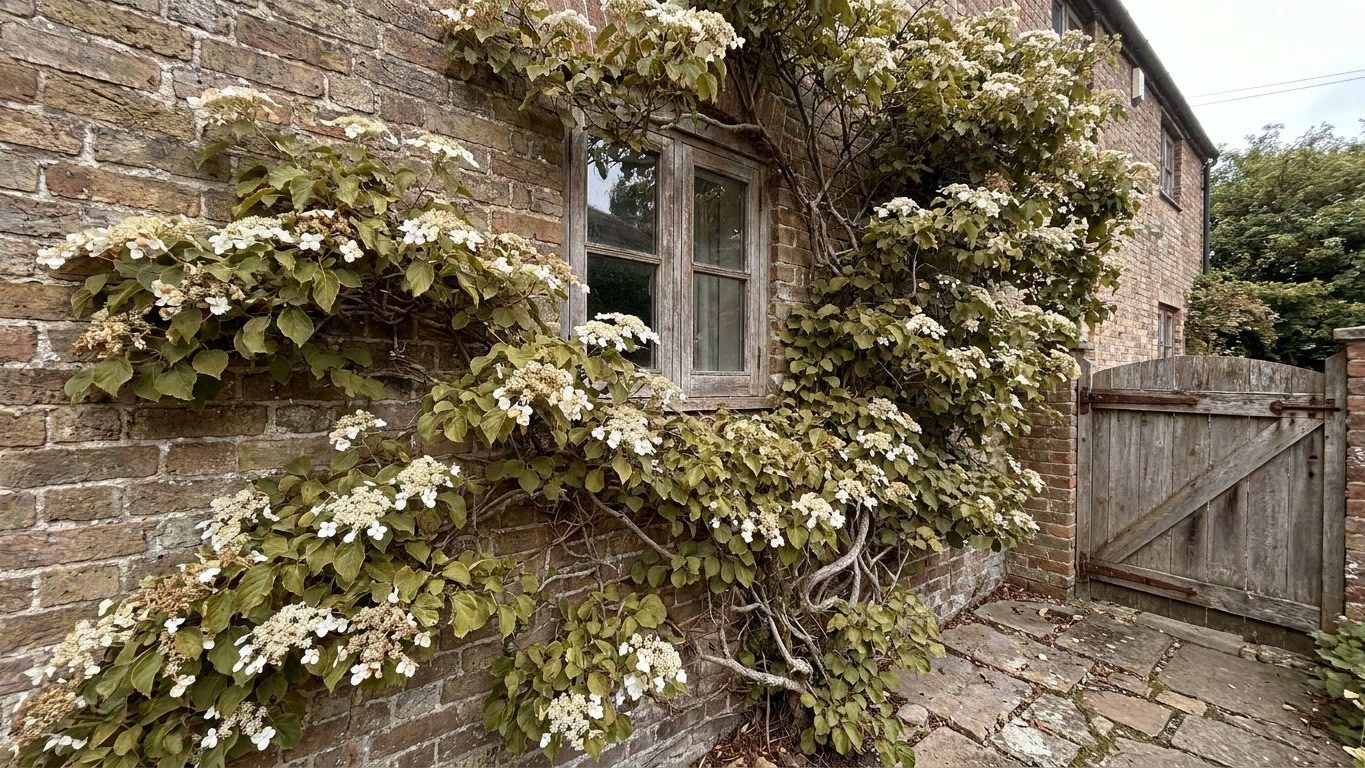

Climbing Hydrangea is the selling name for Hydrangea petiolaris, a self-clinging woody vine hardy in USDA zones 4 through 8. It flowers on last year’s wood, produces flat white lacecap blooms that stay white no matter the soil, and climbs by aerial rootlets to 15 feet or more. The catch: it is slow to settle in and even slower to flower. Whether it earns a spot on a wall depends less on climate zone than on how much patience a gardener brings to the first few seasons.
What Climbing Hydrangea actually is
Most vines climb by twining around a support or grabbing on with tendrils. Climbing Hydrangea does neither. It attaches with aerial rootlets that fasten directly onto whatever surface it touches, which means it needs something with texture, like brick, stone, wood, or bark, and struggles to grip vinyl siding or a smooth painted trellis. That detail decides where it can go before anything else matters.
According to the North Carolina Extension Gardener Plant Toolbox, this is the one hydrangea in the genus built as a true climber, reaching 15 feet and more at maturity, while the shrub types top out between 3 and 25 feet depending on which one. It flowers on the wood it grew the previous year, and the source describes it plainly: slow to establish, very long to flower. That is the closest thing to a maturity figure this plant offers, and it should be read as a warning about patience rather than a countdown.
The flower itself is a flat, white lacecap, held against whatever surface the vine is covering rather than standing up on its own stems the way a mophead or panicle bloom does. That shape and placement are part of why this hydrangea gets planted at all: it reads as a flowering wall rather than a flowering shrub.
What Climbing Hydrangea is good for

This is a vertical-space plant, not a border shrub. Gardeners reach for it to cover a north-facing wall, dress up a bare tree trunk, or soften an arbor where a freestanding hydrangea would never fit. Because it clings on its own, it skips the wire grids and eye-hooks a true vine like clematis needs, provided the surface underneath is rough enough to hold it.
Its color is a selling point in a genus known for finicky blue-to-pink shifts. Bigleaf and mountain Hydrangeas turn blue below roughly pH 5.5 and pink above roughly pH 6.5, chasing available aluminum in the soil, and gardeners spend years fussing with amendments to hold a shade. Climbing hydrangea skips that entirely: its white lacecaps don’t respond to soil chemistry, so there’s no pH to manage and no color to lose.
Households worried about hydrangea toxicity have another reason to consider it. The North Carolina source documents toxicity only in bigleaf hydrangea, and only when eaten in quantity, causing nausea, stomach pain, vomiting and sweating in people, dogs, cats and horses. Climbing hydrangea carries no such documentation, which is worth knowing but not the same as a guarantee of safety.
Maintenance across the genus is rated low, and that holds here too once the vine is established. It doesn’t need seasonal deadheading or the yearly shaping some flowering shrubs demand. Left largely alone against a sturdy wall, with dead stems cut to 12 to 24 inches and left standing over winter for native bees that nest in the hollow centers, it does most of its own work.
Where it ripens in time, and where it is a gamble
Hardiness zone is the first filter, and the genus splits sharply by type. The table below lays out how climbing hydrangea’s range compares to its relatives, all according to the same source.
| Type | USDA zones | Flowers on | Mature size |
|---|---|---|---|
| Bigleaf / mophead / lacecap | 6a-11b | Last year’s wood | 3-6 ft tall and wide |
| Panicle / peegee | 3a-8b | Current season’s growth | 8-25 ft |
| Smooth (Annabelle type) | Hardiest of the genus | New wood | Shrub form |
| Oakleaf | Not specified beyond genus range | Old wood | To about 5 ft |
| Mountain | Not specified beyond genus range | Old wood | Shrub form |
| Climbing | 4-8 | Old wood | 15 ft and more |
Climbing hydrangea sits in a comfortable middle band. Its zone 4 low end tolerates colder winters than bigleaf hydrangea ever will, since that type won’t reliably survive below zone 6a. But its zone 8b ceiling is far short of bigleaf’s reach into zone 11b, which means a gardener in coastal Texas or south Florida who wants this exact climbing habit and lacecap look is working outside the documented range. In that gap, mophead’s wider warm-end tolerance simply covers ground climbing hydrangea doesn’t.
This page can’t hand a reader a frost-date table for their own county, since that depends on local last-spring and first-fall frost dates, which vary by state and even by neighborhood. What can be said is that zone 4 through 8 covers most of the continental interior and the coasts outside the Deep South and the desert Southwest. A gardener checking their own zone against that band, and following up with a state-specific guide for exact planting and pruning timing, gets a more useful answer than any national estimate could offer.
The two ways a season goes wrong
A hardiness zone that technically covers a garden doesn’t guarantee a good bloom year, and this vine fails in two different directions.
At the cold edge of its range, the risk is bud loss rather than plant death. Because climbing hydrangea flowers on last year’s wood, the buds that will open next spring are already formed and exposed through the entire winter. An unusually hard winter near zone 4, or a late freeze hitting just as buds are swelling, kills the flowers for that year even though the vine itself survives and leafs out normally. It’s the same mechanism documented for bigleaf hydrangea, whose buds get wiped out by a late frost or an ill-timed prune. Mountain hydrangea’s old-wood buds tolerate late frost better than bigleaf’s, which shows how much variation exists even among hydrangeas that all bloom on old wood.
At the warm edge, the source simply stops documenting this type past zone 8b. No specific heat threshold appears in the record, and it would be a mistake to invent one. What can be said honestly is that gardeners in zone 9 and warmer are outside the range this vine has been shown to handle, and bigleaf hydrangea’s documented reach into zone 11b makes it the better-tested choice for that climate.
Given how slow this vine already is to flower, the cold-side risk matters more in practice. Losing a winter’s buds doesn’t just cost one season of bloom, it adds another full year to a wait that was already long before the freeze happened.
What it resists, and what it does not
The North Carolina Extension source lists disease and pest pressure at the genus level rather than grading resistance cultivar by cultivar, and climbing hydrangea gets no separate resistance rating of its own. The diseases named across the genus are leaf spot, bacterial wilt and powdery mildew; rust and bud blight are called out specifically for panicle hydrangea and don’t apply here. None of these come with a “resistant” label attached to climbing hydrangea, so the honest position is that the risk exists and no documented protection offsets it.
Pests are described as rarely a problem across the genus: aphids, scales, nematodes and mites all appear on the list, but with that qualifier attached. Deer are the exception. The same source lists deer as a damage agent on one page and mentions resistance to challenges on another, a contradiction worth naming rather than smoothing over. The practical fact is that deer browse hydrangeas, so treating this vine as deer-resistant would be a mistake, whatever a general resistance list implies.
On toxicity, only bigleaf hydrangea carries a documented risk in this source. Climbing hydrangea isn’t listed as toxic, which is useful for households with pets or curious kids, though absence of documentation isn’t the same as a formal safety clearance.
Growing it without the usual mistakes
The single biggest mistake with this vine is choosing the wrong surface. Aerial rootlets need something to bite into, so masonry, weathered wood, or heavy wire mesh works, while vinyl siding, smooth metal, or a glossy painted trellis will leave the vine sliding rather than climbing. Site it with 15 feet or more of wall or structure to fill, and keep it clear of windows, gutters and wood siding seams, since over years those rootlets can work their way into gaps they weren’t meant to reach.
Patience is the second requirement, and it’s not optional. A vine that is slow to establish and slow to flower can sit for several seasons looking like it’s doing nothing before it finally covers ground and blooms. Pulling it out or assuming it failed during that stretch is the most common reason gardeners give up on this plant before it ever gets going.
Pruning follows directly from its bloom habit. Because flowers form on the previous year’s wood, this vine should be pruned only to control size, and only after it finishes flowering. Cutting it back in late winter or early spring, the way a panicle hydrangea tolerates, removes the buds that were going to open that season. Exact timing shifts by region, which is why that specific date belongs on a state-level guide rather than here.
Mulch is a reasonable habit to carry over from its shrub relatives. The source notes that bigleaf and panicle hydrangeas are shallow-rooted and benefit from mulch, and applying the same practice to climbing hydrangea, especially while establishing, is a low-risk way to protect roots through temperature swings without adding maintenance work.
Common questions
Does Climbing Hydrangea change color like other hydrangeas?
No. Color shifts with soil pH apply only to bigleaf and mountain hydrangeas, which turn blue below about pH 5.5 and pink above about pH 6.5. Climbing hydrangea’s white lacecaps don’t respond to soil chemistry at all.
How long does it take Climbing Hydrangea to bloom after planting?
The source describes it as very slow to establish and very slow to flower, without giving an exact number of years. Gardeners should expect a long wait before the first bloom rather than plan around a fixed timeline.
Can Climbing Hydrangea grow in full sun?
That specific detail isn’t documented for this type in the source used here. Panicle hydrangea is the one confirmed to take full sun well; light requirements for climbing hydrangea aren’t spelled out the same way, so checking a state-specific guide is the safer route.
Is Climbing Hydrangea toxic to pets?
Only bigleaf hydrangea is documented as toxic in this source, causing nausea, vomiting and stomach upset in people and animals when eaten in quantity. Climbing hydrangea isn’t listed as toxic, but that absence of documentation isn’t a formal safety guarantee, so it’s still worth keeping pets from grazing on it.