
Yes, melons can be grown in Minnesota, but the state’s cool nights, moderate summer heat and relatively short frost-free window mean success depends on choosing early-maturing types, warming the soil artificially, and watching for the humidity-driven diseases that come with average summer rainfall rather than drought.
When the soil is warm enough in Minnesota

The question every Minnesota gardener actually asks is “when do I plant?” and the honest answer starts with the last spring frost: April 17 to April 30, according to NOAA’s 1991-2020 Climate Normals for the Twin Cities reference station. That’s a 30-70% probability band, not a guarantee, so treat it as the odds of frost, not a promise that the risk ends on a specific morning.
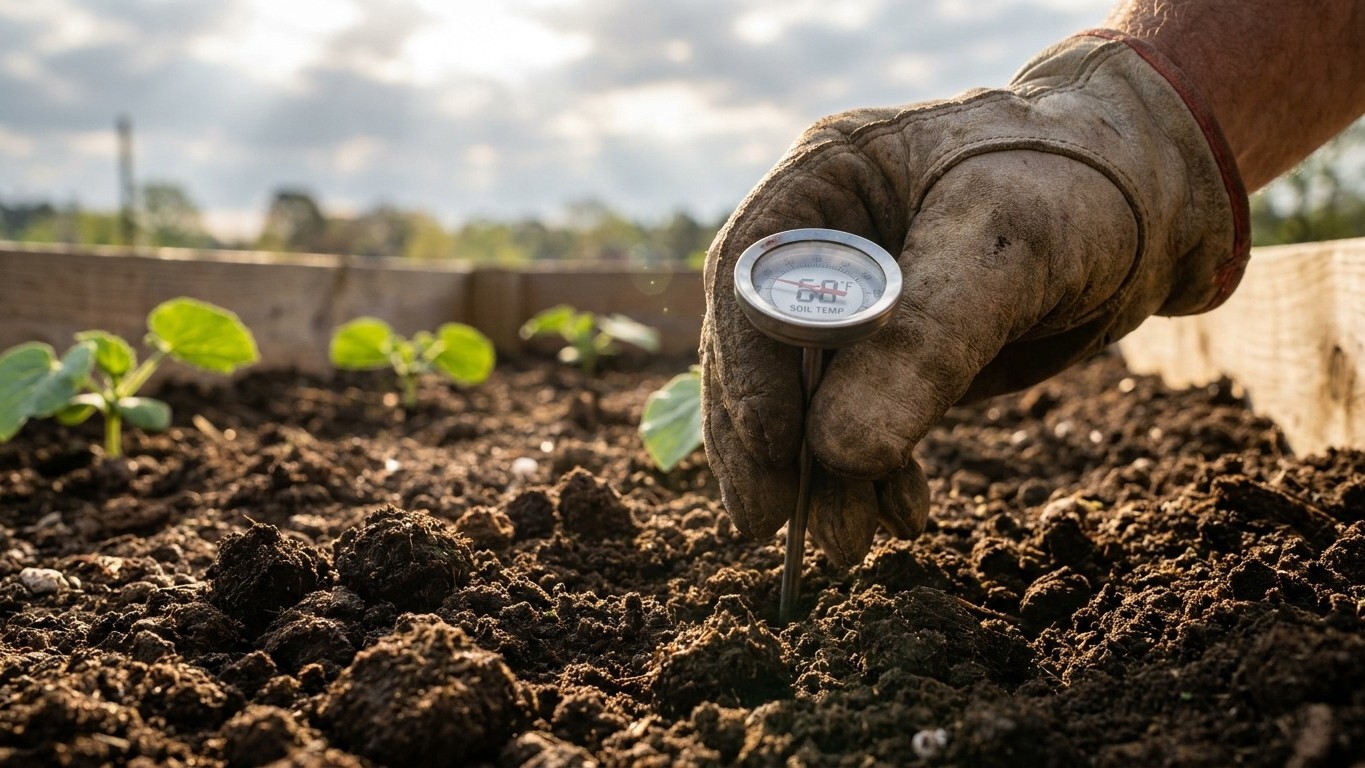
Frost is only the warning label, though. Melon seeds and roots don’t respond to the calendar or to air temperature; they respond to soil temperature, and soil takes time to catch up once the air stops freezing. A garden bed can sit at a chilly, sluggish temperature for a week or two after the last frost date has technically passed, especially in a spring that stays cloudy and wet. Melon seed sown into cold soil often just sits there, rots, or germinates so slowly that any head start is lost.
That gap is exactly why so many Minnesota growers start melons as transplants indoors, or warm the ground ahead of planting with black plastic mulch laid a couple of weeks before the seed or transplant goes in. Both are practices, not products: no tin, no rate, just heat management. Raised beds also help, since they drain and warm faster than flat, heavy garden soil.
One more layer of nuance: the Twin Cities sit in the mild south of the state. Northern Minnesota runs two to three weeks tighter at both ends of the season, which means a gardener near Duluth or International Falls should treat the April 17-30 window as optimistic and lean toward the later, more cautious side of it, or later still. Since local microclimate, soil type and even which side of a hill a garden sits on all shift these numbers, the state’s own reference point for what actually performs on a given calendar is the University of Minnesota Extension, at extension.umn.edu. No cultivar name from this page can substitute for what’s been trialed on their soil.
How long the season lasts here
Pair the last spring frost (April 17 to April 30) with the first fall frost, which NOAA’s same 1991-2020 normals put at October 11 to October 23 for the reference station, and a rough frost-free window appears: as short as 164 days if spring frost lingers to April 30 and fall frost arrives by October 11, or as long as 189 days if spring frost breaks early on April 17 and fall frost holds off until October 23. That’s roughly five and a half to six and a half months of frost-free growing, and every melon crop in the state lives inside that range, whichever end of it a given year lands on.
That length matters because it decides whether a second sowing is even worth considering. In Territories with an eight- or nine-month frost-free season, a gardener can sow melons twice, staggering harvest and hedging against a failed first batch. Minnesota’s window doesn’t offer that kind of room. Even at the generous end, 189 days is enough for one solid melon crop from transplants, not two crops sown weeks apart, because a second sowing started in July would need to mature and ripen before the first fall frost shows up in October, and there isn’t slack left to lose.
That’s also the argument for transplants over direct seeding here. Starting seed indoors four to six weeks before the last frost date effectively banks two to four extra weeks against the frost-free window, which on the short end of Minnesota’s range can be the difference between a melon that ripens and one that doesn’t. Direct seeding is simpler, but it spends calendar days the state doesn’t have much of to spare.
Gardeners in warmer, longer-season territories who do have room for succession sowing, or who want to understand how staggered plantings work where the frost-free window allows it, can find the mechanics in our guide to succession sowing melons. In Minnesota, the more useful question isn’t when to sow a second round, but how to make sure the first one doesn’t run out of season.
Heat and water in Minnesota

Melons are heat-hungry plants that ripen on accumulated warmth, not simply on the passage of time, and Minnesota’s numbers make that distinction unavoidable. The reference station at Minneapolis averages just 10.6 days a year at or above 90°F, per NOAA’s 1991-2020 Climate Normals. That’s a modest heat load compared with territories where 90-degree days run into the dozens, and it means a Minnesota melon patch accumulates warmth slowly across a long string of milder days rather than in occasional heat spikes.
In a territory like this, the type of melon and the soil-warming technique carry more weight than the exact sowing date. Black plastic mulch, row covers pulled off once flowers need pollinators, and siting the melon bed against a south-facing wall or fence that reflects extra heat all do more for a Minnesota harvest than shaving a few days off the planting calendar. Where 90-degree days are scarce, every trick that raises soil and microclimate temperature effectively substitutes for heat the sky isn’t providing.
Rainfall tells a different, equally important story. Summer rain across June, July and August totals about 13.0 inches at the same reference station, broken down as 4.58 inches in June, 4.06 in July (the driest month) and 4.34 in August. That’s a meaningfully wet summer by melon standards, not the arid stretch that vines in hotter, drier growing regions have to survive on drip irrigation. The caution here runs the opposite direction from a hot, dry territory: with a modest heat load and steady rain, the real risk in a cool, damp Minnesota summer is fungal disease, powdery mildew on the leaves, slower ripening as vines stay wet longer, and fruit that struggles to concentrate sugar when nights stay cool. Spacing vines for airflow, watering at the soil rather than overhead, and avoiding a shaded or low-lying spot that holds moisture all matter more here than any irrigation schedule.
None of this replaces a rain gauge and a look at the actual soil. A sandy garden drains that same 13 inches within a day or two and may still need supplemental watering during a dry stretch; a clay-heavy bed holds it far longer and is the one more likely to stay too wet for melon roots. The normals describe the region; the soil in front of the gardener settles the argument.
Which melons suit Minnesota
Given a frost-free window that tops out around six and a half months, a modest heat load of roughly ten 90-degree days a year, and a summer wet enough to invite mildew, the types that make sense in Minnesota share three traits: they mature early, they tolerate cooler ripening conditions without needing weeks of blazing heat, and they carry decent resistance to the fungal pressure that comes with regular rain. Within the muskmelon and cantaloupe family, the earliest-maturing types generally outperform the long-season kinds bred for hot, dry climates. Watermelon growers in the state lean toward the smaller, quicker-maturing types rather than the large, slow-ripening ones that need a longer, hotter stretch to fill out and sweeten.
This page won’t name a specific variety, and that’s a deliberate choice rather than an oversight. Melon breeding moves fast, disease pressure shifts from one growing region to the next, and the varieties that perform reliably in a University of Minnesota trial garden this season are the only recommendation actually worth following, not a name picked because it sounds appropriate for a northern climate. A cultivar that thrives in a trial plot near St. Paul may behave differently in a garden two hours north, in a different soil type, with different microclimate quirks.
The right move is the same one this page has pointed to throughout: the University of Minnesota Extension publishes the state’s own variety trial results and updates them as new melon types come onto the market with better mildew resistance or shorter maturity windows. That resource, cross-referenced with the USDA hardiness zone range for the state (3a-5a, per the USDA Plant Hardiness Zone Map built on 1991-2020 normals), gives a far more useful starting point than any single variety name repeated across gardening sites. Zone alone won’t pick a melon type, since it measures winter’s extreme minimum temperature rather than summer’s growing conditions, but paired with the frost dates and heat data above, it rounds out the full picture of what a Minnesota garden is actually working with each season.