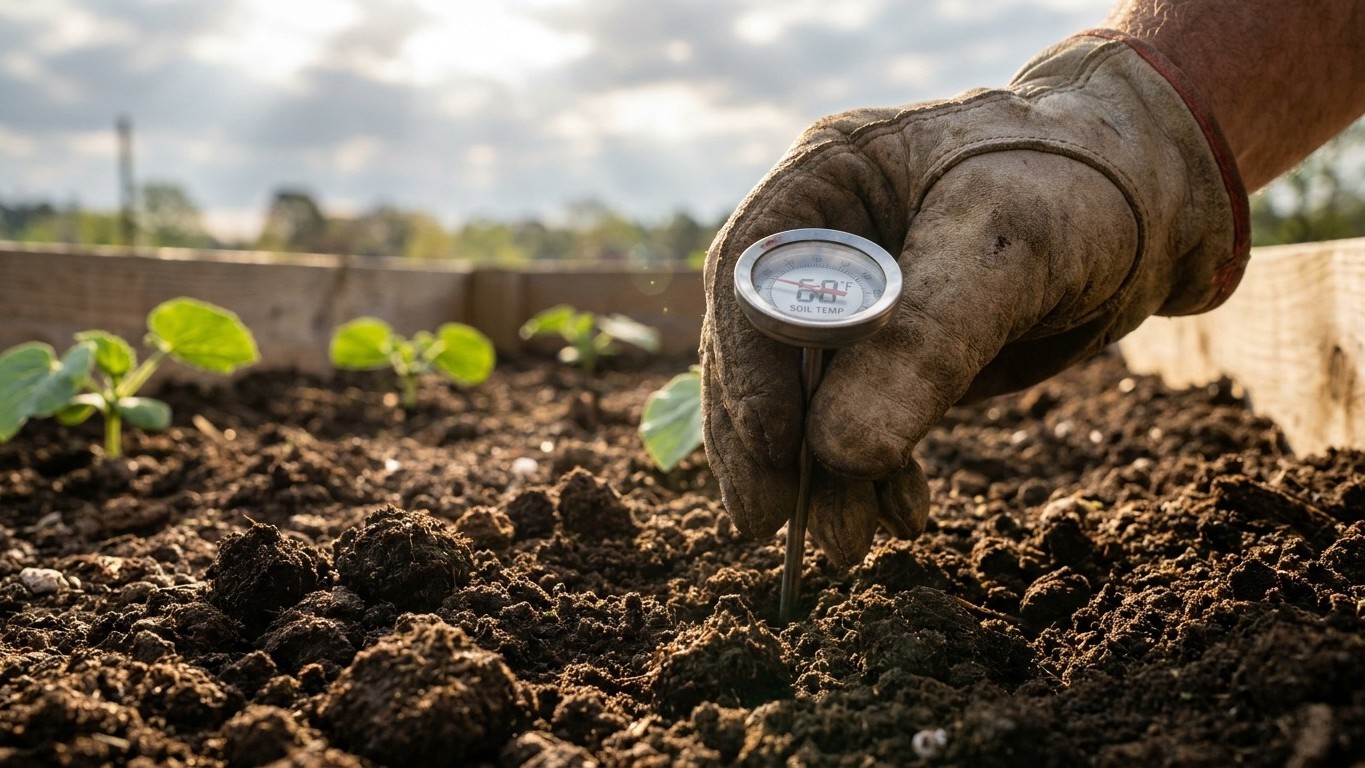

Melons need warm soil, not just frost-free air, and in most of Ontario that point arrives well after the last spring frost has passed. Near Toronto, the average last frost falls April 30, but soil temperature lags weeks behind it. Add a growing season with almost no days above 90°F, and the honest answer is this: plant late, choose a short-season type, and let a soil thermometer decide the date, not the calendar.
When the soil is warm enough in Ontario

The average last spring frost at Toronto Lester B. Pearson International Airport lands on April 30, according to Environment and Climate Change Canada’s Climate Normals for 1981-2010. That’s the number most Ontario gardeners reach for first, and it’s a reasonable place to start. It is not, though, the answer to when melon seed or transplants should actually go into the ground.
Frost dates measure air temperature at a specific moment. Melon germination and root growth respond to something slower moving: soil temperature at planting depth, which needs to sit consistently near 65 to 70°F before seed germinates reliably or a transplant pushes new roots instead of sulking in place. Air can clear the frost threshold on a mild April afternoon while the ground beneath it, still cold from winter, stays unsuitable for a heat-loving vine. In practice, that gap between air and soil often runs two to four weeks in southern Ontario, pushing the realistic planting window into late May or the first week of June for most home gardens.
There’s a second point worth stating plainly: April 30 is a mean date, not a guarantee. Environment and Climate Change Canada calculates it as roughly the midpoint of a distribution built from three decades of record, which means that in about half of those years, frost arrived after April 30, sometimes well after. Treat the date as the center of a window, never as a green light stamped on the calendar.
Why the reference station matters
The Pearson Airport station also isn’t the whole province. It represents one spot in the Greater Toronto Area, and Ontario stretches from the moderating shorelines of the Great Lakes to colder, shorter-season districts farther north and at higher elevation. A garden in Ottawa, Sudbury, or along the Bruce Peninsula typically runs behind this date, sometimes by two or three weeks. Anyone gardening outside the immediate GTA should treat April 30 as a reference point to adjust from, not a figure to copy onto a seed packet.
None of this makes melons a bad bet here. It means the practical move is to stop watching frost warnings and start checking the ground. A basic soil thermometer pushed two inches down, read in the morning before the sun warms the surface, tells a gardener more than any frost-date chart. Black plastic mulch laid over the bed two to three weeks ahead of planting speeds that warming along, often moving the safe planting date up by about a week compared with bare soil left to warm on its own. Raised beds do similar work, draining and warming faster than flat rows simply because more of their surface sits exposed to sun and air.
How long the season lasts here
Between the average last spring frost on April 30 and the average first fall frost on October 16, both measured at the Toronto Pearson station over the 1981-2010 normals, Ontario’s frost-free window runs roughly 169 days, a little under six months on paper.
That figure looks generous next to many northern climates, and on paper it is. But melons don’t use the full window the way a quick crop like lettuce does. Once the soil-warming lag from the previous section is factored in, real planting rarely starts before late May, which trims the usable growing stretch to something closer to four and a half months before the first fall frost risk returns in mid-October. For a vine crop that needs sustained warmth to size fruit and finish ripening, that shorter effective season is the number that actually matters, not the frost-to-frost total.
That distinction decides two practical questions. The first is whether a second sowing makes sense. In territories with a genuinely long frost-free run, gardeners can direct-seed a fast crop again in midsummer for a fall harvest. Ontario’s effective window is tighter than that, and a second melon sowing started after the first has already used up most of June risks running straight into cool September nights before fruit has had time to ripen. For most home gardens here, the first sowing is the only one worth staking a bed on. Anyone curious about how territories with longer seasons handle a second planting, and where the cutoff actually sits, can check the succession sowing guide on this site.
The second question is whether transplanting is worth the risk of disturbing the roots. Melons don’t love being moved. A jostled root ball can set a plant back by a week or more while it recovers, which matters little in a long season and matters a great deal in a short one. Given Ontario’s compressed effective window, starting seed indoors three to four weeks before the soil is ready, then setting out young plants raised in biodegradable or peat pots that go into the ground intact, usually buys more real growing time than direct seeding and waiting for the ground to warm on its own.
Heat and water in Ontario

The Toronto reference station records an average of 0.0 days a year reaching 90°F or higher, over the 1981-2010 normals. That’s not a rounding artifact. It means the accumulated summer warmth that melons depend on to size fruit and convert starch to sugar arrives here more slowly, and less reliably, than in the hot interior climates where these vines originated.
Melons respond to accumulated heat over the season more than to the calendar date of sowing. A territory that logs zero days above 90°F isn’t disqualified from growing melons, but it is one where the type chosen and the technique used to warm the root zone matter more than picking the perfect planting day. Black plastic mulch, row covers pulled over young plants in the first weeks, and siting the bed against a south-facing wall or fence that banks daytime heat all do real work in a climate like this one, sometimes more than an extra week of calendar time would.
Rainfall tells a different part of the story. Summer rain across June, July and August averages about 8.9 inches at the same Toronto station, distributed fairly evenly through the season: June 2.81 inches, July 2.98 inches, August 3.07 inches. That’s a moderate, fairly reliable supply, nothing like the dry-summer territories where irrigation alone decides whether fruit sizes up at all.
This combination, cool summers with steady rain, doesn’t create a watering problem. It creates a different one: mildew, slower ripening, and disease pressure on foliage that stays damp longer than it would in a hotter, drier climate. Powdery and downy mildew both thrive in exactly these conditions, and a wet leaf canopy that doesn’t dry quickly between rain events is the more realistic threat here, not a scorched, thirsty vine. Spacing plants for airflow, watering the soil rather than the leaves, and choosing varieties bred for disease tolerance matter more in Ontario than an aggressive irrigation schedule ever would.
Which melons suit Ontario
Given a shorter effective season and a cool, damp summer rather than a hot dry one, the types worth favoring here are the earliest-maturing kinds within whichever melon category a gardener wants to grow, whether that’s cantaloupe-type muskmelons, smaller icebox-style watermelons, or other short-vine types bred to finish before summer heat has had much chance to build. Airflow-friendly growth habits, whether through trellising or wider plant spacing, help dry foliage faster after rain, and disease resistance, particularly to the mildews favored by cool damp air, should sit near the top of any selection criteria for this territory.
What this page won’t do is put a variety name on that list. Trial results for melons vary enormously by county, by soil, and by microclimate within a single province, and a name that performs well in a trial plot near Windsor may disappoint entirely in a garden near Sudbury or along the Bruce Peninsula. Naming one here would mean guessing at conditions this page has no way to verify for any individual reader, and that guess is the one error a gardener notices the moment the fruit fails to ripen.
The reliable move is to check what’s actually been trialled locally. Ontario’s agriculture ministry publishes crop guidance and variety trial information through the Ontario Ministry of Agriculture, Food and Rural Affairs, reachable at ontario.ca/page/agriculture-and-food. That’s where a gardener finds which specific types have actually performed well in trials run under Ontario conditions, rather than conditions borrowed from somewhere else.
It’s also worth noting that Ontario falls in Canadian plant hardiness zone 7a for the reference city used in these figures, based on Natural Resources Canada’s 1991-2020 normals. That number can’t be read against a USDA zone from a US gardening chart; the two systems are built on different variables entirely, and NRCan itself warns there’s no simple conversion between them. For anyone comparing notes with a gardener across the border, the zone number is a detail to mention with that caveat attached, not a shortcut to matching advice written for a US zip code.