
Melons can succeed in South Dakota gardens, but the state’s short frost-free window and modest heat load mean success depends less on the calendar and more on warming the soil early, choosing the fastest-maturing types, and watching the last weeks of summer closely before the first fall frost arrives.
When the soil is warm enough in South Dakota

At the reference station used by NOAA for this region (station USW00014944), the last spring frost falls somewhere between April 29 and May 9, based on the 1991-2020 Climate Normals. That’s a real range, not a single date, because frost probability is exactly that: a probability, not a promise. A garden a few miles outside town, especially at higher elevation or in a low-lying frost pocket, often sees its last frost later than that airport figure and its first fall frost earlier, sometimes by one to two weeks. So treat April 29 to May 9 as a starting reference for the Sioux Falls area specifically, and check your own county’s frost history before you commit seedlings to open ground.
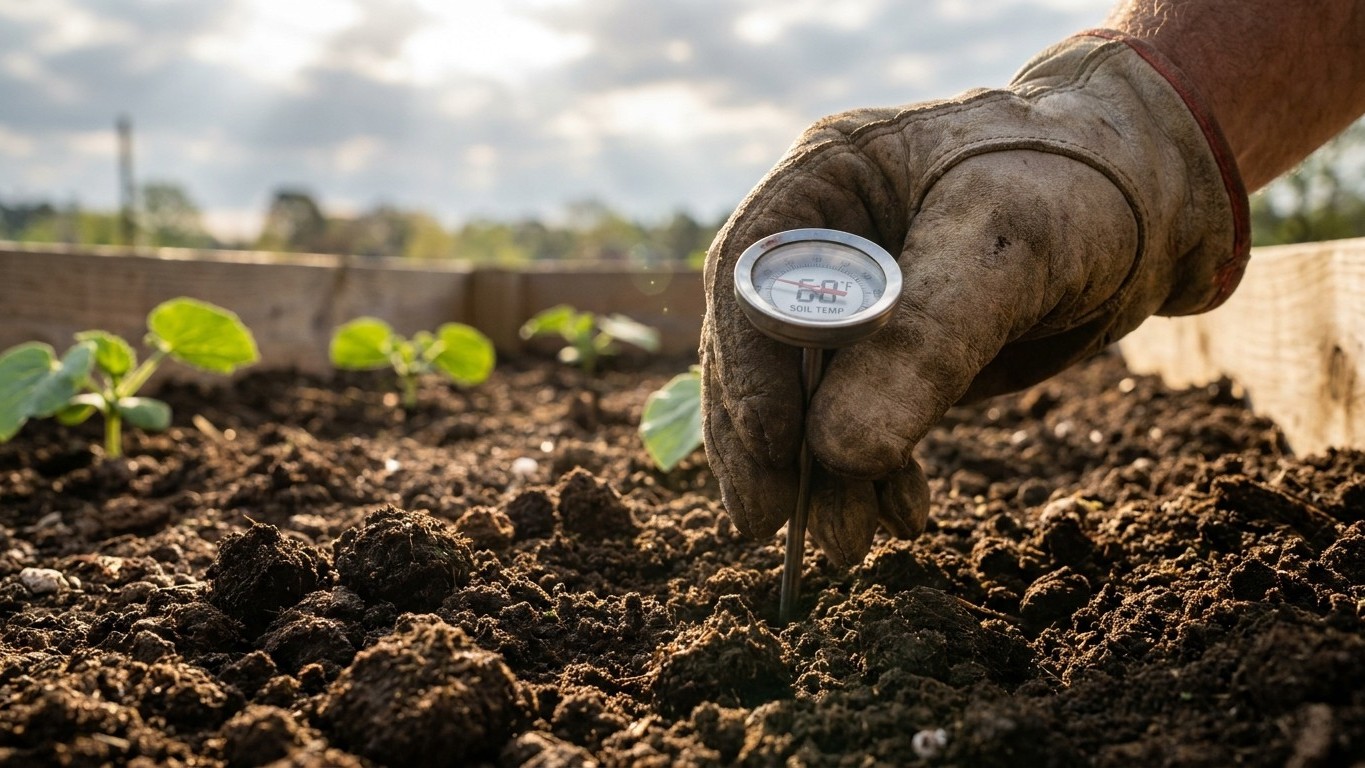
Here’s the part that trips up a lot of gardeners: the frost date tells you when the air stops threatening to kill a plant. It does not tell you when the soil is warm enough to grow one. Melon seeds germinate poorly, and melon roots barely function, in soil below the mid-60s Fahrenheit. Air can clear the frost threshold weeks before six inches of soil catches up, particularly in a state where spring winds can keep surface temperatures swinging even after nighttime lows stay above freezing.
That gap between frost-safe and soil-warm is where most of the useful work happens. Black plastic mulch laid over the bed a couple of weeks ahead of planting captures solar heat and can push soil temperature up several degrees compared to bare ground. Raised beds warm faster than flat rows because they drain and shed cold air more efficiently. Row covers or low tunnels do double duty, holding soil warmth in and buying an extra week or two of season on both ends. None of this replaces waiting for the frost window to close, but it does mean a gardener who preps the bed in mid-April can often set out melon transplants closer to the early end of the frost range than someone relying on bare soil and a seed packet.
One more nuance worth keeping in mind: this state’s hardiness range spans zones 3b to 5b under the USDA Plant Hardiness Zone Map, which is built entirely on average annual extreme minimum temperature. That figure matters for perennials that have to survive winter in the ground. It has almost nothing to do with a melon vine, which lives and dies within a single frost-free season and never sees a South Dakota winter at all. Don’t let the zone number drive melon-planting decisions; the frost dates and soil temperature do that job.
How long the season lasts here
Running the two frost dates from the Climate Normals against each other gives a frost-free window that lands somewhere between 138 and 158 days, depending on which end of each range you pair up, with most years falling closer to the middle of that band. Call it roughly five months, give or take a week or two on either side. That is a workable season for melons, but it is not a generous one, and it leaves little room for a slow start or a late transplant.
What that length actually allows is the real question. A frost-free window in the 150-day neighborhood is long enough to grow a full-season melon crop from transplant to harvest with a reasonable buffer before the first fall frost shows up. It is not, in most years, long enough to comfortably fit two separate sowings of melons the way a gardener in a six- or seven-month climate might. In practice, South Dakota gardeners get one real shot at a melon crop per season, which raises the stakes on getting the timing of that single planting right.
This changes the transplant-versus-direct-seed calculation, too. In a longer season, direct-seeding straight into the garden and losing a couple of weeks to slow spring germination barely matters, because there’s time to spare. Here, that lost time comes directly out of the harvest window. Starting melons indoors three to four weeks before the last frost date, then transplanting once the soil has warmed, is the more reliable route for most of the state. It does mean checking root health before transplanting, since melons dislike root disturbance and a pot-bound seedling can stall for a week or more after going into the ground, a setback a longer season could absorb but a South Dakota season can’t always afford.
Where a gardener does have space and wants to hedge against a poor first attempt, staggering a small backup sowing a week or two behind the main planting is worth considering rather than a true second full-season crop. For the mechanics of spacing sowings to extend or protect a harvest, the succession sowing guide on this site walks through how that timing works in short-season climates like this one.
Heat and water in South Dakota

The Sioux Falls reference station logs an average of 13.8 days a year at or above 90 Fahrenheit, based on the 1991-2020 Climate Normals. That’s a modest heat load. It is not the number you’d see in a traditional hot-summer melon region, and it matters because melons build sugar through accumulated warmth over the whole season, not through the calendar alone. A territory logging under two weeks of 90-degree days is one where the sowing date matters less than making sure the plant gets every available degree of warmth it can, which is exactly why the soil-warming techniques described earlier carry more weight here than they would in a hotter state.
Rainfall tells the other half of the story. Summer rainfall across the reference station runs about 10.8 inches total over June, July and August, out of 27.9 inches for the full year. Broken down by month: June averages 4.23 inches, July drops to the driest point of summer at 3.25 inches, and August comes in at 3.34 inches.
| Month | Average rainfall (inches) |
|---|---|
| June | 4.23 |
| July | 3.25 |
| August | 3.34 |
That’s a fairly even spread rather than a sharp dry season, but it never reads alone. Rain that falls as a single summer thunderstorm tends to run off rather than soak in, and the same inch of rain behaves differently depending on whether a garden sits on sandy or clay soil. Combined with a relatively low count of 90-degree days, evaporation demand here is lower than in a hotter state, which means the rainfall totals go further than the raw numbers might suggest. Still, a rain gauge staked in the actual garden bed is the only real way to know whether a given week needs supplemental watering.
The bigger risk in a climate like this isn’t drought stress on the vine, it’s the opposite. A cool, damp stretch of weather slows ripening, and standing moisture on leaves in a state without heavy heat to dry them out quickly can invite powdery mildew and other fungal issues. Watering at the base of the plant rather than overhead, and giving vines enough spacing for air to move through the foliage, matters more here than building elaborate irrigation infrastructure for drought defense.
Which melons suit South Dakota
Given a frost-free window in the 140-to-160-day range and a heat load that rarely climbs past 90 Fahrenheit more than a couple weeks a year, the earliest-maturing melon types available are the ones with realistic odds of finishing before the first fall frost shows up in late September or early October. This isn’t the state to gamble on a long-season type that needs the entire summer to reliably ripen.
Beyond speed, three practical traits matter more here than in a hotter, drier climate:
- Compact or space-efficient vines that fit under a row cover or plastic mulch during the cool early weeks
- Foliage that tolerates being spaced for airflow, since dampness and mildew risk outweigh drought risk in most South Dakota summers
- Disease resistance bred into the type, particularly against fungal pressure, since that’s the more likely failure point here than heat stress
What this page won’t do is hand over a specific variety name. That’s not an oversight, it’s the honest answer. Variety performance shifts by soil, by microclimate, and by which strains a given seed house is currently trialing, and a name printed here with no local trial data behind it is a guess dressed up as advice. The people who actually run replicated variety trials for this climate are at South Dakota State University Extension, and their current recommendations reflect real seasons grown in real South Dakota soil, updated as new types prove themselves or fall out of favor. That’s the list worth checking before buying seed, not a name pulled from a general gardening article with no ties to this state’s growing conditions.
Reasoning by type rather than by brand also protects a gardener from a common trap: buying a melon because it performed well in a review written for a warmer, longer-season state. A type praised for its heat tolerance in a place logging forty or fifty days above 90 Fahrenheit a year is answering a problem South Dakota gardeners mostly don’t have. The type that matters here is the one that finishes fast, breathes well in damp air, and shrugs off the fungal pressure that a short, cool-ish summer tends to bring.