
Thrips show up in Arizona twice a year with real force: a spring surge that starts as early as February in the low desert and runs through May, then a smaller fall wave in September and October when temperatures drop back into the 80s. Between those windows, dry summer heat above 105°F actually slows them down. Stopping them means matching the timing with reflective mulch, insecticidal soap or spinosad, and predatory insects that already live in Arizona landscapes.
When Thrips Show Up in Arizona

Arizona’s desert climate creates two distinct thrips seasons instead of one long summer problem like you’d find in humid states. The first and biggest wave hits the low desert (Phoenix, Tucson, Yuma) between February and May, right when citrus trees bloom, roses push new growth, and spring vegetable gardens get planted. Western flower thrips, the species most common across the Southwest, times its life cycle to that flush of tender new growth.
High desert and mountain regions (Flagstaff, Prescott, Sedona) run about a month behind the valley floor. Their thrips activity peaks in April and May, once nighttime lows stay reliably above 50°F. That elevation gap matters if you’re comparing notes with a friend in a different part of the state; what’s happening on their roses in March might not hit yours until April.
Summer brings a strange lull. Once daytime highs push past 105°F, adult thrips populations drop off sharply, not because the heat kills them outright but because it dries out the soft plant tissue they feed on. A second, smaller wave returns in September and October as monsoon moisture fades and temperatures settle into a more thrips-friendly range again.
Which Arizona Plants Get Hit Hardest
Citrus, roses, and vegetable transplants (tomatoes, peppers, squash) top the list statewide. In the low desert, thrips also target date palms and ornamental oleander. Native and drought-adapted landscaping isn’t immune either; agave and yucca flower stalks attract thrips during bloom, though damage there is mostly cosmetic.
Spotting Thrips Damage Before It Spreads
Thrips are barely visible without a hand lens, so most homeowners notice the damage before they notice the insect. Leaves develop a silvery or bronze stippling, almost like they’ve been lightly sandpapered. Flip the leaf over and you’ll often find tiny black flecks, which are thrips excrement, not disease.
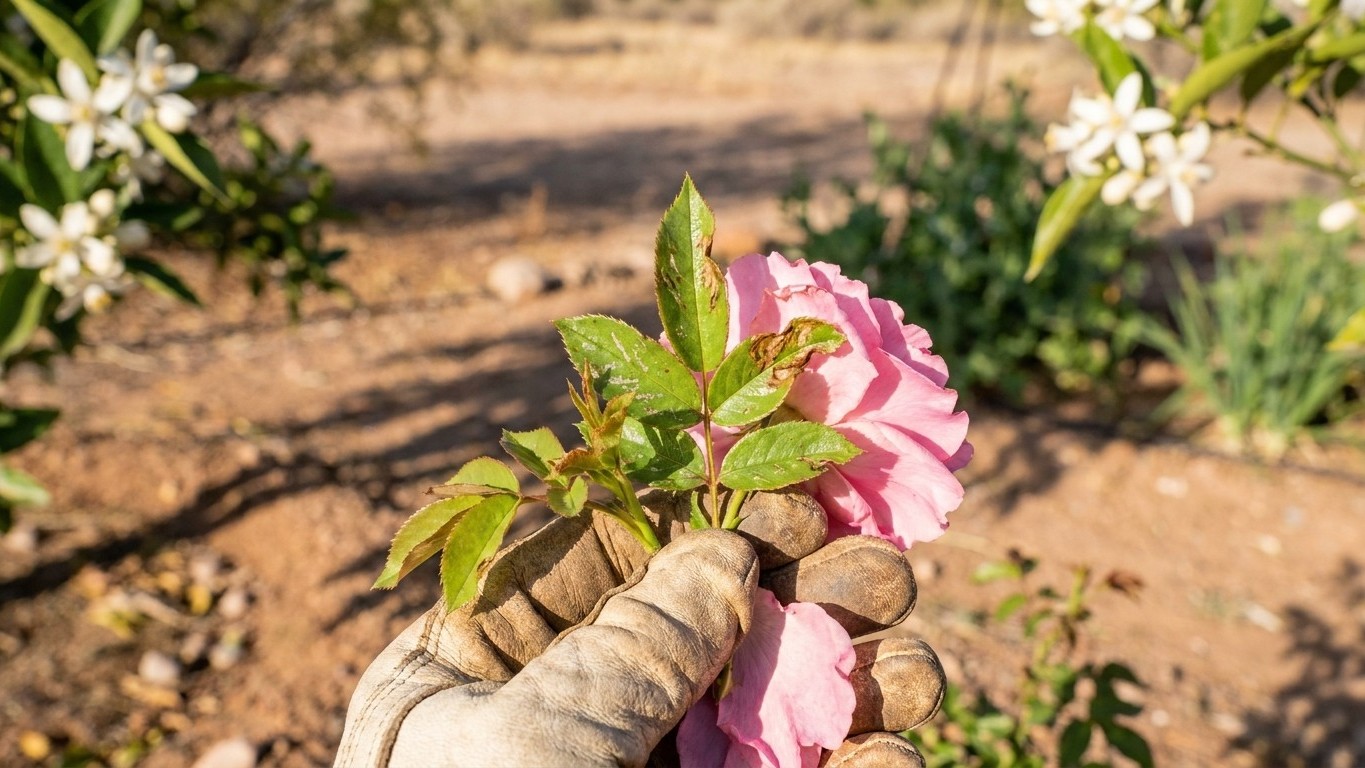
On roses, thrips feeding shows up as brown streaking on petal edges and buds that fail to open properly. Citrus growers in central Arizona see scarring on young fruit rinds, a cosmetic issue that doesn’t affect the fruit inside but does affect what you can sell or show off. Vegetable transplants wilt and curl at the growing tip, sometimes mistaken for heat stress since the timing overlaps.
A blue or yellow sticky card, the kind sold at most garden centers, hung a few inches above plant canopy will catch adult thrips within a day or two if a population is building. That’s a low-cost way to confirm what you’re dealing with before spraying anything.
What Actually Stops Thrips in Arizona
Control works best when it lines up with the seasonal pattern rather than fighting thrips year-round. Three approaches consistently show results in Arizona’s desert conditions: cultural changes, biological controls, and targeted products used at the right moment.
Cultural and Physical Controls
Reflective mulch, silver or aluminum-colored plastic laid around vegetable beds and rose plantings, disrupts thrips navigation and cuts landing rates significantly. It’s a technique validated in university pest management research and works particularly well in open, sunny Arizona yards where there’s nothing blocking the reflection.
Removing spent blooms and pruning out heavily damaged growth in late winter, before the spring surge starts, reduces the overwintering population that kicks off the season. Weeds along fence lines and irrigation ditches also host thrips between plantings, so clearing that vegetation in January limits the spring reservoir.
Overhead watering, used sparingly, knocks adult thrips off leaves and disrupts pupation in the soil. That’s a rare case where Arizona’s usual advice to avoid overhead irrigation gets flipped for pest management purposes, though it should stay occasional to avoid fungal issues on citrus and roses.
Biological Controls Already Living in Arizona Yards
Minute pirate bugs and predatory mites occur naturally across Arizona landscapes and feed heavily on thrips larvae. Avoiding broad-spectrum insecticides preserves these populations, which often does more long-term work than any spray. Lacewing larvae, sold commercially and easy to release in a backyard garden, also target thrips effectively during the spring bloom window.
Releasing beneficial insects works best timed to coincide with the first sign of thrips activity on sticky cards, rather than as a blanket springtime ritual. Releasing too early, before thrips arrive, just means the beneficials move on to find food elsewhere.
Targeted Treatments That Hold Up in Desert Conditions
Insecticidal soap and horticultural oil remain the most reliable low-toxicity options, and they work by smothering thrips on contact rather than through residual poisoning, which matters in a state where beneficial insect populations are worth protecting. Spinosad, a naturally derived product, shows strong results against thrips specifically and has a track record in university extension trials across the Southwest.
Systemic products applied to soil around ornamentals can offer longer protection but come with tradeoffs for pollinators, so they’re better reserved for non-flowering shrubs like oleander hedges rather than roses or vegetable gardens where bees are working the blooms. According to University of California’s Integrated Pest Management guidelines, which cover thrips management strategies applicable across similar Southwest desert climates, repeated applications timed to the thrips life cycle outperform single treatments by a wide margin, since adults, larvae, and pupae respond differently to the same product.
Timing any spray for early morning, when Arizona’s intense midday sun hasn’t yet degraded the product, extends its effectiveness. Applying insecticidal soap at 2 p.m. in June is mostly wasted effort, and it stresses the plant further in heat that’s already pushing 110°F.
Regional Differences Worth Knowing
Yuma’s agricultural intensity, with year-round vegetable production feeding much of the country’s winter produce, creates a thrips pressure that residential gardeners in that area don’t fully escape. Homeowners near large-scale farm operations in Yuma County often see earlier and heavier thrips arrival than those in similarly hot but less agricultural parts of the state.
Tucson’s slightly higher elevation and cooler nights compared to Phoenix shift the spring peak about two weeks later on average, though the difference narrows once summer heat arrives statewide. Flagstaff and other high-country communities deal with thrips mostly as a late-spring rose and vegetable garden issue, with far less pressure on citrus since most of that region can’t grow it outdoors anyway.
One detail that surprises a lot of Arizona gardeners: thrips can travel long distances on wind currents, which means a yard that’s done everything right can still get hit by a population blown in from miles away during a windy spring afternoon. That’s less a treatment failure and more a reminder that some years bring heavier pressure regardless of what’s happening in a single backyard.