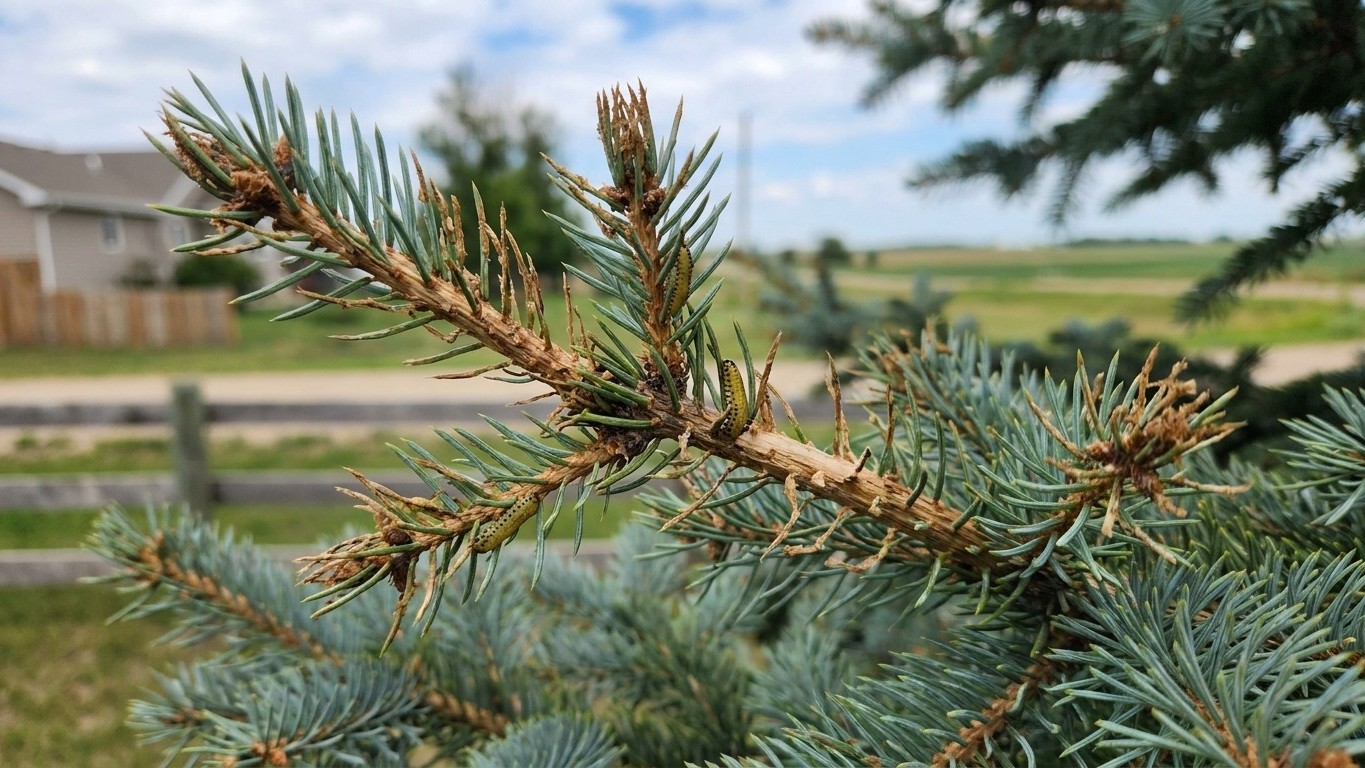

Yellowheaded spruce sawfly larvae start stripping needles in North Dakota shelterbelts and yards around late May, usually peaking through mid-June before the insects disappear back into the soil for the rest of the year. The good news: this pest has a narrow window of vulnerability, and catching it during that stretch, while larvae are still small, is what actually keeps a spruce tree from losing its shape for good.
Unlike drought or winter burn, damage from this insect isn’t subtle once you know what to look for. But by the time most homeowners notice bare branch tips, the larvae have already done a chunk of their feeding for the season. Timing is everything with this one.
A Pest Built for North Dakota’s Windbreaks and Yards

Yellowheaded spruce sawfly (Pikonema alaskensis) targets spruce almost exclusively, with Colorado blue spruce and white spruce taking the worst of it across the state. That matters in North Dakota specifically because spruce isn’t just a landscaping choice here. It’s the backbone of farmstead shelterbelts and field windbreaks planted decades ago to cut wind erosion and snow drift, plus the go-to tree for privacy screens in newer subdivisions.
The insect has a preference that makes rural plantings especially exposed: it does far more damage to isolated, open-grown trees than to spruce packed into dense stands or thick shelterbelt rows. A lone blue spruce anchoring a front yard, or a windbreak with gaps where trees died and were never replaced, gives this sawfly exactly the kind of sunny, unobstructed branch structure it favors for egg-laying and feeding. Trees crowded together in a healthy, continuous row tend to escape with lighter damage simply because there’s more shade and less exposed surface for adults to work.
Dwarf Alberta spruce, a popular foundation planting around North Dakota homes, is particularly vulnerable. Its dense, slow-growing form means even a single bad season of feeding can leave visible dead zones that take years to grow back, if they ever fully do.
The Yellowheaded Spruce Sawfly’s North Dakota Calendar
This insect runs one generation per year in North Dakota, which sets it apart from pests that produce multiple overlapping waves of damage all summer. Adult sawflies, small non-stinging wasp relatives, emerge from the soil in spring and lay eggs along the current year’s new needle growth, typically in late May.
Eggs hatch quickly, and the larvae feed for roughly four to six weeks, running from late May into July depending on spring temperatures. Once they’ve finished feeding, mature larvae drop to the ground, burrow into the soil or duff beneath the tree, and spend the rest of summer, fall, and winter there as prepupae. They pupate the following spring, and the cycle starts over.
That single-generation life cycle is actually useful information for anyone managing spruce on a property. There’s no second or third flush of larvae to worry about later in the summer the way there is with some caterpillar pests. Miss the spring window, and you’re waiting until next year for another shot at catching them small, though the damage from that missed year is already locked in.
Spotting the Damage Before It Gets Worse
The larvae themselves are easy to overlook at first. They’re small, pale yellow-green caterpillar-like insects with a noticeably darker, orange-brown head, growing to about five-eighths of an inch by the time they’re done feeding. Young larvae are barely a couple millimeters long, which is exactly why early detection takes some deliberate looking rather than a quick glance at the tree.
Feeding follows a predictable pattern that helps separate this pest from other spruce problems. Larvae start at the branch tips and work on older needles first, often leaving the current season’s new growth alone at first before moving to it as they mature. Damage tends to concentrate on the upper and outer parts of the tree, where sun exposure is highest, and it often starts at the top of the tree and progresses downward in later years if the infestation goes unchecked.
A few identifying clues separate this from spider mite damage or winter desiccation:
- Chewed needle stubs remain on the branch rather than needles dropping cleanly or turning uniformly brown
- Damage clusters on branch tips and the tree’s sunny side, not evenly across the whole canopy
- Small, pale larvae are visible on close inspection of affected branches during late May and June
- Repeated years of feeding leave a tree with a thin, tufted, “lion’s tail” look at the branch ends
One season of moderate feeding rarely kills a healthy spruce. The real threat comes from repeat infestations. A tree defoliated two or three years running, especially a smaller or younger one, can lose enough needle mass that whole branches die back, and severely weakened trees become easier targets for bark beetles and other secondary problems.
What Actually Stops Yellowheaded Spruce Sawfly
Control comes down almost entirely to timing. Because there’s only one generation a year and the larvae are most vulnerable while small, the practical window for stopping this pest in North Dakota runs from late May through mid-June, before larvae mature and before they’ve done the bulk of their feeding.
Chemical control timing
For homeowners with a handful of ornamental spruce, insecticidal soap or a labeled insecticide such as spinosad works well when applied while larvae are still small, generally within the first couple weeks after egg hatch. Waiting until larvae are large and damage is already obvious cuts down on how effective a spray application will be, since much of the needle loss has already happened by then.
Larger windbreak or shelterbelt operations, where dozens or hundreds of trees are involved, typically rely on broader-labeled insecticides applied by ground sprayer, again timed to that late-May-to-mid-June window. Because this pest produces only one generation, a well-timed single application in a given year usually covers the full season, unlike pests that require repeat treatments through summer.
Non-chemical and cultural options
Physical removal works for small numbers of trees or light infestations. Larvae can be knocked off branches with a strong stream of water or picked off by hand on smaller ornamental spruce, then disposed of away from the base of the tree so they can’t simply crawl back up.
Spacing and tree health play a bigger long-term role than most people expect. Because open, isolated spruce take the worst damage, filling gaps in a shelterbelt row or avoiding wide, sunny spacing when planting new ornamental spruce reduces how attractive a tree is to egg-laying adults in the first place. Keeping trees adequately watered, especially spruce already stressed by North Dakota’s periodic drought years, helps them tolerate a round of feeding without long-term dieback.
Natural predators and parasites exist for this sawfly in other parts of the country, but populations in North Dakota generally aren’t dense enough to provide reliable control on their own, which is part of why direct monitoring and timed intervention matter more here than in regions with more established natural enemy populations.
Checking spruce trees weekly from mid-May through mid-June, rather than waiting for obvious thinning to show up, remains the single most effective habit for anyone trying to keep a blue spruce, a dwarf Alberta spruce, or a stretch of windbreak intact. A tree that gets caught and treated in its first light year of infestation rarely shows the same damage the following spring, while one that goes unnoticed through two or three seasons can take the better part of a decade to fill back in, if it recovers at all.