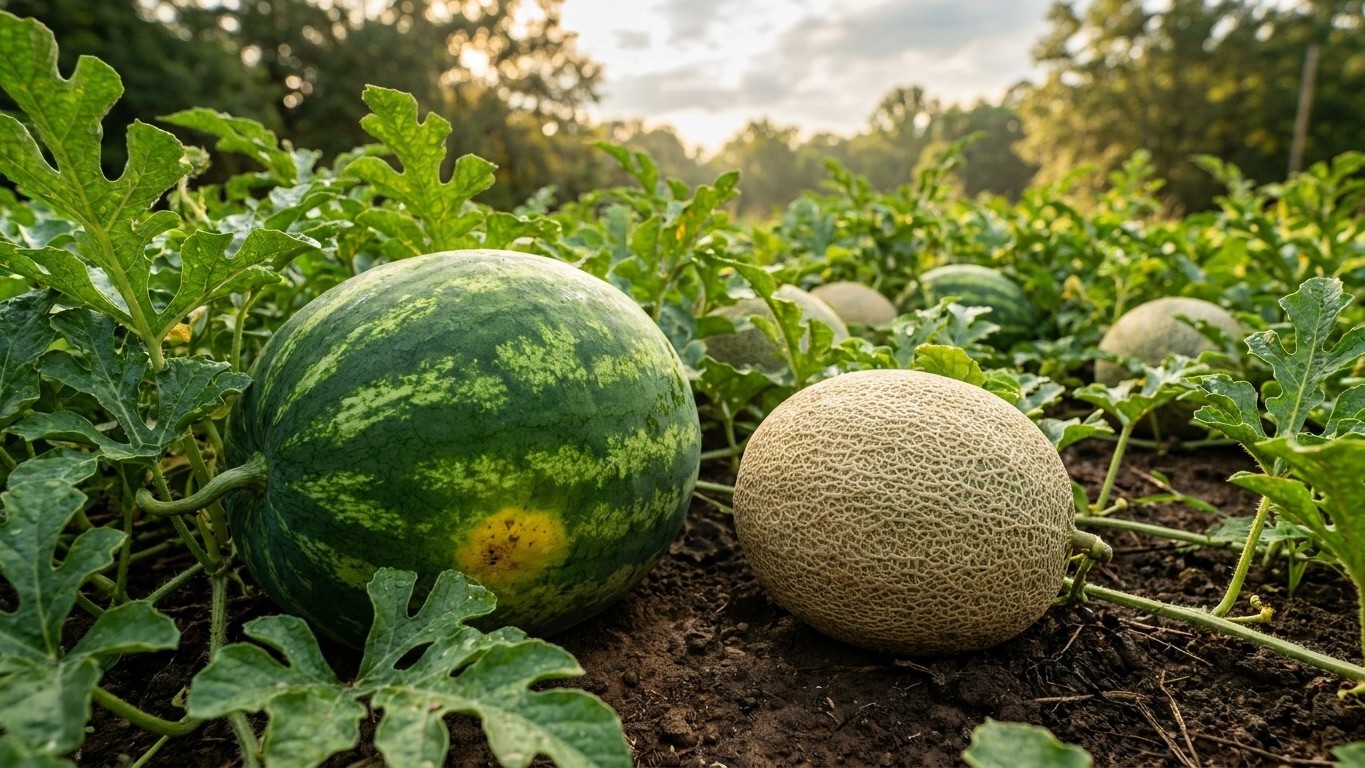

Short-season muskmelons and cantaloupes bred for cool climates are the safest bet in Quebec, given a mean frost-free window of about five months and essentially zero days of real summer heat. Long-season watermelons and heat-loving heirloom melons are a gamble here, not a strategy.
The short answer for Quebec
Two numbers decide this before you even pick a seed packet. The average last spring frost at the Montreal/St-Hubert A reference station falls on May 6, and the average first fall frost lands October 5. That’s a mean growing season of roughly five months, on paper. But these are averages, not guarantees: in half the years on record, frost has arrived later than May 6 in spring and earlier than October 5 in fall. So the real planting-to-harvest window most gardeners can count on is shorter than the calendar math suggests.
The bigger constraint is heat, not calendar days. The reference station records an average of 0.0 days a year above 90°F. Melons don’t just need frost-free days, they need accumulated heat to sweeten and size up. A vine sitting in 70-degree afternoons all July is not building sugar the way it would in a region that regularly clears 90°F. That single fact rules out a lot of melon types before frost dates even enter the conversation.
What that means in practice: prioritize melon types with a short number of days to maturity, and favor ones known to set fruit and ripen under moderate rather than intense heat. Here’s how the main categories stack up against those two limits.
| Melon type | Typical days to maturity | Fit for Quebec’s season and heat |
|---|---|---|
| Short-season muskmelon / cantaloupe | ~65-75 days | Best fit; can mature within the frost-free window even in a cool summer |
| Icebox-type watermelon | ~75-85 days | Workable most years, but tight if spring runs late or the summer stays cool |
| Long-season watermelon or honeydew | 90-100+ days | High risk; often needs more heat and more frost-free days than this station’s normals provide |
Starting transplants indoors rather than direct-seeding buys back some of that lost time and heat, which is why it shows up again in the next section as almost non-negotiable here.
What will not work here

Long-season melons are the clearest failure point. A variety needing 95 or 100 days to maturity, counted from transplant, is already asking for more time than the mean frost-free window comfortably offers once you account for the fact that frost can arrive before October 5 in half of all years. Add in a stretch of overcast, cool weeks in July, which is common with zero days above 90°F on the books, and a long-season fruit can still be pale and hard on the vine when the first cold night hits.
Direct-seeding outdoors is the second trap. Melon seed wants warm soil to germinate quickly, and soil temperature lags well behind the average last frost date. Sow directly into ground that’s only just frost-safe and you lose one to three weeks of growing time before the plant even breaks the surface, time this territory doesn’t have to spare. Starting seed indoors three to four weeks ahead of the average last frost and transplanting out once the soil has genuinely warmed is less a preference than a way of compensating for a heat-short summer.
Heat-hungry heirloom types
Heirloom cantaloupe and specialty melon varieties bred for hot, dry regions of the U.S. Southwest or the Mediterranean are the third failure mode. They’re often selected for flavor under intense heat load, and without that heat they can vine vigorously, flower, and still deliver small, underripe fruit with disappointing sugar. That’s a mismatch with the 0.0 average days above 90°F here, not a failure of the gardener’s technique.
Summer rainfall, by contrast, is not the enemy in Quebec the way it is in hotter, drier states. The region sees about 10.6 inches of rain across June, July and August, with June the driest month at 3.42 inches. That’s enough moisture that under-watering is rarely what sinks a melon crop here. The bigger risk from that moisture, paired with cooler summer temperatures, is fungal pressure: melon vines planted too close together in a cool, damp summer are slower to dry off after rain or dew, which favors powdery mildew and other leaf diseases. Wider spacing and good airflow matter more here than in a hot, dry climate where the same spacing would be a minor inconvenience.
What changes across Quebec
The hardiness zone figure available for this territory, 5b, is the Canadian system’s rating for the Montreal reference area specifically, not a single number that applies to the whole province. Quebec stretches from the milder Montérégie and St. Lawrence valley lowlands up through the Laurentians, the Gaspésie, the North Shore, and into Nord-du-Québec, and that spread covers a wide swing in both zone rating and growing-season length. A province this size does not have one melon answer; it has several, layered on top of the mean dates from a single reference station.
Readers gardening north of the greater Montreal area, at higher elevation, or closer to the St. Lawrence estuary should expect a shorter effective season than the May 6 to October 5 averages used above. Frost can linger later into spring and arrive earlier in fall the further north or the higher up you go, which pushes even harder toward the shortest-season melon types and away from anything in the 90-day-plus range.
It’s worth remembering the Canadian hardiness system itself is built differently from the American one used elsewhere on this site: it weighs seven climate variables rather than one, and Natural Resources Canada is explicit that its zones don’t convert cleanly across the border. A Canadian zone number tells you something different than a USDA number would, so it shouldn’t be read as directly comparable to zone talk from a U.S. state page.
Where to check this for your own county
The provincial-level picture is built from one reference station’s climate normals. Your own MRC or county-equivalent region can do better than that, and the place to check is Quebec’s agriculture ministry, MAPAQ.
Two things are worth hunting down there specifically. First, a local or regional planting calendar, if one exists for your area, since it will reflect actual frost patterns near you rather than Montreal-area normals. Second, any list of melon and cucurbit varieties that have been trialled or recommended for your specific growing region, since a variety that performs well in the Montérégie may not be the same one that succeeds in a shorter, cooler season further north or east.
A county or regional recommendation beats a provincial one every time, for the simple reason that it’s built on local conditions rather than one station’s thirty-year average.
Checking this against your own garden
Every date and average is a starting estimate. Your own garden will tell you more than any calendar once the season is underway, and three simple signs are worth tracking by hand, without needing a single instrument.
Soil warmth by feel is the first. Push a bare hand a couple of inches into the bed where you plan to transplant. If it still feels cold and damp rather than mild, the soil hasn’t caught up to the calendar yet, no matter what the average last frost date says, and setting melon transplants out early will only stall them.
The first flush of male flowers is the second. Melon vines typically produce male flowers before the female flowers that actually set fruit. Their appearance is a sign the plant has settled in and is building toward fruit set, and the timing of that first flush, earlier or later than you expected, is a decent read on how warm your particular spot has actually been running compared to the regional average.
The first true leaves, the ones that appear after the initial seed leaves and actually look like melon foliage, are the third. Their size and color say a lot about whether the plant has enough light and warmth where it’s sitting: small, pale true leaves point to a cooler or shadier microclimate than the provincial averages assume, which is exactly the kind of local detail no station-based figure can capture for your own yard.