
Across most of California’s coastal and southern regions, there’s effectively no frost date to plant around: the growing window runs the full calendar year. But that answer only holds where the ocean moderates the air. Move inland or north, and the calculation changes completely, because California isn’t one climate, it’s a dozen stacked on top of each other.
When the soil is warm enough in California
Here’s the thing that makes California unusual among the states in this herb series: for the Los Angeles station (USW00023174), NOAA’s 30 years of daily records show zero days at or below 32°F. The frost-free season is listed as 365 days. NOAA’s 1991-2020 Climate Normals can’t even compute a freeze normal for that station, which is coded -666, essentially the agency’s way of saying the math doesn’t apply because the event doesn’t happen.
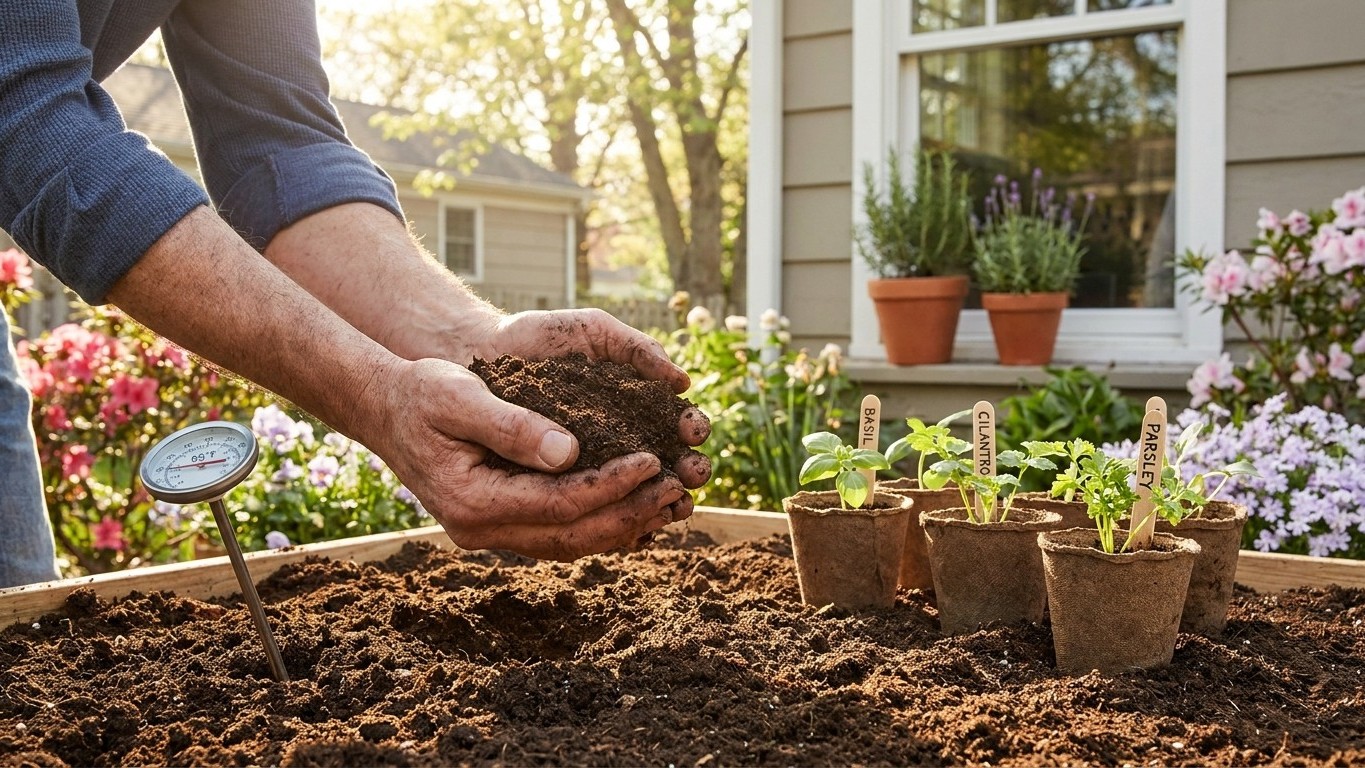
So for gardeners along the coast and through Southern California, the usual “count from your last frost” instructions from other Territories in this series simply don’t translate. There’s no spring thaw to wait out, no soil warming up after a winter freeze. What replaces it is a subtler mechanic: soil temperature still needs to climb into the range that lets herb seeds germinate reliably, and winter rains keep that soil cool and slow to warm even without frost. A frost-free reading is still an average, not a guarantee for every square mile or every year, so treat “no freeze occurs in an average year” as a strong probability, not an absolute promise.
This is not the whole state
Northern California, the Central Valley, and the Sierra foothills and higher elevations freeze in a normal winter. NOAA’s frost-free data above describes the Los Angeles station specifically, and applying it to Redding or Truckee would be a mistake with real consequences for anyone planting there. If you garden outside the immediate coastal and southern belt, your local frost dates come from a different station than the one behind these numbers, and your own county’s cooperative extension office is the fastest way to find them.
None of this changes which herbs are safe to identify by sight in the wild. Several plants that resemble common culinary herbs are toxic, some seriously so, and this page isn’t a foraging guide. Stick to nursery starts or seed packets with a known species on the label.
How long the season lasts here
Where both the last spring frost and first fall frost come back as “no freeze occurs in an average year,” the subtraction that usually defines a growing season doesn’t apply in the normal sense. The frost-free season is recorded as 365 days for the Los Angeles reference station. In practice, that means coastal and Southern California gardeners aren’t working within a season at all. They’re working within a continuous window, interrupted only by the plant’s own tolerance for heat or by a gardener choosing to rest a bed.
A window that long changes the logic of planning. In territories with a short frost-to-frost season, the first sowing is often the only sowing, and every week of delay eats into a narrow harvest. Here, the constraint disappears, and the real question becomes how many times you can cycle a bed through short-lived herbs like cilantro or dill before summer heat makes them bolt, or whether it’s worth pulling a tired basil planting in September to start a fresh one for fall. That’s a scheduling decision, not a survival one, and it rewards succession sowing more than almost any other territory in this series, because there’s no fall deadline forcing an early stop. The site’s succession sowing guide walks through staggering plantings by weeks rather than by a single frost-bounded season, and it applies directly here.
Transplant timing also shifts. Where a short season makes every transplant a race against a closing window, a 365-day window means there’s little penalty for waiting an extra week to check that a seedling’s roots have filled its cell before moving it into the ground. Again, this logic holds for the coastal and southern belt described by the Los Angeles data. Gardeners in the frost-prone parts of the state are working with an actual, bounded season, and should size their sowings the way a shorter-season territory would.
Heat and water in California
California’s defining climate feature for gardeners isn’t a summer heat count or a rainfall total from a single station, it’s the pattern: wet winters, and summers that go largely dry for months at a stretch. That rhythm, common to Mediterranean climates, means the usual “how much summer rain will my herbs get” question barely applies along the coast and through the south. The practical constraint is irrigation and, in many years, formal water restrictions imposed by local water districts during drought periods. Herbs that tolerate going dry between waterings have a real advantage here over thirstier crops.
But the number that actually reorganizes a California herb bed is a winter one, not a summer one. The mean daily minimum temperature for the coldest month, measured at the Los Angeles reference station, is 49.1°F. That’s not a record low and not a monthly average, it’s the typical overnight floor during the coldest stretch of the year. It’s mild enough that many herbs usually treated as tender annuals elsewhere can persist through winter outdoors in this specific reference location.
The USDA Plant Hardiness Zone Map, built from the average annual extreme minimum temperature under the 1991-2020 normals, places California across zones 5a to 11a. That’s one of the widest ranges of any state in this series, and it’s not a rounding error, it’s the honest result of stacking coastal lowlands, interior valleys, high desert, and alpine elevation into one state boundary. A zone 10b reading for the Los Angeles area says almost nothing about a mountain garden three hours away sitting at 6a. Treat the reference city, not the statewide range, as the number that applies to any given planting decision, and confirm your own zone before assuming a herb will overwinter outdoors.
That coldest-month figure is what separates herbs that live in the ground year-round from herbs that need a pot and a doorway to move through in winter. In the coastal and southern reference zone, a 49°F overnight floor lets several woody perennial herbs skip the pot entirely. Push north or up in elevation, toward the colder end of that 5a-11a range, and the same herbs become container plants brought in before the first real cold snap, whatever the local frost calendar looks like.
Which herbs suit California
The state’s climate range means the honest answer here is organized by type, not by variety name, and it splits along the same line the winter data already drew. In the mild, frost-free coastal and southern belt, woody Mediterranean-origin perennial herbs, the rosemary, thyme, sage, and lavender types, are well matched to the dry summers and mild winters described above. They tolerate the irrigation limits that come with drought-driven water restrictions better than leafy annuals do, and a 49°F winter floor lets them stay in the ground rather than cycling through pots.
Tender annual herbs, basil chief among them, benefit most from the near-continuous frost-free window along the coast and south. Where other territories in this series force basil into a single narrow summer slot, California’s extended calendar supports staggered sowings well into fall, provided the plant gets enough water during dry months.
Short-lived, cool-preferring herbs like cilantro and dill face the opposite pressure: California’s dry, often warm stretches push them toward bolting faster than a cooler, damper climate would. In these types, succession sowing in smaller, more frequent batches, shaded during the hottest weeks, tends to outperform one large planting.
In the colder reaches of the state’s 5a-11a range, herbs generally treated as reliable perennials along the coast need to be reclassified as pot plants, moved in before the coldest month sets in, since the mild winter that protects them near Los Angeles simply doesn’t exist at the other end of that zone range.
What this page won’t do is name a specific variety within any of those types. Variety trials that actually mean something for a California garden, tested against this state’s specific pest pressure, humidity pockets, and microclimates, come from the University of California’s Cooperative Extension network, reachable through ucanr.edu. A statewide article can responsibly narrow the field to a type of herb suited to your slice of California’s climate; only a local extension trial can responsibly recommend the exact variety to plant this season.