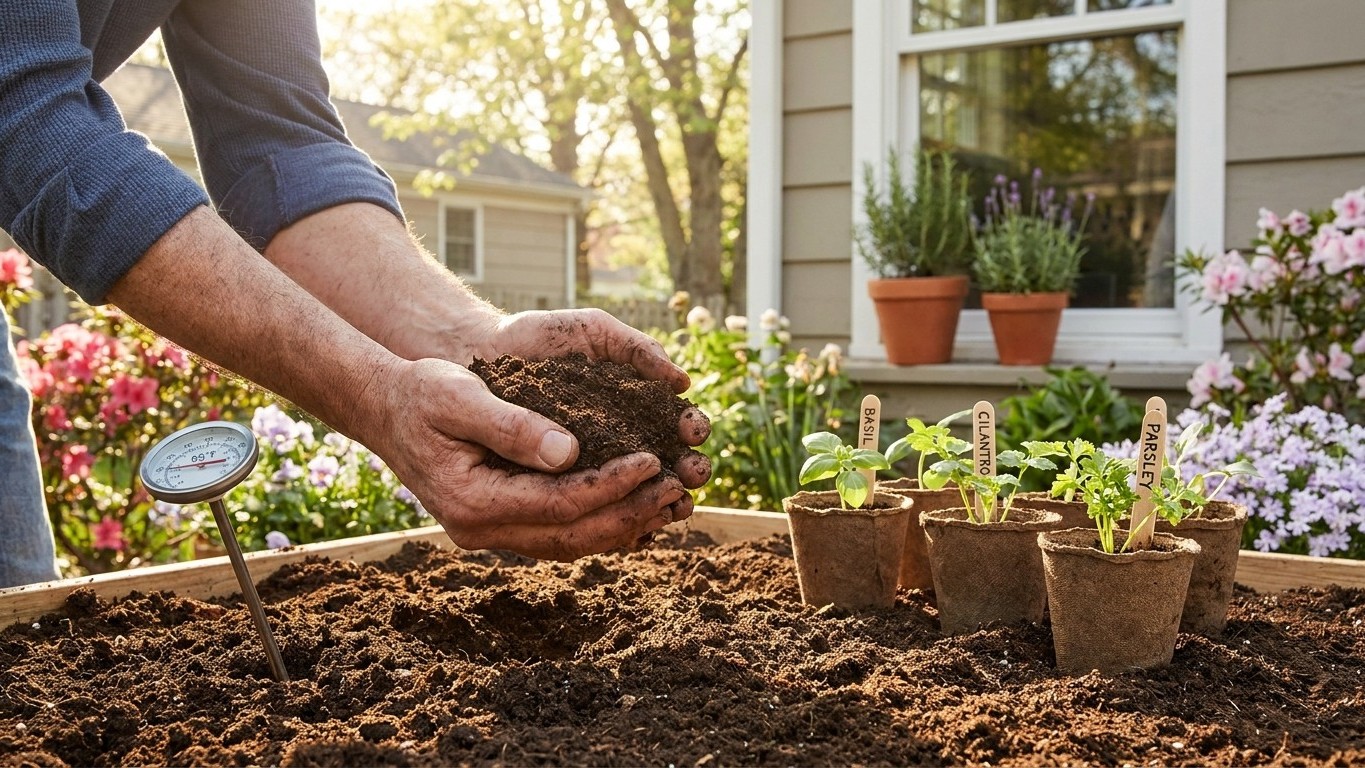

Growing Herbs in Florida depends entirely on where in the state you garden. In Jacksonville and the rest of north Florida, frost still shapes the calendar, and soil warms enough for tender herbs only after the last spring freeze passes, typically between February 16 and March 7. In central and south Florida, frost is rare or absent, and the whole logic flips: winter becomes the prime growing season, and summer heat and humidity become the real obstacle.
When the soil is warm enough in Florida

The date on everyone’s mind is the one gardeners ask everywhere: when can tender herbs go in the ground without a cold snap taking them out? At Jacksonville’s reference station (USW00013889), NOAA’s 1991-2020 Climate Normals put the last spring frost somewhere between February 16 and March 7, based on the 30 to 70 percent freeze probability band. That’s not a single day. It’s a window built from thirty years of actual freeze records at one airport site, not a guess dressed up as a date.
Soil temperature matters more than the frost date by itself. Basil, young cilantro, and most other tender herbs will sulk, or die outright, in ground that’s still cold even on a morning with no frost in sight. Frost is a proxy for that colder soil, and the soil usually needs another week or two past the last frost date to catch up to it. Treat February 16 to March 7 as the point after which frost risk drops off, not as a starting gun for planting that same afternoon.
Treat it as a probability, too, not a promise. NOAA built this window from three decades of data at one inland station, and even there, three of the thirty years recorded no freeze at all inside that range. Some years run colder later than this window suggests; a few barely dip below freezing before spring arrives. North Florida gardeners hedge with row cover on the fringe weeks instead of betting the whole bed on a calendar.
This entire window applies to north Florida (Jacksonville and similar latitudes), not to the rest of the state. Central Florida and south Florida are close to frost-free in most years, which flips the calendar entirely. There, the tender herbs that north Florida gardeners plant in spring often go into the ground in fall and grow through winter instead, because summer is the season that punishes them, not the season that welcomes them. A gardener in Tampa or Naples should read this frost window as background on the state, not as a planting instruction for their own yard.
None of this changes which species are worth growing here in general terms. Basil, parsley, cilantro, dill, and the Mediterranean woody herbs like rosemary, thyme, and oregano remain the backbone list statewide. What changes by region is timing, not the herb list itself. Several of these species also carry a long-standing medicinal reputation in folk use; this page addresses growing them for the kitchen, not any therapeutic use, and it stops there.
How long the season lasts here
Subtract one date from the other and north Florida’s frost-free stretch looks long by most standards. Using the earliest edge of each window (last spring frost February 16, first fall frost December 13), the season runs close to 300 days. Using the more cautious pairing, a last frost as late as March 7 and a first fall frost as early as November 26, it still comes out to roughly 264 days. Either way, that’s somewhere between about eight and a half and ten months without frost at the Jacksonville station, once both ends of NOAA’s freeze-probability bands are taken into account rather than a single point estimate.
A window that long changes what’s worth attempting, not just when to start. Herbs that take a while to bulk up, or that bolt in real heat and need a second try later in the year, have time for more than one sowing before fall frost risk returns. Gardeners further south don’t run this calculation at all, since there’s effectively no frost to bracket the season, and the growing year turns on temperature and rainy-season timing instead of freeze dates.
Practically, that means north Florida gardeners can treat a spring sowing as the first of two or three, not the only shot of the year. Basil sown in March can be followed by a second sowing in June for a fall harvest, and cilantro, which bolts fast in real heat, generally does better sown again in September once temperatures ease rather than nursed through a Florida summer it isn’t built for. The site’s succession sowing guide walks through spacing those plantings so a second round isn’t competing with a spent first one for light and root space.
The length of the window also affects whether starting seed indoors is worth the trouble. With eight or nine months of frost-free ground ahead, direct-sowing fast growers like dill or cilantro right where they’ll stay usually beats starting them inside and transplanting, since both resent root disturbance and rarely recover cleanly from it. Slower herbs, or ones grown from cuttings rather than seed, like rosemary, are the exception where a head start under cover still pays off even with a long season on the calendar.
Heat and water in Florida

Ask which season is hardest on herbs in Florida, and the honest answer is that this page doesn’t have station-level counts for how many days climb over 90 degrees or how many inches of rain fall each summer here to back up a specific figure. What is on record, and what actually decides the shape of a Florida herb bed, is winter: the hardiness zone and the mean minimum temperature of the coldest month.
Florida spans USDA hardiness zones 8b through 11b, according to the 2023 Plant Hardiness Zone Map built on 1991-2020 normals. That’s about as wide a range as any single state carries, and it means a planting rule accurate for Jacksonville can be flatly wrong for Key West. Using Jacksonville as the reference point for a dated recommendation, the coldest month there averages a daily minimum of 42.9 degrees Fahrenheit, a mean, not the record low and not the average for the whole month, but specifically the average of each day’s coldest reading.
That figure is what separates herbs that live in the ground year-round from herbs that live in a pot and come indoors, or that get treated as an annual and replanted each year. At a 42.9-degree average coldest-month minimum, rosemary, oregano, and sage generally hold on outdoors in north Florida without special protection, since they’re rated hardy well below that figure in most references. Basil, by contrast, is a tropical perennial that behaves as an annual anywhere frost reaches it, so it dies back at the first real freeze regardless of the mean. Bay laurel and some scented geraniums sit in between, often surviving a north Florida winter against a warm wall but not reliably out in the open.
Move south past the frost line into zones 10 and 11, and this whole framework changes. Rosemary and thyme, plants that shrug off the Jacksonville cold, can actually struggle with south Florida’s mild but humid winters, since they evolved in a dry Mediterranean climate and don’t appreciate constant damp at the roots even when the temperature itself is comfortable. Down there, the challenge shifts from cold tolerance to drainage and airflow, and the question of which herbs can stay outside all year gets answered by humidity tolerance more than by degrees on a thermometer.
Which herbs suit Florida
None of this adds up to one herb list for “Florida,” because the state doesn’t have one climate. It reasons out by type instead, and which type suits a given yard depends on which of the two Floridas described above actually applies to it.
In north Florida, where a real frost window still shapes the year, the practical short list splits into two groups: woody Mediterranean herbs (rosemary, thyme, oregano, sage) that can stay in the ground through the winter described above, and tender annual herbs (basil, cilantro, dill, parsley) that get replanted each year around the frost dates already covered. The tender group does best with morning sun and airflow around the leaves, since Florida’s humidity pushes fungal disease onto crowded plantings faster than drier climates ever would.
Further south, the priority order flips. Herbs that expect a drier Mediterranean winter often do better lifted into pots with sharp drainage than planted straight into humid, rain-soaked ground, and moisture-tolerant types like mint and lemongrass, which would sulk in a drier northern yard, often outperform the classic Mediterranean lineup instead. Disease resistance, not cold tolerance, becomes the first filter for anything grown in the ground year-round.
| Herb type | North Florida (zone 8b-9b) | Central/South Florida (zone 10-11b) |
|---|---|---|
| Woody Mediterranean (rosemary, thyme, oregano, sage) | Hardy in ground through winter | Struggles with humid winters; needs sharp drainage or pots |
| Tender annual (basil, cilantro, dill, parsley) | Killed by winter frost; grown spring through fall | Grown through the cooler months; summer heat and rain set the limit |
| Humidity-tolerant (mint, lemongrass) | Grows well but can spread aggressively | Often outperforms Mediterranean types year-round |
What this page won’t do is point to a specific variety within any of those types, and that’s a deliberate choice, not an oversight. The trials that actually test how a given rosemary or basil selection performs against local humidity and local pests are run by university extension programs working real plots in real Florida soil, not by a general gardening article. The University of Florida’s IFAS Extension network, at sfyl.ifas.ufl.edu, publishes county-level guidance built on exactly that kind of local trial data, and it’s the one recommendation on this subject actually worth following to the letter.