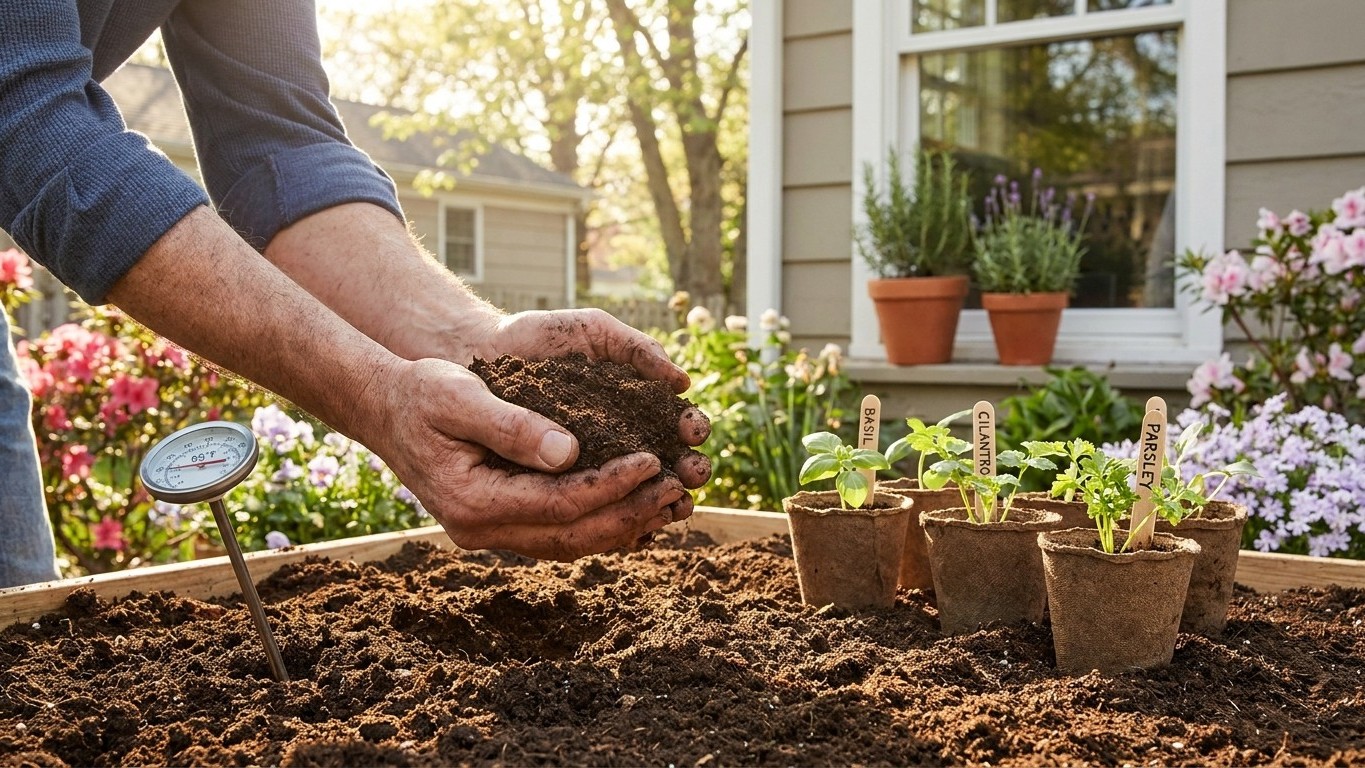

The direct answer: garden soil across Iowa isn’t reliably warm for herb seeding or transplanting until sometime between mid and late April, and the safe window to keep tender herbs outdoors runs into October. But that single window hides the real decision for this territory: winter, not spring, is what decides whether an herb becomes a permanent resident of the garden bed or a pot that has to come inside every year.
When the soil is warm enough in Iowa

NOAA’s 1991-2020 Climate Normals put the last spring frost at a central Iowa station (identifier USW00014933) somewhere between April 12 and April 24, based on the 30-70% probability band for a 32°F freeze. That’s not a single date on a calendar. It’s a probability range, and it means that even at the late end, April 24, there’s still meaningful odds of frost after that day in a given year. Iowa State University Extension’s own county-level records, built from 1950-2021 data, tend to run about four days later in spring than this airport figure, so treat the NOAA range as the optimistic end of what your particular county might see.
Frost is only a proxy for the number that actually matters to herbs, which is soil temperature. The air can clear the freezing mark days before the ground six inches down catches up, especially after a wet, cool spring. Seeds sown into cold, damp soil don’t die from frost. They rot, or they sit dormant and get outcompeted by weeds that don’t care how cold the dirt is. So the practical move isn’t to circle April 12 or April 24 and plant that day. It’s to wait until the soil itself, not the forecast, has caught up.
Different herb types respond to that soil-warming curve on very different schedules. Cool-tolerant types such as chives, parsley, and cilantro will germinate in soil that’s still on the cool side and can go in near the earlier end of that frost window, sometimes a little before it, since a light frost rarely bothers them once established. Warm-season herbs, the Mediterranean group that includes basil in particular, want soil that has held steadily warm for at least a week or two and will sulk, yellow, or simply stall if set out too early, frost or no frost. That’s a species-level difference worth planning around rather than a single planting day for the whole herb bed.
None of this changes for a species with a well-known medicinal reputation. Several common culinary herbs are also sold or discussed for traditional health uses; this page doesn’t evaluate any of those claims and isn’t the place to look for them. The scheduling advice above applies the same way regardless of what a plant is famous for beyond the kitchen.
How long the season lasts here
Putting both NOAA figures together, spring frost ending between April 12 and April 24 and fall frost beginning between October 14 and October 25, gives a frost-free window of roughly 173 to 196 days, depending on where in that probability band a given year and location falls. That’s a six-month season at the generous end, closer to five and a half months at the tighter end. Because both dates come from the same NOAA source and station, this subtraction is solid; where only one end of a date range is documented, it’s not worth guessing at the other.
A window that size is workable for more than one round of the fastest annual herbs. Cilantro in particular tends to bolt to seed quickly once heat arrives, which makes it a natural candidate for sowing again in mid to late summer for a fall crop, rather than treating a single spring planting as the only shot at it. Dill behaves similarly. With close to 190 days of frost-free growing at the better end of the range, there’s genuine room to stagger sowings of these quick, self-seeding types instead of planting once and hoping the first batch lasts.
At the shorter end of the range, closer to 173 days, and remembering that Iowa State Extension’s county figures typically trim that further (about four days later in spring, ten days earlier in fall, roughly two weeks off the total), the math changes. A short window makes the first sowing the one that counts, especially for slower herbs like parsley or the woodier Mediterranean types that take longer to size up before they’re useful in the kitchen. It also shifts the transplanting decision: starting those slower herbs indoors and moving them out as young plants, with a careful root check to avoid transplant shock, buys back weeks that direct-seeding in the garden would spend on early growth. For a full walkthrough of staggering plantings to make the most of whatever window your county actually has, the site’s succession sowing guide covers the mechanics of timing a second or third round.
Heat and water in Iowa

For most vegetable crops, the summer heat count and rainfall total would be the headline here. For herbs in this particular territory, they’re not the number that reorganizes the garden. The figure that does that work is the coldest month’s average daily minimum, which NOAA’s 1991-2020 Climate Normals put at 13.8°F for the Des Moines reference station. That’s not the record low for the coldest night of the decade. It’s the average low across the whole coldest month, and it’s the figure that determines whether a woody perennial herb actually survives an ordinary winter here, not just an unusually mild one.
The USDA Plant Hardiness Zone Map, built on a single variable, the average annual extreme minimum temperature, places the state across a range of zone 4b to 6a. That’s a wide spread for one state, and it means a herb that overwinters fine in a warmer pocket near the Mississippi River can die outright in a colder county further north or west. Any planting decision keyed to a hardiness zone needs a reference city attached to it, because “Iowa is zone 5” isn’t a claim this territory actually supports; different parts of it aren’t.
What that combination, a mid-teens average winter low and a zone range that tops out at 6a in the mildest pockets, means in practice is that most of the herbs marketed as perennials in seed catalogs and garden centers are perennials somewhere, but not reliably here. Rosemary and bay, both often sold as landscape perennials in warmer states, are not hardy through an Iowa winter in the ground for the overwhelming majority of the state. They function here as container plants that spend the growing season outside and the winter indoors near a bright window, or as annuals replaced each spring. A smaller group, hardy sages, oregano, thyme, and mint among them, can persist in the ground through an Iowa winter, particularly in the milder end of the zone range, though even those benefit from a layer of mulch once the ground starts to freeze.
Summer conditions here aren’t part of the documented figures for this page, but the winter answer already does most of the organizing work: it’s less about which herbs tolerate an Iowa August and more about which ones survive an Iowa January without help.
Which herbs suit Iowa
Sorted by type rather than brand name, the picture that falls out of the season length and the winter numbers above is fairly clean. Fast annual herbs, cilantro, dill, and basil among them, fit comfortably inside even the shorter end of the 173-to-196-day window and are worth treating as true annuals, replanted each year regardless of hardiness zone, since none of them are cold-hardy candidates anyway. Slower annual and biennial herbs, parsley being the clearest example, benefit from the transplanting approach described above rather than direct seeding, simply because the shorter end of Iowa’s frost-free window doesn’t leave much margin for a slow starter.
Among the herbs capable of surviving winter in the ground here, the ones worth prioritizing are the types documented as hardy into the mid-4 and 5 zones rather than only into zone 7 or warmer, since the 13.8°F average winter low rules out anything on the tender end of the perennial spectrum. Given the humidity that tends to build across an Iowa growing season, airflow and spacing matter more than they do in a drier climate; crowded, low-airflow plantings of any perennial herb are where mildew and other foliar disease tend to show up first, and thinning or wider spacing does more to prevent that than any product applied after the fact.
This page isn’t going to name a specific variety, and that’s a deliberate choice rather than an omission. Variety trials, the kind that actually test which strain of a given herb species holds up to a specific county’s soil, disease pressure, and microclimate, are run locally by land-grant university extension programs, not by general gardening content. Iowa State University Extension maintains that kind of locally tested guidance, and it’s the only source positioned to say which specific cultivar of thyme, oregano, or basil has actually performed well in your county’s conditions over multiple seasons. Recommending a name here, without that trial data behind it, would be a guess dressed up as advice.
The species-level and type-level answer, though, holds regardless of which named variety a reader eventually picks: plan the fast annuals around the frost dates, plan the slow ones around a head start indoors, and decide the perennial bed around the winter low, not the summer heat.