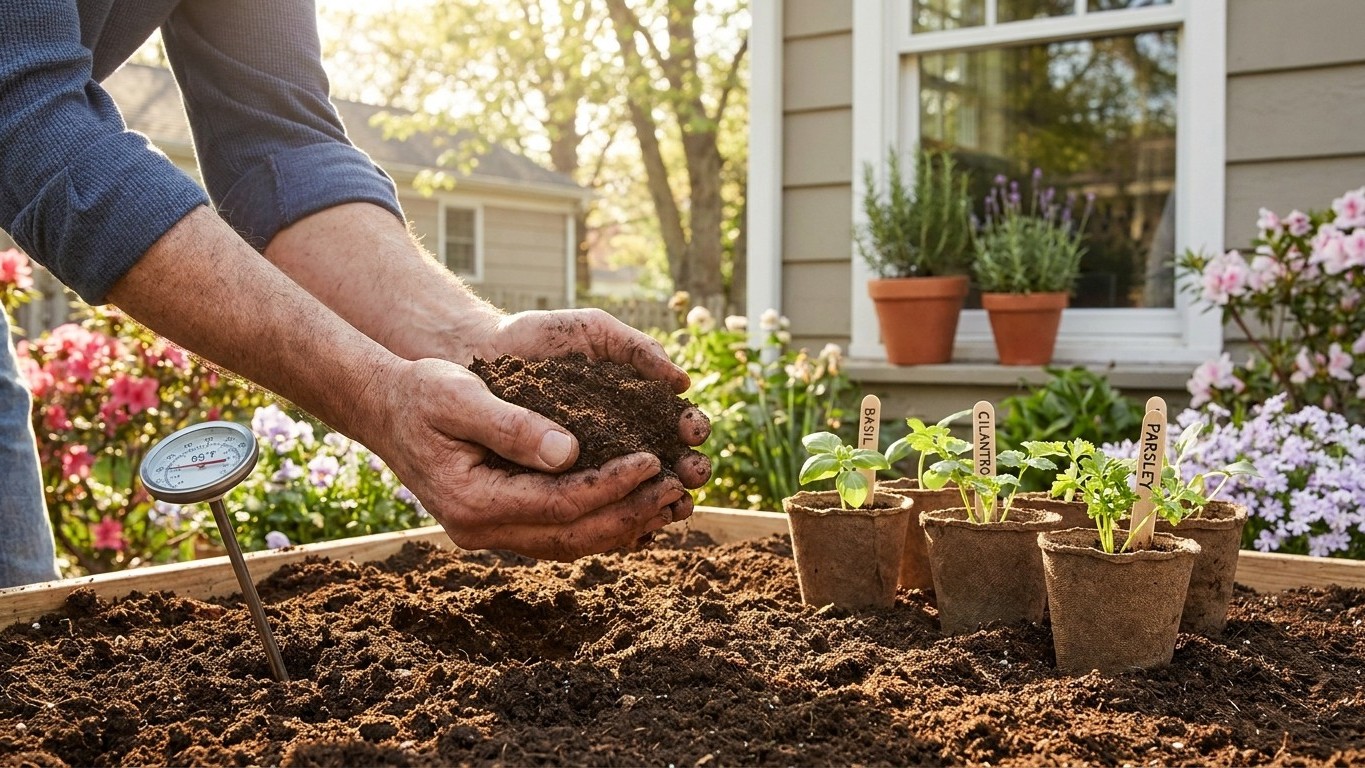

Manitoba growers can raise a full range of culinary herbs, but the province’s short frost-free window and its cold, dry winters mean most herbs behave as one-season plants here, not permanent residents of the garden bed. A handful of hardy perennials survive outdoors; the rest need fresh seed each spring or a pot that comes indoors before the season turns.
When the soil is warm enough in Manitoba

The average last spring frost at Winnipeg Richardson Int’l A, the reference station for the province in the Environment and Climate Change Canada normals (1981-2010), falls on May 23. That date gets treated as a planting deadline by a lot of gardeners, but it isn’t one. It’s a mean: in one year out of two, frost arrives later than May 23, sometimes well into the first week of June. Treat it as the midpoint of a window of risk, not as a green light.
Frost is a stand-in for soil temperature
The frost date matters less for herbs than what it signals about the ground itself. Air can clear the frost risk while the soil a few inches down is still cold enough to stall germination or rot a transplant’s roots. Cool-season herbs, the leafy types that tolerate a chilly start, can go into ground that’s still cool. Warm-season herbs, the ones native to Mediterranean or tropical climates, want soil that has had real time to warm, which in this province usually means waiting past the average frost date rather than rushing to meet it.
That gap between frost clearing and soil warming is wider in a continental climate like Manitoba’s than in a coastal one, because the same sun that clears frost fast also cools the ground fast overnight. A gardener working from the Winnipeg date alone, without checking the soil itself, is working from an average for one airport, not a promise for one backyard. Northern districts and any upland or low-lying pocket prone to cold air pooling will run behind this station by days or weeks, and no single provincial date accounts for that.
None of this changes with variety selection, so there’s no point chasing a specific cultivar to beat the calendar. What changes the outcome is patience with the soil itself, and a willingness to start tender herbs indoors under lights rather than direct-sow them into ground that hasn’t caught up with the air. Herbs with a reputation for medicinal use, and several common kitchen herbs carry one, are treated here purely as culinary and garden plants; this page has nothing to say about whether that reputation holds up.
How long the season lasts here
Subtract the average last spring frost, May 23, from the average first fall frost, September 22, both from the same Winnipeg Richardson Int’l A normals, and the frost-free window runs roughly 122 days. That’s the number that actually organizes a Manitoba herb garden, more than any single planting date does.
What a 122-day window means for planting
A season just shy of four months is workable for almost every annual culinary herb, but it leaves little slack for mistakes. A slow germinator sown too late may not produce a usable harvest before the first fall frost risk begins climbing again in September. That pushes the balance toward starting tender herbs indoors, six to eight weeks ahead of the expected outdoor planting window, rather than direct-sowing everything once the soil finally warms.
It also changes whether transplanting from a nursery pot or seed tray is worth the trouble. In a longer season, a gardener can afford to direct-sow and simply accept a slower start. Here, with roughly four months to work with, checking a transplant’s roots before it goes in the ground, making sure they aren’t circling or bound, buys back time that a short season doesn’t otherwise offer.
Succession sowing or a single planting?
Whether a second sowing is worth attempting depends on the herb and on how much of the 122 days a first sowing actually used. Quick, cut-and-come-again leafy herbs can sometimes support a second round in the same season; slower, bushier types generally get one shot. For the mechanics of staggering plantings and deciding which herbs tolerate a second sowing in a short-season territory, the site’s succession sowing guide covers the method in more detail than fits here.
Heat and water in Manitoba

For a lot of herb-growing Territories, the defining summer numbers are a count of days over 90°F and a rainfall total, and growers plan around drought stress or bolting. Manitoba’s herb story runs the other way. The number that actually decides the shape of a Manitoba herb garden is a winter figure: a mean daily minimum of -6.6°F in the coldest month, and a Canadian plant hardiness rating of zone 3b at the reference city used for these figures.
Winter, not summer, sets the limits
That cold, expressed as zone 3b in the Canadian system, does not translate to a USDA zone; Natural Resources Canada is explicit that the two systems aren’t built the same way, since the Canadian rating draws on seven climate variables against the USDA’s one. Don’t try to match this number to a US hardiness map. What it does tell a Manitoba gardener, plainly, is which herbs can live outdoors year-round and which can’t. Woody Mediterranean herbs have no realistic chance of surviving a winter with minimums near -7°F without protection; they either come indoors as potted plants before the first fall frost risk sets in, or they get replanted from scratch every spring. A smaller group of genuinely hardy perennial herbs can take that cold in the ground, particularly with a snow cover or mulch layer over the crown.
On the summer side, Manitoba’s warm season is real but short, and the bigger practical issue for herbs tends to be humidity after a warm rain rather than sustained heat stress. Basil in particular is prone to fungal trouble in a summer that alternates warm days with damp, still air. Spacing plants for airflow and watering at the soil line rather than overhead does more for a Manitoba herb bed than any drought-proofing strategy borrowed from a hotter, drier territory.
Which herbs suit Manitoba
Sorted by type rather than by name, three categories cover most of what a Manitoba herb garden actually grows, and each one lines up with a different piece of the climate picture above.
| Herb type | Manitoba strategy | Reason |
|---|---|---|
| Fast annual leafy herbs (basil, dill, cilantro, parsley types) | Sow or transplant after soil has warmed past the average frost date; watch spacing for airflow | 122-day window is enough, but humidity favors disease over drought |
| Woody tender perennials (rosemary, bay-type herbs) | Grow in containers, bring indoors before first fall frost | Zone 3b winters and a -6.6°F coldest-month minimum rule out outdoor survival |
| Hardy perennial herbs (chives, mint, some thyme and oregano types) | Leave in the ground with mulch or snow cover | Can tolerate zone 3b conditions where the tender types cannot |
A short season points toward the earliest-maturing types within each of these groups, since there’s little room to recover from a slow start. A humid summer makes disease tolerance the first thing worth asking about, ahead of flavor or habit. What this page won’t do is name a specific variety within any of these types. Manitoba Agriculture runs its own variety trials suited to the province’s actual growing conditions, and that local trial data, available through the Manitoba government’s agriculture services, is the only variety recommendation grounded in this territory rather than borrowed from somewhere else. A page built on national frost normals and hardiness maps has no business pretending to know which specific basil or thyme selection performs best on a given plot outside Brandon or Dauphin, and saying so plainly is a more useful answer than guessing.