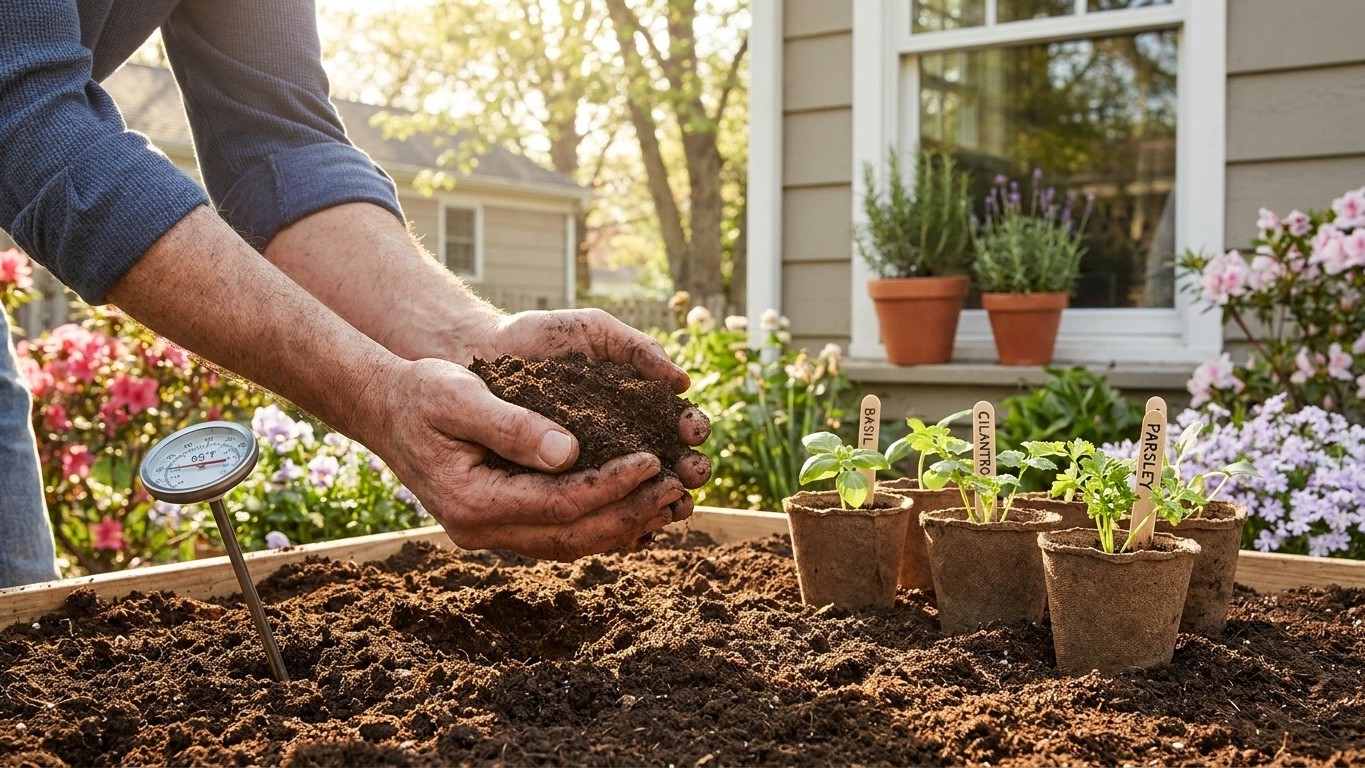

Herbs get moving in Oklahoma once the soil holds steady warmth, typically by mid-spring, then push through a long hot season that favors species built for drought and airflow. The state’s real dividing line isn’t summer heat, though. It’s winter. Whether an herb comes back every year here or needs a pot and a windowsill in January depends on how far the mercury drops in the coldest weeks, not how hot it gets in July.
When the soil is warm enough in Oklahoma
NOAA’s 1991-2020 Climate Normals put the last spring frost for the Oklahoma City-area reporting station somewhere between March 28 and April 10, based on the 30-to-70 percent freeze probability band. That’s a wide window on purpose. It comes from thirty years of real weather rather than a single tidy date, and it means some springs the frost threat clears by late March while others still carry a risk into the second week of April.
None of that answers the question that actually matters for planting, though: when has the soil itself warmed up enough for herb roots to take hold. Air temperature staying above freezing tells you frost damage is unlikely. It says nothing about the ground, which typically lags two to three weeks behind air temperature in the heavier clay soils common across much of the state. A frost date is a probability about the air, not a promise about the dirt, and that distinction is worth stating once rather than treating the calendar date as a starting gun.
That lag is why direct-seeding tender annual herbs, the basils and dills and cilantros of the world, right at the last-frost date so often disappoints. Seeds sit in soil that’s still cold and damp, and they rot before they ever germinate, even during a week with zero frost risk on the forecast. Waiting another week or two after the frost date, until the top few inches of soil feel warm to the touch rather than merely frost-free, gets better results than racing the calendar.
Hardy perennial types, rosemary, thyme, sage, oregano, tolerate cooler soil better and can go in as transplants a bit earlier, since they’re already established plants rather than seeds waiting to sprout. Starting these from nursery starts or from cuttings rooted indoors sidesteps the cold-soil problem almost entirely.
One more note on the frost dates themselves: they come from an airport weather station, and suburban and rural gardens away from that station typically see the last spring frost land later and the first fall frost arrive earlier, sometimes by one to two weeks, more at higher elevation. Treat the March 28 to April 10 window as a reference point for the metro area, not a guarantee for every county, and check local conditions before committing tender seedlings to the ground.
How long the season lasts here
Pair that spring frost window with the first fall frost, which NOAA’s same Climate Normals data set puts between October 29 and November 8 for the same reporting station. Subtracting the two gives a frost-free growing season running roughly 212 to 215 days, depending on which end of each range a given year lands on. That’s close to seven months, and it’s a genuinely long season by national standards, longer than most of the country gets.
What a window that long actually allows is a second sowing of quick-cycling annual herbs. Cilantro is the clearest example: it bolts and goes to seed fast once temperatures climb, so a spring planting followed by a second sowing in late summer for a fall crop makes better use of the season than trying to stretch one planting across seven months. Dill behaves similarly. Basil, by contrast, tends to reward one solid planting that runs from late spring through the first fall frost, since it keeps producing steadily through the hot months rather than bolting early.
A season this long also changes how much a root check matters at transplant time. Herbs bought as nursery starts sometimes arrive root-bound, circling the bottom of their pot, and in a short season that tangle can slow a plant down for weeks it doesn’t have to spare. With roughly seven frost-free months on the calendar here, a plant that takes two or three extra weeks to recover from a gentle root tease at planting still has plenty of season left to catch up. That’s one less thing to worry about compared to gardeners working with a much shorter window.
Anyone planning to stagger plantings through a season this long benefits from a real succession sowing schedule rather than guesswork, and the succession sowing guide on this site walks through timing intervals crop by crop.
Heat and water in Oklahoma
Exact day counts for readings at or above 90°F aren’t part of the verified data used for this page, but anyone who has spent a summer in Oklahoma knows the stretch of hot weather runs long, often for weeks without much of a break, and it arrives on top of soil that dries out fast once the rain slows down. That combination pushes herb gardeners toward morning watering and mulch more than toward worrying about the heat itself, since most kitchen herbs, being native to Mediterranean hillsides, actually tolerate heat and dry spells better than they tolerate constant dampness at the root.
The number that actually reorganizes an Oklahoma herb bed isn’t a summer figure at all. It’s winter. The USDA Plant Hardiness Zone Map, built entirely on average annual extreme minimum temperature, places Oklahoma across a 6a-8a range, and the coldest month here averages a daily minimum of 27.0°F at the Oklahoma City reference station. That single figure, the average low during the coldest stretch rather than any record cold snap, decides which herbs survive a normal Oklahoma winter outdoors and which don’t.
Rosemary is the plant this shows up on most clearly. It’s borderline hardy through much of zone 6a and 7a, and a mean coldest-month minimum in the high 20s puts a lot of Oklahoma gardens right at the edge of what an established, well-sited rosemary plant can shrug off. Gardeners in the warmer 8a pockets of the state, generally toward the south, have better odds of rosemary surviving outdoors year after year than gardeners in the cooler 6a areas, where the same plant is safer treated as a container specimen brought indoors or into an unheated garage once the coldest month sets in.
That’s the practical split this figure creates: a handful of woody perennial herbs, rosemary chief among them, live as permanent garden residents in the milder parts of the state and as movable pots everywhere colder. Thyme, sage, and oregano tend to handle the same winter minimums with less drama, since they’re generally hardier through this whole zone range, which is part of why they show up as reliable perennials across most of Oklahoma while rosemary remains the plant people fuss over each fall.
Which herbs suit Oklahoma
Given a season this long and a winter this variable across the state, the herbs worth building a bed around fall into a few practical types rather than specific varieties. Fast-cycling annuals like cilantro and dill suit the succession-planting approach the season length allows. Heat-tolerant annuals like basil reward one long planting that runs the summer through. Woody Mediterranean perennials, thyme, oregano, sage, and rosemary where winters allow, form the backbone that comes back year after year without replanting, provided they get the sharp drainage and airflow their native hillside origins call for.
Humidity is the other filter worth applying, since Oklahoma summers pair heat with enough moisture at times to favor fungal problems on herbs planted too closely together. Disease resistance and simple airflow, plants spaced further apart than a seed packet might suggest, matter more here than they would in a drier climate, and that’s a reasonable first criterion when comparing types at a nursery.
What this page won’t do is name a specific variety. That’s a deliberate choice, not an oversight. Variety trial data, the kind that says which particular basil or which particular thyme selection actually performed well in Oklahoma soil and Oklahoma summers over multiple seasons, comes from local trials, not from a general climate page like this one. Oklahoma State University’s Extension service runs those trials and publishes county-level recommendations that reflect actual local performance, which is a different and more useful kind of authority than anything a territory-wide article can offer. Checking with the local county extension office before settling on specific varieties is the step that actually pays off, and it’s worth treating as part of the planning process rather than an afterthought.