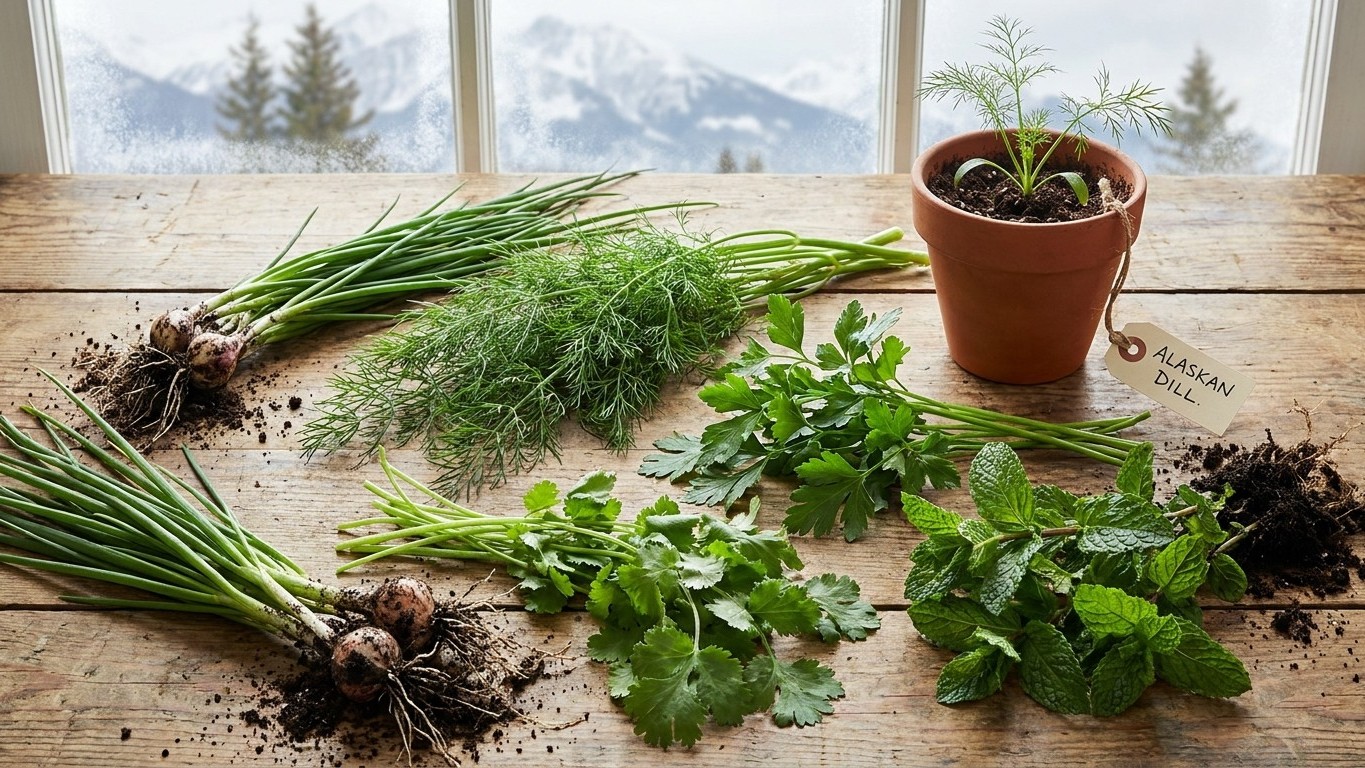

Basil, Thai basil, lemongrass, oregano, rosemary, and mint grow year-round in Hawaii’s frost-free lowlands, often producing continuously for years rather than one season. Cilantro, dill, and French tarragon struggle almost everywhere below 2,000 feet because the heat and humidity push them to bolt or rot before they mature.
The short answer for Hawaii
Start with the number that changes everything here: the coldest month in Honolulu still averages a minimum of 66.8°F. That’s not a chilly night, that’s the average low for the entire month. No inhabited part of the state sees a freeze in a normal year, according to NOAA’s 1991-2020 climate normals for station USW00022521, where every freeze percentile comes back “not computable” because there’s simply no data to compute. There is no last frost date and no first frost date to build a calendar around, because there is no frost season where people garden.
That single fact reorganizes the whole question of which herbs to plant. Instead of asking “when do I sow,” the useful question in Hawaii is “which herbs tolerate constant heat and which ones need a winter they’ll never get.” Woody Mediterranean herbs and tropical natives answer that question well. Rosemary, oregano, Thai basil, lemongrass, ginger, and turmeric come from climates that either match Hawaii’s warmth or tolerate it without needing a cold dormant period to reset. Basil in particular treats the islands like home turf: without a frost to kill it back, a healthy plant can keep producing leaves for two or three years, something gardeners in the continental 48 rarely get to see.
The herbs that struggle are the ones evolved for a temperate spring-to-fall cycle with a real winter chill in between. Cilantro, dill, chervil, and French tarragon all want cool nights and a dormant season to set seed properly or maintain flavor. In Hawaii’s lowlands, cilantro often bolts to seed within a few weeks of germinating because the plant reads constant 70-degree-plus nights as a signal to reproduce immediately rather than build leaf mass. That’s not a growing mistake. That’s the plant doing exactly what it evolved to do, just on a schedule that doesn’t suit a kitchen garden.
The practical decision, then, sorts herbs into two piles: heat-tolerant perennials that will reward patience with years of harvest, and short-lived annuals from cooler climates that need to be treated as a fast, one-shot crop, planted in the coolest stretch of the year and harvested young before they bolt.
What will not work here

Lavender is the herb most gardeners try and lose in Hawaii, and the reason is humidity, not heat. Lavender comes from dry Mediterranean hillsides where the air itself pulls moisture off the leaves. Hawaii’s windward coasts and valley bottoms rarely offer that, and the combination of warm nights and damp air around the crown of the plant invites root and stem fungus faster than most gardeners can react. It’s not that lavender can’t survive 66.8°F winters, it’s that it can’t survive wet feet in July.
French tarragon has a different problem: it needs an actual winter chill to break dormancy and produce its best flavor compounds. Without one, plants often grow leggy and flavorless, then decline within a year or two. Most gardeners who want a tarragon flavor in Hawaii substitute Mexican tarragon (an entirely different plant, more heat-tolerant and unrelated botanically) rather than fight the real thing.
Weekly watering, the default advice on most seed packets, is often too much rather than too little in Hawaii’s wetter regions. On windward coasts and in upland rainforest zones, ambient rainfall alone can exceed what many Mediterranean herbs want, and adding a weekly hose session on top of that turns raised beds into standing swamps. Rosemary, sage, and thyme, all bred for lean, fast-draining soil, rot at the roots long before they show any sign of drought stress. The fix isn’t a different watering schedule so much as raised mounds, gritty soil amendments, and skipping supplemental water entirely during rainy stretches.
Close spacing, another common seed-packet default, causes trouble for a related reason. In humid air that doesn’t move much between plants, tight spacing keeps leaves wet longer after rain or morning dew, and that’s exactly the condition powdery mildew and leaf spot need to spread. Herbs planted with the on-package spacing in Ohio or Pennsylvania often need noticeably more air room in Hilo or Hana to stay disease-free.
Short-season thinking doesn’t apply here at all, since there’s no short season to plan around, but heat-and-humidity thinking replaces it as the filter every herb choice has to pass through.
What changes across Hawaii
Hawaii’s official hardiness range, 9a through 13a on the USDA Plant Hardiness Zone Map, is one of the widest spreads of any state in the country, and it’s built entirely on one number: the average annual extreme minimum temperature. A zone 13a reading, found in warm coastal pockets, describes conditions that essentially never occur anywhere else in the continental United States. A zone 9a reading, found at higher elevations on the Big Island or upcountry Maui, is cool enough that some Mediterranean herbs that sulk at sea level actually do better there.
The bigger day-to-day variable isn’t temperature, though. It’s rainfall, driven by whether a garden sits on the windward or leeward side of an island. Windward coasts (the east-facing sides that catch the trade winds) can receive several times the annual rainfall of leeward coasts just a few miles away over a mountain ridge. A herb garden in wet, windward Hilo faces constant fungal pressure and needs excellent drainage and wider plant spacing. The same herb garden in dry, leeward Kona might need supplemental irrigation that a Hilo gardener would never touch a hose for.
Elevation adds a third layer on top of both. Upcountry areas on Maui, at higher elevations on the Big Island, and parts of Kauai’s interior run noticeably cooler than the coastal norms, sometimes by ten degrees or more on any given day. That’s often enough to let lavender, French tarragon, and other cool-loving herbs perform closer to how they would on the mainland, in gardens just a short drive from coastal spots where those same herbs would rot in a season.
There is no single answer for “Hawaii” as a whole, because the state spans that 9a-13a range across small distances. Anyone gardening here should check the USDA hardiness zone map for their specific location rather than assume a number from this article, since the zone at a coastal address and the zone a few miles inland or upslope can differ enough to change which herbs are realistic at all.
Where to check this for your own county
The University of Hawaii’s College of Tropical Agriculture and Human Resources runs the state’s official cooperative extension service, and it’s the right next stop for anyone trying to move from “what generally works in Hawaii” to “what works at my address.” The service is reachable at ctahr.hawaii.edu/site/extension.aspx.
Two things are worth hunting for on that site specifically. First, any local planting calendar or crop guide published for the island or district closest to the reader, since CTAHR’s research stations are spread across several islands and often publish guidance tuned to local rainfall and elevation patterns rather than one blanket set of dates for the whole state. Second, variety trial results for herbs, which matter more in Hawaii than in most states because so much of the useful commercial herb research here has been done specifically to handle tropical humidity and pest pressure that mainland trials never test for.
A county-level (or in Hawaii’s case, island-level, since the counties are Honolulu, Hawaii, Maui, and Kauai) recommendation will always beat a state-wide one, for the simple reason that this article is written at the state level and has to describe a range, while a county extension office can describe one specific place. That’s not a knock on either source, it’s just what each one is built to do. Windward and leeward gardens behave differently, but only a local office, or a local test bed, can say exactly how much water a specific hillside needs in a specific month.
Anyone gardening near an active CTAHR research or extension station in particular should ask what herbs have actually been trialed nearby, since that answer is often more reliable than any general guidance, including this one.
Checking this against your own garden
None of the numbers above beat what a gardener can see and feel in their own bed, especially in a state where rainfall and elevation override the broader climate data so completely. Three simple checks tell most of the story.
Soil warmth by hand is the first. Pushing a finger a couple of inches into the bed on a cool upcountry morning versus a coastal afternoon will show a real difference in Hawaii, sometimes a bigger one than the air temperature suggests, because damp, shaded soil on a windward slope holds cold and moisture longer than a sunny, well-drained coastal bed. Warm, slightly dry soil at planting depth favors basil, oregano, and lemongrass. Cool, damp soil favors nothing that isn’t already adapted to it, and it’s a signal to raise the bed or add drainage before adding a cool-climate herb like tarragon.
The first flush of flowers on an herb like basil is the second check, and in Hawaii it often shows up faster than gardeners expect. Early flowering usually means heat or day-length stress pushing the plant toward seed production ahead of schedule, and it’s a cue to pinch flowers back hard and harvest leaves more aggressively rather than wait for a bigger plant that may never come.
The first true leaves on any herb started from seed are the third. If they’re slow, pale, or oddly spaced compared to what the seed packet promises, that’s the plant reporting on light, drainage, or humidity conditions specific to that exact spot, and it’s worth trusting over any generic timeline, including the ranges described here.