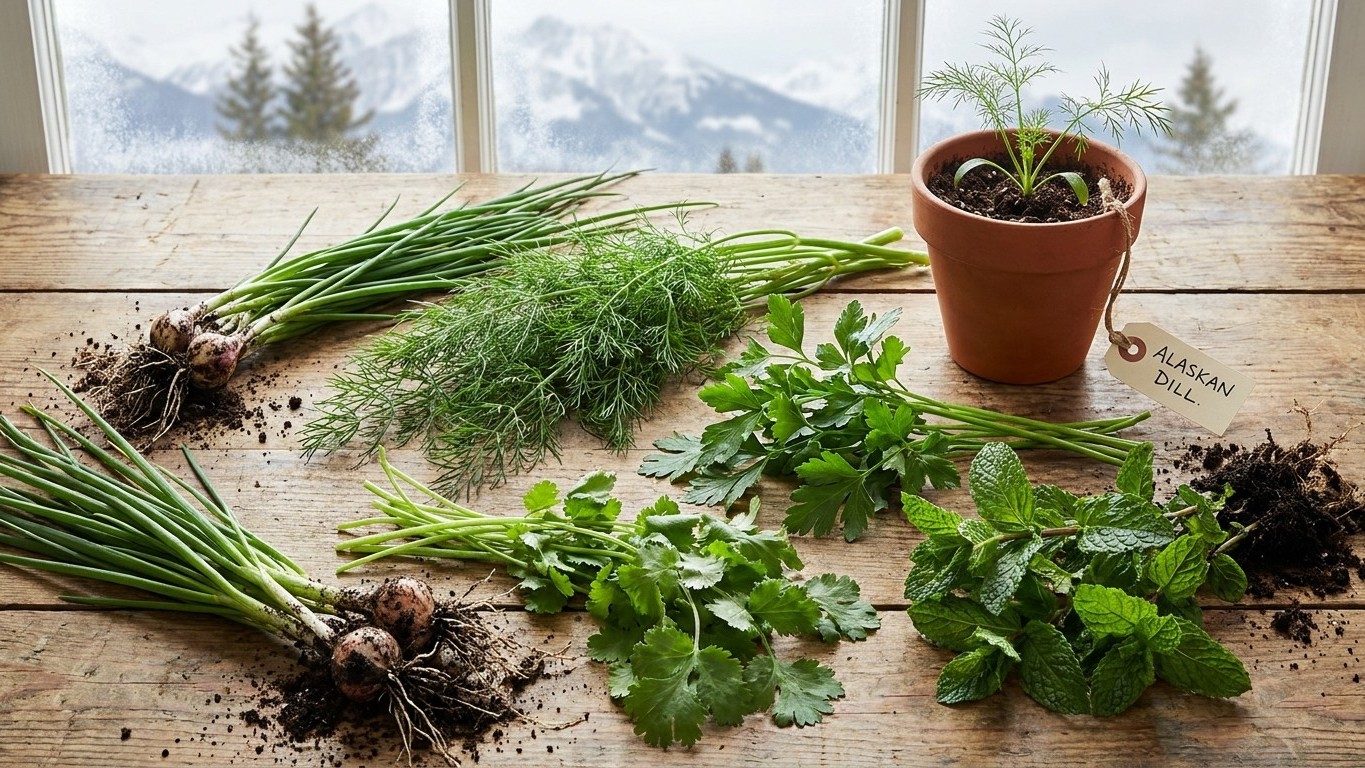

Perennial Mediterranean herbs, rosemary, thyme, sage, oregano, are the safest bet across most of Washington, since they tolerate the wet winters west of the Cascades and the dry summers east of them. Basil and other heat lovers struggle almost everywhere in the state unless grown against a warm wall or under cover.
The short answer for Washington
Washington doesn’t have one growing season, it has two climates wearing the same state line. West of the Cascades, the reference station used for this page (Seattle, USW00024233) shows a last spring freeze landing somewhere between February 27 and March 18, and a first fall freeze arriving between November 13 and November 30. That’s a long frost-free window on paper, easily eight months. But length isn’t the whole story here, because the coldest month still averages a nightly minimum of 37.1°F, which is mild enough to keep woody Mediterranean herbs alive through winter without much fuss.
That combination, mild winters plus a long but cool and often overcast frost-free window, points the decision toward herb TYPE rather than variety. Woody perennials that evolved on dry Mediterranean hillsides (rosemary, thyme, sage, oregano, winter savory) read the coastal Washington winter as tolerable and the summer as merely adequate. They don’t need blazing heat to produce oil in their leaves, just decent drainage and enough light. Chives, parsley, cilantro, and mint (a genus that will colonize anything damp) also perform reliably here, since they’re built for cooler, moister soil.
Where the western Washington climate pushes back is on heat-loving annuals. Basil, in particular, wants nighttime temperatures that stay comfortably above 50°F and daytime heat that builds steadily, conditions the Puget Sound lowlands rarely deliver for more than a few weeks at a stretch. Growers who insist on basil here usually start it indoors, harden it off late, and give it the warmest, most reflective spot in the yard, up against a south-facing wall or in a container that can be moved.
East of the Cascades the calculus flips. That side of the state is high desert: short, intense summers with real heat, and winters cold enough that the same woody Mediterranean herbs that thrive on the coast can struggle to survive without protection. This page’s frost-date numbers come from the western reference station and do not apply there. A gardener in the Columbia Basin or the Okanogan should treat basil, dill, and cilantro as the reliable summer performers, and treat rosemary as a herb that may need to come indoors or get heavy mulch for winter.
What will not work here
Basil sown too early is the most common failure west of the Cascades, and it isn’t really about frost. The last-freeze window here runs into mid-March at the latest, but soil in a maritime lowland stays cold and wet for weeks after that date passes, and basil seed simply rots or sits dormant in soil below roughly 60°F. Gardeners who plant on the calendar date instead of the soil condition often lose the whole first sowing and don’t realize why.
Cilantro planted for a full summer harvest is another near-guaranteed disappointment on the west side, though for the opposite reason people expect. It’s not that cilantro can’t survive the cool coastal summer, it’s that cilantro bolts to seed the moment daytime temperatures spend a few days above the mid-70s, and the plant’s flavor turns bitter and soapy right as it does. The fix isn’t a variety, it’s timing: sow it in short, repeated batches spring through fall rather than expecting one planting to carry the season.
On the coast and in the Puget Sound trough, close spacing on herbs like oregano and thyme invites the kind of foliage disease that thrives in still, humid air trapped between leaves. The region’s marine layer keeps relative humidity high on many summer mornings even when the afternoon turns dry and sunny, and low, dense herb mats that don’t get air movement can develop powdery mildew or root rot at the crown. Wider spacing than a seed packet suggests, plus raised beds or mounded rows for drainage, solves most of this.
Rosemary and other tender Mediterranean woody herbs face a different threat east of the Cascades: winter cold without the buffering the coast provides. The 37.1°F average coldest-month minimum recorded at the western reference station has no eastern equivalent on this page, but the region’s documented winter extremes run well colder, and unprotected rosemary in the open ground east of the mountains is a common winter casualty. Growing it in a container that can be moved to shelter, or choosing a documented cold-hardy rosemary cultivar, matters far more there than it does around Seattle or Tacoma.
What changes across Washington
The USDA Plant Hardiness Zone Map lists Washington across an unusually wide range, zone 4a to zone 9a, a spread built entirely on one measurement: the average annual extreme minimum temperature at a given location. A nine-zone-point range inside one state means there is no single hardiness answer for Washington, only a spread that a reader has to place themselves within.
Zone 9a sits in the mildest coastal and Puget Sound pockets, where the extreme annual minimum rarely drops much below 20°F and woody Mediterranean herbs can be treated almost as permanent garden residents. Zone 4a, by contrast, describes high-elevation and far-eastern locations where the same extreme minimum can fall to -25°F or colder, a level of cold that kills rosemary, bay laurel, and even some sage varieties outright unless they’re containerized and moved indoors.
Elevation does as much work inside this range as latitude does. A garden in a low-lying coastal valley and one a few thousand feet up a Cascade foothill can differ by two or three full hardiness zones despite being separated by a short drive, because cold air pools and temperature drops with elevation regardless of how far north or south a site sits. Anyone gardening near the mountains, even on the wetter west side, should treat their own site as colder than the regional reputation suggests.
None of this tells an individual reader which zone applies to their own yard, and this page won’t guess. The right move is checking the current USDA Plant Hardiness Zone Map by ZIP code before deciding whether a woody perennial herb needs winter protection, a container, or nothing at all.
Where to check this for your own county
Washington State University’s Extension service is the source built for exactly the gap this page can’t close. A statewide article has to describe two climates and a nine-point hardiness spread in general terms; a county extension office narrows that down to the soil, elevation, and microclimate a reader is actually gardening in.
Two things are worth looking for once there. First, a local planting calendar for the specific county or region, since WSU Extension’s county offices and master gardener programs publish sowing windows tuned to local frost patterns rather than the single western reference station used on this page. A county office in Spokane or Yakima will describe a genuinely different herb-growing season than one in King or Whatcom County, and that difference matters more than anything a statewide page can capture.
Second, look for any list of herb varieties the local extension office has actually trialled in that county’s conditions. Extension offices frequently run demonstration gardens or collect grower feedback on which rosemary cultivar survives the local winter, or which basil variety holds up best against the region’s particular disease pressure. That kind of trial-tested recommendation, built on real local seasons rather than climate normals, outranks anything this state-level page can offer.
The general rule holds regardless of which corner of Washington a reader gardens in: a county recommendation beats a state one, every time, because it accounts for the elevation, soil, and microclimate quirks that a state-wide average necessarily smooths over. This page describes the state. The county office describes the actual yard.
Checking this against your own garden
Every date and average on this page is a regional probability, not a guarantee about one particular patch of ground, and a gardener’s own senses will settle the question faster than any chart. Soil warmth by feel is the first and most reliable check: press a bare hand into the planting bed each morning, and once it no longer feels cold to the touch, roughly the sensation of a cool basement floor giving way to something closer to room temperature, heat-loving herbs like basil have a real shot at germinating instead of rotting.
Watching for the first true leaves on any direct-sown herb tells a second, different story. The initial pair of seed leaves (cotyledons) that pop up first are generic and don’t confirm much, but the first true leaves, the ones that actually look like miniature versions of the mature plant, are the sign that the seedling has enough warmth and light to keep building rather than stall. A long gap between cotyledons and true leaves usually means the soil or air is still too cold for that particular herb, regardless of what the calendar says.
For perennial herbs coming out of winter, new growth at the base of the plant, fresh green shoots pushing up from the crown of a rosemary, thyme, or sage plant, is the clearest sign the plant survived and is ready for pruning or transplanting. If that new growth is slow, sparse, or absent on one side of a shrub, it’s usually pointing at a specific microclimate problem on that plant’s exposure, whether it’s water pooling on one side, prevailing wind, or shade from a nearby fence, and that’s worth reading before assuming the whole variety is a bad fit for the yard.