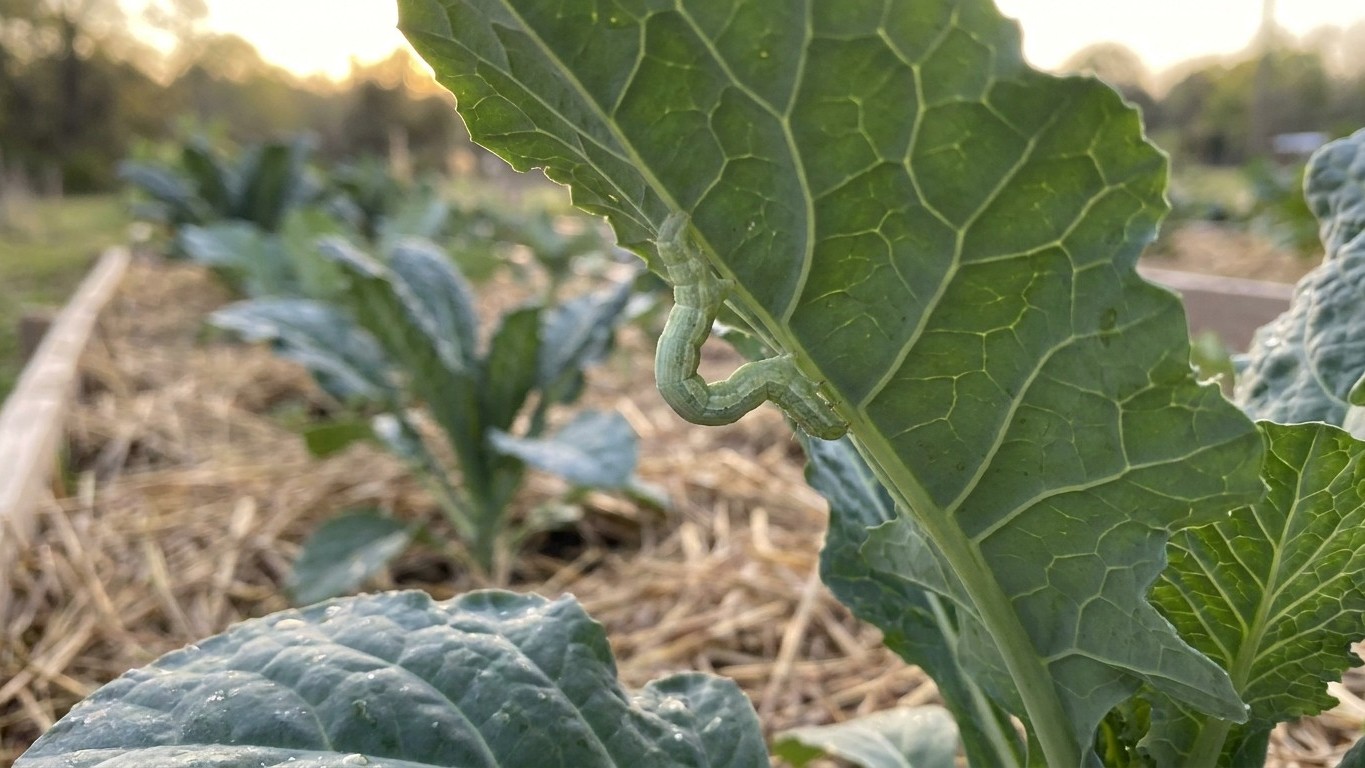

Cabbage loopers turn up in South Carolina gardens as early as March in the Lowcountry and stick around through November, with the heaviest pressure landing in late summer when heat and humidity let several generations overlap at once. The fix that actually works isn’t one product, it’s a layered approach: Bacillus thuringiensis (Bt) sprays timed to young caterpillars, floating row covers on new transplants, and a habit of flipping leaves over to check for eggs before damage gets out of hand.
Cabbage Looper Season in South Carolina Gardens

South Carolina’s mild winters give this pest an advantage that gardeners farther north don’t deal with. Cabbage loopers (Trichoplusia ni) don’t survive hard freezes well, but they often persist through winter in the coastal plain and can also drift up from Georgia and Florida on warm fronts each spring. That means the Upstate usually sees populations arrive a few weeks later than Charleston or Beaufort, since colder nights slow the moths’ spread inland.
Once established, the life cycle moves fast. In summer heat, an egg can become a moth in about four weeks, and with South Carolina’s growing season stretching from March into November, that adds up to four to six generations before frost. Each generation is a little bigger than the last, which is why a garden that looked fine in June can be riddled with holes by September. Late summer and early fall are consistently the worst stretch, right when fall collards, broccoli, and kale are going into the ground.
Spotting the Damage Before It Spreads
The caterpillar itself is pale green with faint white stripes running down its sides, and it moves by arching its back into a loop, a trait that separates it instantly from the velvety, straight-crawling imported cabbageworm most Southern gardeners already know. Look closely and you’ll notice it only has two pairs of prolegs near the rear plus the claspers at the tip, which forces that hunching gait. It’s a small detail, but it’s the fastest way to tell the two pests apart without a magnifying glass.
Adult moths are easy to miss. They’re a dull, mottled brown with a small silvery mark near the middle of each forewing, sometimes described as a spot or a broken figure-eight, and they fly mostly at dusk. Eggs are the real early-warning sign: pale yellow-green, ribbed, dome-shaped, and laid singly on the underside of leaves rather than in clusters. Checking the undersides of a dozen leaves once a week during peak season catches an infestation while it’s still a handful of eggs instead of a defoliated bed.
Feeding damage starts as small, irregular holes between leaf veins and can progress to skeletonized leaves with only the tougher veins left standing. Dark, pellet-shaped frass on the leaf surface or caught in the crown of a cabbage head is another giveaway, especially since the caterpillars themselves are so well camouflaged against green foliage.
Crops at Risk Across the Palmetto State
Cole crops take the brunt of it: cabbage, broccoli, cauliflower, Brussels sprouts, and especially collards, which show up in nearly every Southern backyard garden and fall harvest. Kale and mustard greens are close behind. But cabbage loopers aren’t picky eaters the way some garden pests are. They’ll also work through:
- Lettuce and spinach
- Tomato foliage
- Potato leaves
- Cucumber and squash leaves, though less commonly than cole crops
Collards deserve a special mention here, since they’re planted so widely in South Carolina both spring and fall, and their long harvest window (gardeners often pick leaves for months rather than pulling the whole plant) gives loopers extended access to a food source that keeps regenerating.
What Actually Stops Cabbage Loopers
Bt, specifically the kurstaki strain, remains the most reliable organic option for home gardens. It’s a naturally occurring bacterium that disrupts the caterpillar’s gut once ingested, and it leaves bees, ladybugs, and other beneficials alone because it only affects caterpillars that actually eat sprayed foliage. The catch is that sunlight breaks it down within a week to ten days, so a single application in July won’t carry a plant through the season. Reapplying after heavy rain or every week or two during active feeding periods matters more than the specific brand used.
Row covers are the simplest physical barrier, and they work especially well on cole crops because these plants don’t need pollinator access to form heads. Covering transplants right after planting, before moths have a chance to lay eggs, blocks the problem before it starts. The cover needs to stay sealed at the edges, though, since a single gap is often all a moth needs.
Handpicking sounds old-fashioned, but on a backyard scale it’s genuinely effective, particularly for gardeners who’d rather skip sprays altogether. Checking the undersides of leaves twice a week and crushing eggs or dropping caterpillars into soapy water keeps small infestations from becoming big ones. It’s tedious, sure, but it’s also free and immediate.
Natural predators do a lot of unpaid work in South Carolina gardens already. Parasitic wasps in the Trichogramma and Copidosoma groups target looper eggs and larvae, and populations of these wasps tend to build up over a season if pesticide use is limited to targeted products like Bt rather than broad-spectrum sprays that wipe out everything indiscriminately. Birds and predatory insects such as the spined soldier bug also chip away at populations. Removing broad-spectrum insecticides from the routine, even just for a season, often lets these natural checks catch up.
Crop rotation and weed management round out the strategy. Wild mustard and related weeds act as a reservoir host between plantings, so clearing them from field edges reduces the population waiting to move into a fresh bed of broccoli or kale. Staggering plantings, or timing fall collards to go in slightly earlier before looper numbers peak in late summer, can also mean less pressure by the time heads are forming.
When Sprays Beyond Bt Make Sense
For larger infestations, spinosad is a common step up that’s still approved for organic use and generally easier on beneficial insects than older synthetic options. Pyrethroid insecticides work too, but cabbage loopers have shown resistance to some synthetic pyrethroids in various regions over the years, which is a reminder that rotating modes of action, and not leaning on the same product season after season, keeps any one control method from losing effectiveness. Scouting before spraying anything is worth the five minutes it takes: a rule of thumb many extension programs use is treating once feeding damage covers roughly 10 to 15 percent of leaf area on young transplants, since cole crops can tolerate a fair amount of cosmetic damage on outer leaves without any real yield loss.
One detail that surprises a lot of gardeners: cabbage loopers can travel long distances as adult moths on prevailing winds, which is part of why South Carolina sees populations arrive from the Gulf Coast some years even in gardens that had no looper problem the previous fall. A clean garden in June doesn’t guarantee a clean garden in September, and that’s exactly why the weekly leaf check matters more than any single product on the shelf.