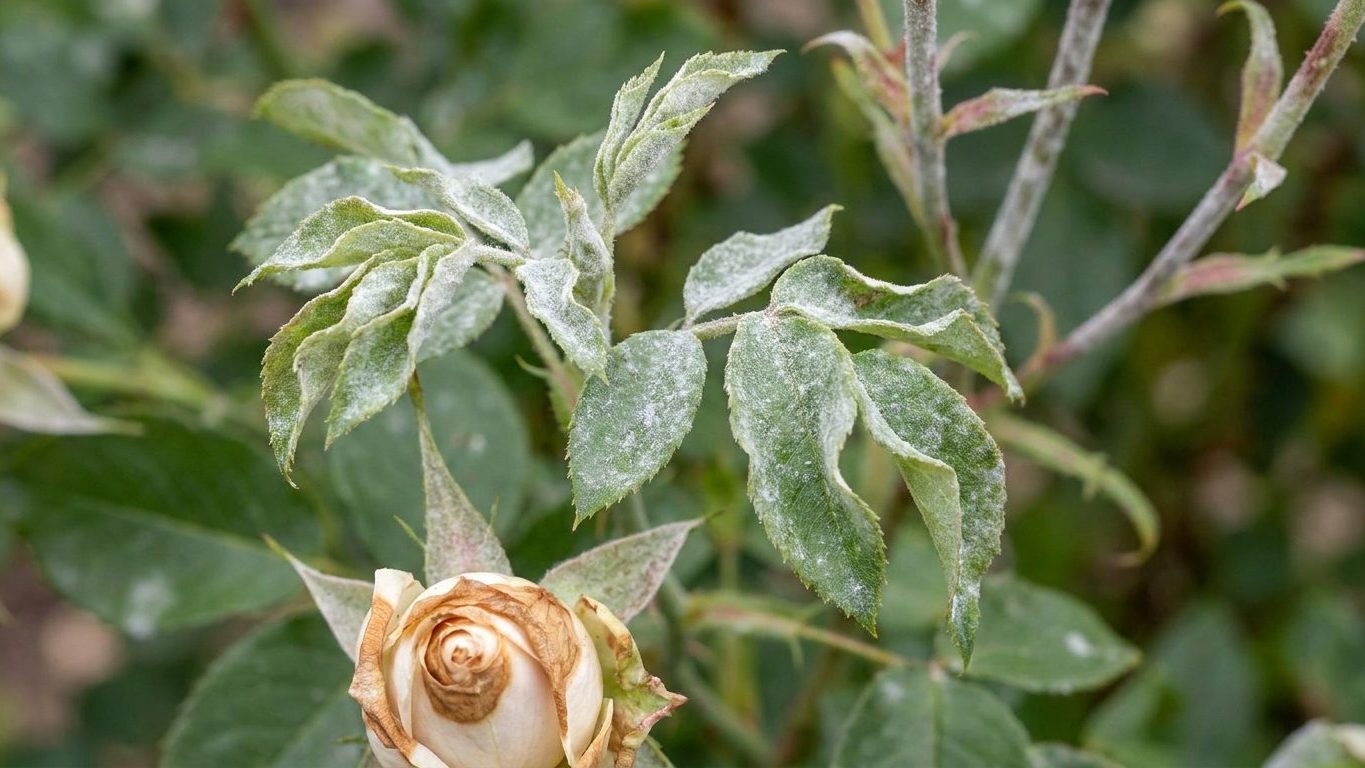

Powdery mildew thrives when the air is warm and humid but the leaf surface stays dry, because its spores actually die when sitting water touches them. Rain and overhead watering wash spores away and stop germination. So the disease shows up hardest during dry spells with humid nights, not during rainy weeks, which is the opposite of almost every other rose fungus.
What you are looking at
This is one of the easier rose diseases to spot early, and it rarely kills a healthy bush outright, though it will stunt growth and ruin bloom quality if left alone. It moves fast on new growth, sometimes coating a shoot tip within a week of the first fuzzy patch appearing.
White powder on young leaves and buds
The first sign is a light, talcum-powder coating on the newest leaves, often on the upper surface but sometimes on both sides. Young leaves curl, twist, or pucker before they even fully open, and the coating can be rubbed off with a finger, unlike the crusty scabs of other rose diseases.
Distorted buds and stems
Flower buds covered early may fail to open at all, or open lopsided with browned, papery edges on the petals. Stems near the tip can develop a dusty gray-white film and a slight reddish or purplish tinge underneath the coating, especially on varieties with naturally red new growth.
Spread down the cane
Left untreated, the white film moves from the growing tip backward down the stem and onto older leaves, which yellow and drop while still carrying patches of mildew. The plant does not wilt and there is no dark lesion with a defined ring, just a spreading gray-white bloom that thickens over several weeks.
What it is not
Three other problems get mistaken for powdery mildew on roses, and the mix-up matters because the fixes are almost opposite each other. Treating the wrong one wastes a season and sometimes makes the real problem worse.
Downy mildew
Downy mildew produces angular, purple-to-black blotches on the upper leaf surface, with a faint grayish fuzz on the underside that you only see in the early morning while humidity is still high. It needs a wet leaf surface to infect, the exact opposite of powdery mildew, and it can defoliate a bush in days during a cool, rainy stretch. If a gardener treats downy mildew as powdery mildew and simply stops watering overhead, the plant keeps losing leaves because the real trigger was never addressed.
Black spot
Black spot lesions are round, black, and fringed at the edge like a torn coffee filter, usually surrounded by a yellow halo, and they appear on lower and older leaves first rather than new growth. Black spot needs several hours of leaf wetness to germinate, so it flares after rain or heavy dew, not during dry spells. Confusing the two means a gardener might skip fungicide applications during dry weather, exactly when black spot pressure is actually easing and powdery mildew risk is climbing.
Rose rosette disease
Rose rosette causes a tight cluster of red, distorted shoots (a “witches’ broom”), excessive soft thorniness, and stems that keep branching abnormally, with no white coating anywhere on the plant. It is a virus spread by a microscopic mite, and there is no fungicide that touches it. Mistaking early rosette symptoms for a mild mildew case and spraying a fungicide costs weeks while the virus spreads to neighboring roses, and by the time the mistake is caught, removal of the whole plant is usually the only option.
| Condition | Key visual tell | Weather that favors it |
|---|---|---|
| Powdery mildew | Dry, rubbable white powder on new growth | Dry days, humid nights |
| Downy mildew | Purple-black angular blotches, gray fuzz underside at dawn | Wet leaves, cool humidity |
| Black spot | Fringed black spots with yellow halo on lower leaves | Rain or heavy dew |
| Rose rosette | Red witches’-broom growth, extra thorns | Not weather-driven (mite-spread virus) |
Where it comes from and when it strikes
The fungus behind rose powdery mildew overwinters in dormant buds and in infected plant debris left on the ground, then produces spores as soon as new growth starts in spring. Those spores travel on wind, sometimes over long distances, and they need almost no water to germinate, just enough humidity in the surrounding air.
This is the detail that trips gardeners up: most fungal diseases need a film of water sitting on the leaf to infect, but this one’s spores are actually damaged or killed by standing water. What the fungus wants instead is high relative humidity at night combined with dry, mild days, the kind of stretch common in late spring and again in early fall when daytime warmth gives way to cool, damp evenings. Shade, crowded plantings, and still air all make it worse because they trap humid air against the leaf surface without ever letting a good soaking rain rinse the spores off.
That is also why mildew often looks worse on roses tucked against a wall, under a tree canopy, or packed tightly together, and comparatively light on an isolated bush in full sun with room to breathe. Once conditions turn consistently wet, with regular rain wetting the foliage, mildew pressure usually drops, even as black spot and downy mildew pressure rises.
What to do about it now
Start by removing the worst-affected shoot tips and any buds that are already deformed, and destroy that material rather than composting it, since composting won’t reliably kill the fungal structures. This alone reduces the amount of spore-producing surface on the plant without setting back overall growth.
Improve airflow next. Thin out crowded interior canes, widen the gap between neighboring rose bushes if they’re touching, and prune back any overhanging branches from nearby shrubs or trees that keep the area shaded and still. Air movement dries the leaf surface and interrupts the humid microclimate the fungus depends on, even though standing water isn’t the trigger here the way it is for other rose diseases.
Watering strategy matters, just not in the direction people expect. Because spores die on contact with water, a strong overhead spray in the morning can actually knock down an active mildew outbreak and rinse spores off the leaf, as long as the foliage then has time to dry before evening. This is one of the few cases in the rose disease world where overhead watering, done at the right time of day, works in your favor rather than against you.
Where the coating is heavy and spreading fast, a fungicide labeled for powdery mildew on roses, applied according to the label, will slow it while the airflow and pruning changes take hold. Nothing here reaches the flowers in a way that makes them unsafe to enjoy or handle; this is a cosmetic and vigor problem for the plant, not a food-safety issue, since roses aren’t a food crop in the first place.
Keeping it out next season
Sanitation carries real weight for this disease because the fungus survives winter in fallen leaves and infected bud tissue right on the plant. Rake and destroy all dropped leaves in fall, and prune out any canes that showed heavy mildew coating before new growth resumes in spring, cutting back into clean wood.
Cultivar choice does more long-term work than any spray program. Seed and plant catalogues mark rose varieties bred for resistance to powdery mildew, often noting them as resistant or tolerant in the variety description; look for that language specifically rather than assuming all disease-resistant roses cover this particular fungus, since resistance packages differ by disease. Shrub and landscape rose classes bred for low-maintenance disease tolerance tend to carry stronger resistance to powdery mildew than many hybrid tea varieties, which are often selected first for bloom form.
Spacing prevents the problem before it starts. Give each bush enough room that mature foliage from neighboring plants doesn’t touch, and site new roses in full sun with good air movement rather than against a fence, wall, or dense hedge line. A two-to-three-inch layer of mulch under the plants also helps by keeping humidity from building up right at soil level around the base of the canes, and it does double duty by suppressing splash-borne pathogens that behave differently from this one.
Buy transplants from a source that inspects stock, and check new plants closely for any white coating on the growing tips before bringing them near an existing rose bed, since an infected transplant is one of the more common ways the fungus arrives on a property that never had it before.
Common questions
Does rain make rose powdery mildew worse?
No. Rain and overhead watering actually wash spores off the leaf surface and interrupt germination. The disease flares during dry spells with humid nights, not during wet weather, which is the opposite pattern from black spot and downy mildew.
Can I still cut roses for a vase if they have powdery mildew?
Yes, cosmetically affected blooms can still be cut and enjoyed indoors. Wipe visible white coating off stems and leaves before bringing them inside so spores don’t spread to houseplants nearby.
Will powdery mildew kill my rose bush?
Rarely on its own. It weakens the plant, distorts new growth, and reduces bloom quality over a season, but a mature, otherwise healthy rose usually survives and rebounds once conditions change or the plant is pruned and treated.
Is the white powder the same fungus that attacks squash and cucumbers?
No. Powdery mildew is a general name for a group of related but host-specific fungi. The strain that infects roses does not spread to vegetable garden plants, and vice versa.