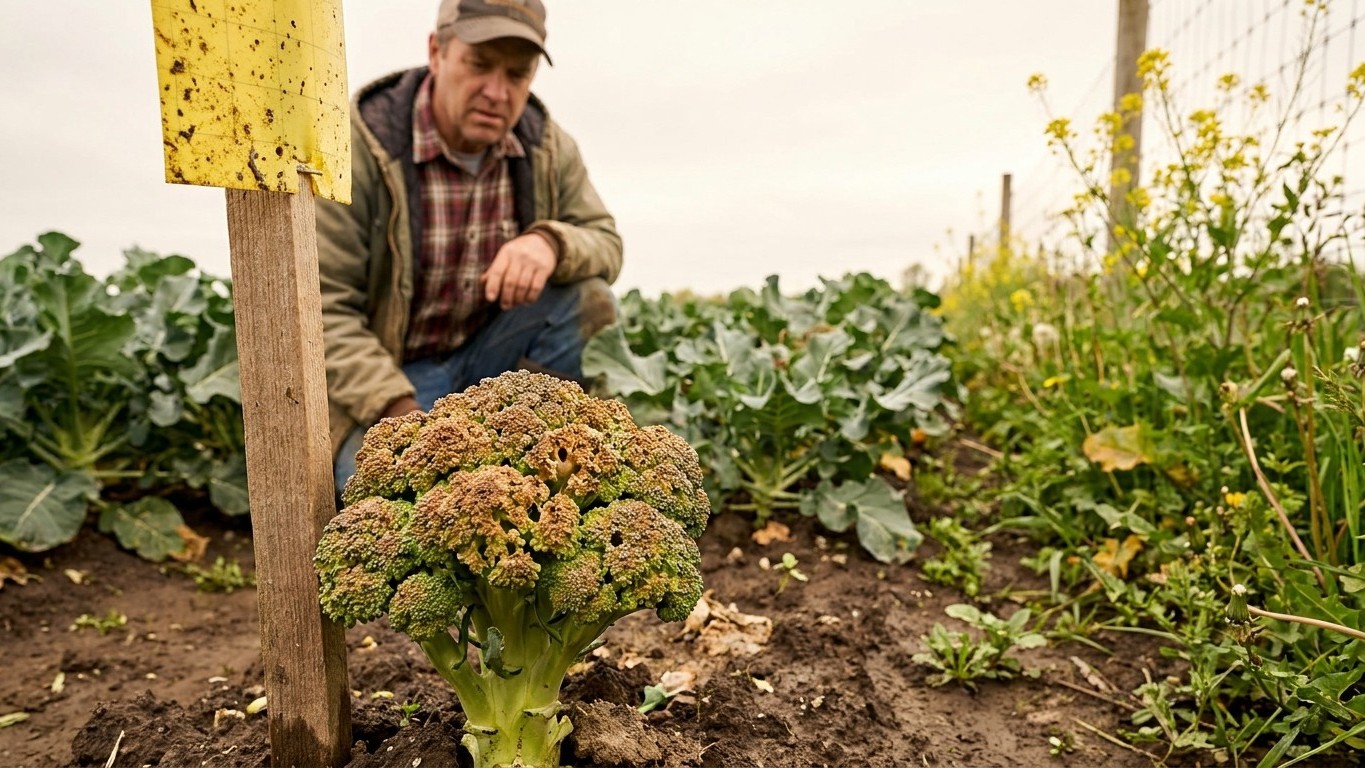

Swede midge doesn’t announce itself with obvious signs. By the time a grower notices something’s wrong with a broccoli head or a canola stand, larvae have often already done their damage and moved on. In Ontario, this tiny fly typically starts emerging from the soil in mid-May and stays active in overlapping generations through September, which is exactly why timing matters so much for control. Rotating brassica crops, trapping adults with pheromone lures, and cleaning up crop residue remain the three tools that actually slow it down.
What Swede Midge Is and Why Ontario Growers Watch For It

Contarinia nasturtii is a fly barely the size of a mosquito’s shadow, about 1.5 to 2 millimeters long. It’s native to Europe and was first detected in North America near Ottawa around 2000. Since then it has spread through some of Ontario’s busiest vegetable-growing regions, including the Holland Marsh, York Region, and parts of Niagara, all areas that grow a lot of broccoli, cabbage, and cauliflower for grocery shelves.
The insect feeds on the entire brassica family. That means broccoli, cauliflower, cabbage, kale, Brussels sprouts, canola, and mustard are all fair game, along with wild relatives like wild mustard, wild radish, and shepherd’s purse growing along fence lines and ditches. Because those wild hosts stick around all season, simply skipping a year of canola or cabbage in a field doesn’t remove the food source entirely, the midge can keep breeding on weeds nearby while waiting for the next cash crop to come around.
Canola is where the economic stakes get big. Ontario and the wider Canadian Prairie region export canola in volumes that matter to global vegetable oil markets, so agencies like the Canadian Food Inspection Agency and OMAFRA track swede midge spread closely. That tracking has led to movement restrictions on certain plant material and soil between regions, aimed at slowing the fly’s advance into areas that haven’t seen it yet.
When Swede Midge Shows Up in Ontario
Swede midge overwinters as larvae wrapped in silken cocoons sitting in the top few inches of soil. Adults emerge once soil temperatures climb into a suitable range, usually mid-May in southern Ontario, a bit later further north or in cooler springs. From there, things get complicated fast.
A single Ontario growing season can see two to four overlapping generations, sometimes more in a long, warm stretch. Adult females live only three to five days, just long enough to find fresh brassica growth and lay eggs tucked into leaf folds near the growing point. Because generations overlap rather than march through in a neat sequence, a field checked in July can hold eggs, larvae, and pupae all at the same time. That overlap is a big reason single spray applications rarely solve the problem on their own.
Activity generally tapers off by September as temperatures drop and the last generation settles into the soil to overwinter. For home gardeners in southern Ontario, that gives a rough five-month window, mid-spring through early fall, when brassica plantings need attention.
How to Spot Swede Midge Damage Before It’s Too Late
The damage comes from larval feeding, not from the adults. Larvae secrete saliva that interferes with normal cell growth at the plant’s growing point, and the results show up as distorted, puckered young leaves and swollen, scarred stems. In broccoli and cauliflower, the classic symptom is a “blind head,” where the plant produces multiple stunted growing points instead of one usable head. That single symptom can wipe out an entire planting’s market value.
The tricky part is that larvae feed hidden inside folded leaf tissue and inside the protected growing point itself. A grower walking a field often won’t spot anything unusual until the head has already failed to form properly, and by then there’s no fixing that plant. Brown, corky scarring near the crown is another giveaway worth checking for on younger transplants.
Canola damage looks different and gets confused with other problems more easily. Distorted racemes and reduced seed set from swede midge can resemble frost injury or herbicide drift, which complicates diagnosis in the field. Anyone growing canola in an area with known midge activity should factor that in before assuming a stand’s poor performance is weather-related.
What Stops Swede Midge in Ontario Fields and Gardens
Monitoring and Timing
Pheromone traps baited with the swede midge’s sex pheromone are the main early-warning tool. Placed at field edges and checked weekly starting in early May, they tell growers when adult activity is picking up. Combined with degree-day tracking, trap counts help pinpoint the narrow window when insecticide applications actually work, which is against eggs and newly hatched larvae, before they burrow into the growing point.
Once larvae have settled into folded leaf tissue, most contact insecticides can no longer reach them. That single fact explains why timing beats intensity here, spraying too late does little good no matter how strong the product.
Crop Rotation and Sanitation
Because larvae drop to the soil to pupate and overwinter, distance and time are the cheapest defenses available. Keeping brassica crops off a given field for at least two seasons, some Ontario extension guidance points toward three, gives overwintering pupae less chance of connecting with a fresh host the following spring.
Cleaning up crop residue and destroying volunteer brassica plants right after harvest removes late-season food sources that would otherwise let one more generation build up before winter sets in. Wild mustard, wild radish, and shepherd’s purse along field margins deserve the same attention, since they keep populations ticking along even during years when a field sits in corn or soybeans.
Resistant Varieties and Physical Exclusion
Some Brassica napus canola lines show partial tolerance to swede midge feeding, and breeding programs in Canada continue working on stronger resistance. For now, no widely available variety is fully immune.
Home gardeners and small-scale growers have a reliable non-chemical option in fine mesh row covers or insect netting, installed before adult emergence in spring and sealed tightly at the soil line. Since most brassica vegetables are harvested before flowering, the netting can stay on for the entire growing period without interfering with pollination. That’s the simplest, lowest-risk defense available to anyone growing broccoli or cabbage on a backyard scale in a region where swede midge is already established.
Swede midge hasn’t stayed confined to Ontario. It has also turned up in parts of New York State, close enough to the border that gardeners and small growers in the northern US shouldn’t assume this is strictly a Canadian problem. Anyone growing brassica crops within reasonable range of established populations in Ontario has good reason to start watching pheromone trap counts each spring rather than waiting for visible damage to show up.