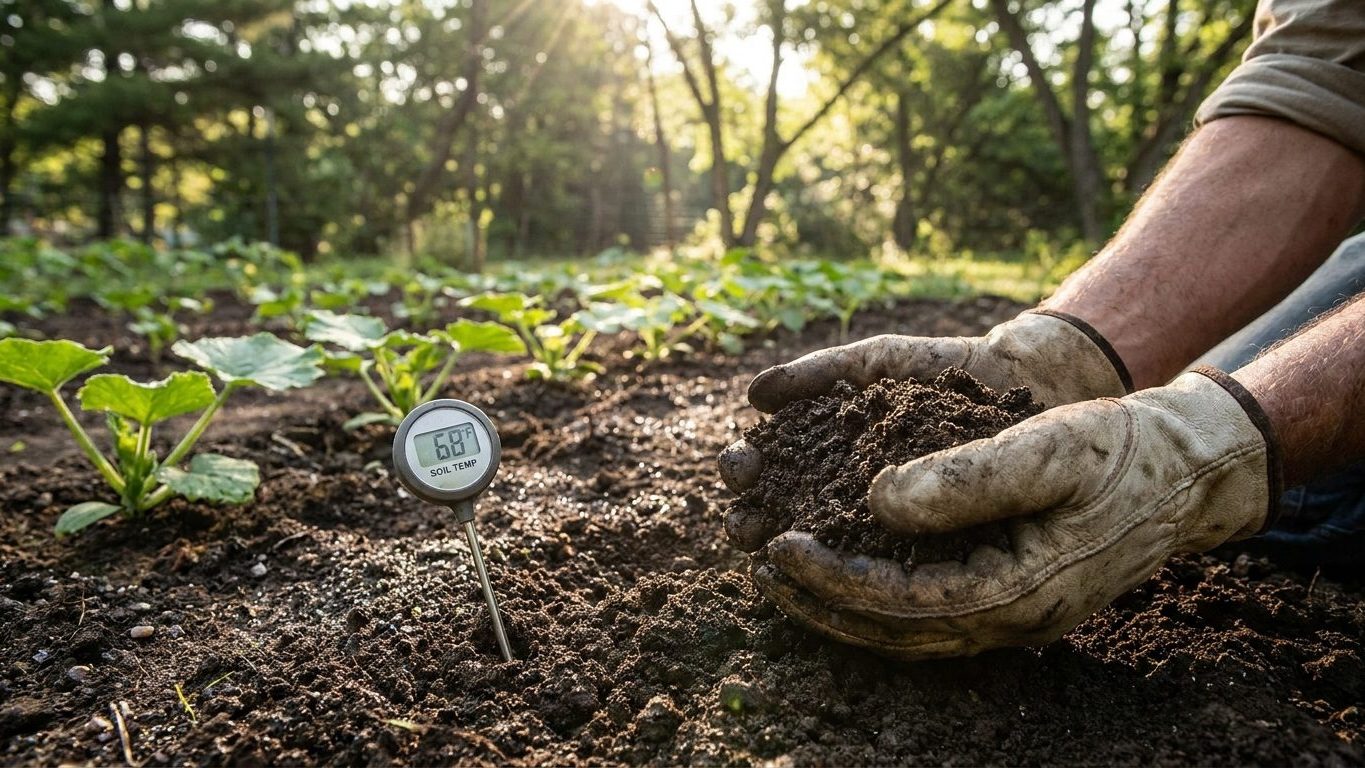

Direct-seed Winter Squash in Alabama once the soil has warmed past the last frost risk, generally from mid-April into late May, with a second window open into early June for gardeners chasing a fall harvest. The state’s long frost-free stretch gives even slow-maturing types like hubbard squash room to finish before the first fall freeze. What decides the real date for your plot, though, comes down to soil temperature and summer heat, not just a calendar square.
The short answer for Alabama
At the reference station used for these normals (Huntsville, station USW00003856), the last spring frost falls somewhere between March 19 and April 3, and the first fall frost arrives between November 2 and November 16. Those aren’t fixed dates. They mark the window where the probability of a 32F freeze sits between 30% and 70%, according to NOAA’s 1991-2020 Climate Normals. In plain terms: even after April 3, a frost is still possible in a cool year, and before November 2, one is already plausible in a cold one. Winter squash seed rots in cold, wet soil faster than it ever gets killed by a light frost, so the practical rule is to wait past the stated window, not sow right at its edge.
Do the math on the season length and the picture gets generous. From April 3 to November 2 is roughly 213 days of frost-free growing at the reference station. Winter squash varieties run anywhere from about 80 days (acorn types) to 100-110 days (hubbard, some pumpkin-type squash) from seed to harvest-ready fruit. Even planting on the late side of the spring window and allowing a few extra weeks for the skin to cure on the vine before frost, the math leaves slack most years.
That slack is exactly why a second sowing makes sense for many Alabama gardeners: a first planting in mid-April, a second in early-to-mid June, staggers harvest and hedges against a bad stretch of pollinator weather or a vine borer hit on the first batch. Both plantings still have room to mature and cure before the first fall frost arrives in early-to-mid November.
The figures above come from one airport weather station. Rural and suburban gardens routinely see their last spring frost run later, and their first fall frost arrive earlier, sometimes by one to two weeks, more at elevation. Treat these as the reference figure for the region, not a guarantee for your particular garden.
What will not work here
Short season isn’t the enemy in Alabama the way it is farther north. What actually undoes a winter squash crop here is timing against heat and moisture, not against days on a calendar.
The state’s summers run hot enough to stall pollination outright. The reference station averages 58.5 days a year at or above 90F, a heat load concentrated in July and August. Squash flowers are open for a matter of hours each morning, and heat above roughly the low 90s tends to make pollen less viable and bees less active during that window. A planting timed so its main flowering push lands in the hottest stretch of July often shows plenty of blossoms and very little fruit set, a frustration gardeners sometimes blame on missing bees when the real culprit is heat stress on the flower itself.
Humidity compounds the problem. Summer rainfall averages about 12.1 inches across June, July and August, front-loaded in June (4.06 inches) and July (4.49 inches) before easing slightly in August (3.55 inches). Combine that rainfall with the heat load and you get long stretches of high humidity, the exact condition powdery and downy mildew need to spread through a squash patch. Vines planted at the tight spacing that works fine in a drier climate trap moisture on the leaves overnight. In a humid Alabama summer, that crowding is often the difference between a healthy vine in August and one collapsed to bare stems by September.
Watering on autopilot fails too. A once-a-week soaking schedule, common advice in drier states, doesn’t hold up against 58.5 days of 90-plus heat, especially on sandy soil that drains within a day of a rain event. Clay holds moisture longer, but the same rainfall total behaves very differently depending on which soil sits under the vines, and neither soil type gets a pass from the heat load driving evaporation. A single summer thunderstorm, common in the June-July pattern here, also tends to run off rather than soak in, so a rain gauge reading doesn’t always translate to root-zone moisture.
What changes across Alabama
Alabama spans USDA Hardiness Zones 7a to 9a, a spread built on one measure: the average annual extreme minimum temperature, not a growing-season length or a rainfall total. That range alone tells you there’s no single planting date for the whole state. A colder 7a pocket, typically at higher elevation or farther north, behaves differently from a milder 9a stretch near the Gulf.
In the cooler end of that range, the practical shift is to lean toward the later side of the spring sowing window and treat the fall frost date as arriving sooner than the reference station’s November 2-16 figure, not later. A grower in a colder pocket loses days on both ends of the season compared with the reference station, which tightens the margin for slower-maturing hubbard and pumpkin-type squash and favors the quicker acorn and delicata types instead.
At the milder end of the zone range, the season opens earlier and closes later than the reference figures suggest, which is exactly the kind of margin that makes a second June sowing more reliable and gives slower varieties more room to cure on the vine before any frost risk shows up.
Elevation, distance from the coast and even a north-facing slope can shift the practical zone within a few miles. The USDA Plant Hardiness Zone Map, built on the 1991-2020 normals, is the tool for placing a specific address inside that 7a-9a range, and it’s worth checking directly rather than assuming from a county’s general reputation.
Where to check this for your own county
Everything above is a state-level answer, and Alabama is large enough that a state-level answer will be wrong for plenty of individual counties. The Alabama Cooperative Extension System (aces.edu) is the source built to close that gap, and it’s worth a direct visit before finalizing a planting date.
Two things are worth pulling from a county extension office or its published materials. First, the local planting calendar: county agents track frost dates and soil temperature trends specific to their area, and those figures routinely differ from the airport-station normals, sometimes by a week or more in either direction. Second, the list of winter squash varieties actually trialled in that county. Extension trials account for local disease pressure, the specific mildew and vine borer patterns common to a given region, and heat tolerance under real local summer conditions, information a state-wide page simply doesn’t have.
A county recommendation beats a state one every time there’s a conflict between the two. The state-wide picture is useful for understanding the broad pattern of frost dates, heat load and zone spread across Alabama, but it isn’t a substitute for what a local agent has already tested on soil similar to your own. Anyone planting on a meaningful scale, or anyone who’s had a squash crop fail for reasons that don’t match the explanations above, has more to gain from that county-level check than from another read of a state normal.
If you follow the almanac, here is when to plant winter squash by the moon. It is a tradition, not a proven method.
Checking this against your own garden
Every date here is a normal, an average built from thirty years of weather at one station. A reader’s own garden overrides all of it, and three simple observations say more than any calendar square.
Soil warmth by feel is the first check. Winter squash seed wants soil that’s warmed well past the chill of late winter before it germinates reliably rather than rotting in the ground.
The first flush of male flowers is the second signal. Squash plants reliably produce male flowers before female ones, sometimes by a week or two, and a healthy first flush of males shows the plant has settled in and is building toward fruit set. A patch that skips straight to female flowers with no male flush first, or shows almost no flowering at all deep into the season, is telling the gardener something about heat stress or a nutrient gap that the calendar can’t diagnose.
The first true leaves, the ones that appear after the initial rounded seed leaves, mark the point where the plant is running on its own root system rather than seed reserves. Slow, pale or stunted true leaves in a bed that’s otherwise been watered and planted on schedule usually point to cool soil or compacted ground rather than bad timing, and it’s a cue worth acting on before the plant falls further behind the season.