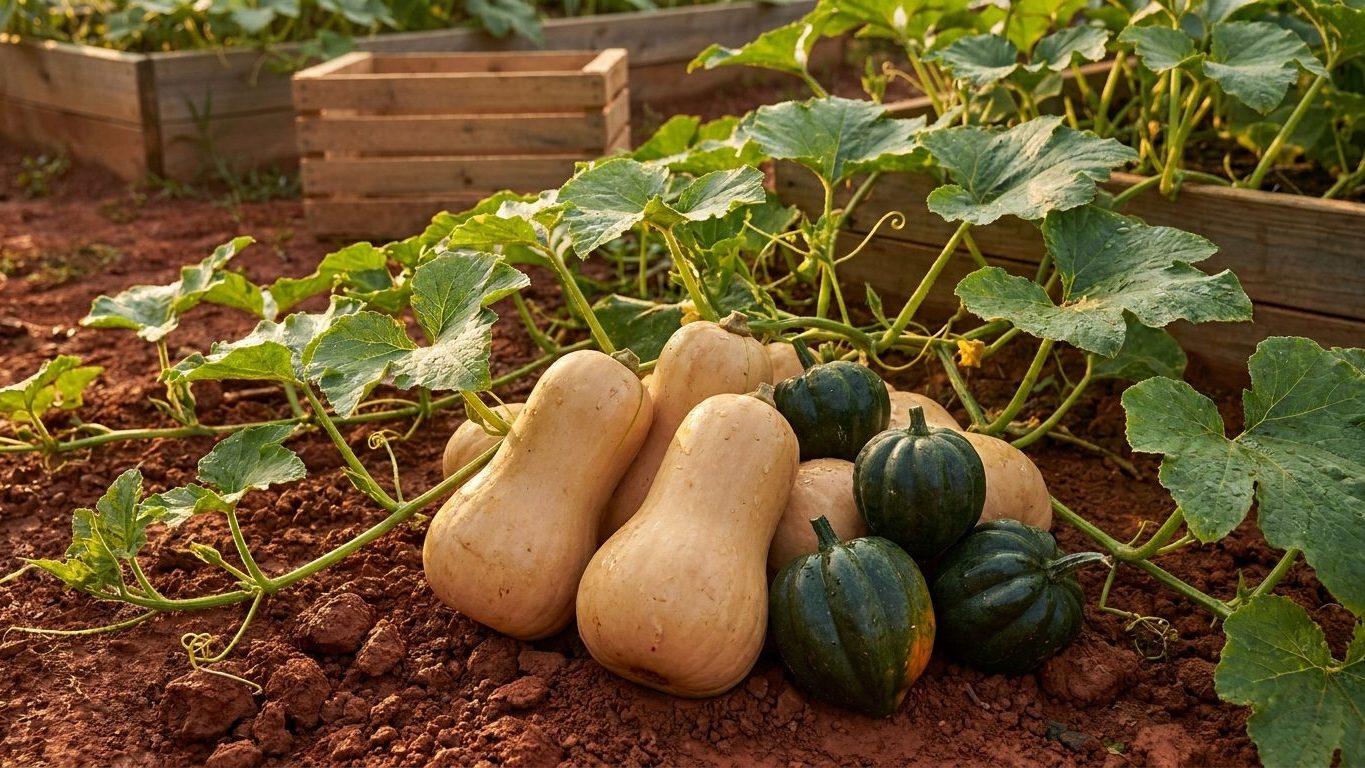

For most of Alabama, the growing season is long enough for nearly every winter squash type on the shelf: butternut, acorn, spaghetti, even the slower-to-mature Hubbard types. The limiting factor isn’t days to maturity. It’s summer heat and humidity, which reward vining, disease-tolerant varieties over the dense-leaved, cooler-night-loving ones.
The short answer for Alabama
At the reference station used for these normals, the frost-free window runs from somewhere between March 19 and April 3 in spring to somewhere between November 2 and November 16 in fall. That’s a minimum of about 213 days without frost, and up to roughly 242 in a mild year. Nearly any winter squash, including 100- to 110-day varieties, fits inside that window with weeks to spare. So the type decision in Alabama isn’t driven by the calendar. It’s driven by what happens in the middle of the season, when the region logs an average of 58.5 days a year at or above 90F.
That heat load points squarely toward Cucurbita moschata, the species behind butternut. Moschata types keep vining and setting fruit through stretches of 90-plus-degree weather that stall other squash, and their solid stems give them an edge against squash vine borer, a pest that thrives in warm Southern soil. Acorn and delicata, both Cucurbita pepo, mature fast and taste great, but their hollow stems are an open door for borers once the heat sets in. Cucurbita maxima types, the Hubbard and buttercup family, tend to want cooler nights to set fruit reliably and are the shakiest bet on the list.
| Species | Common types | Heat tolerance | Vine borer risk |
|---|---|---|---|
| Cucurbita moschata | Butternut, some cushaw | High | Low (solid stem) |
| Cucurbita pepo | Acorn, spaghetti, delicata | Moderate | High (hollow stem) |
| Cucurbita maxima | Hubbard, buttercup, kabocha | Lower | Moderate |
None of this means acorn or spaghetti squash should be skipped. It means a gardener choosing between two otherwise equal varieties should lean toward moschata for the main crop and treat the others as a secondary bet, watched more closely once the mercury climbs.
What will not work here
The clearest failure point is fruit set during the hottest stretch of summer. With 58.5 days a year reaching 90F or more, Alabama gardens routinely hit runs of heat long enough to stall pollen viability in maxima types bred for cooler nights, like many Hubbard and giant show squash. Blossoms open, bees visit, and still nothing sizes up, because the pollen itself has been damaged by nighttime lows that never really cool off.
Weekly watering is the second thing that fails, and the summer rainfall numbers explain why. The region averages about 12.1 inches of rain across June, July and August, which sounds generous, but August, the month when fruit is sizing on most varieties, is the driest of the three at just 3.55 inches. Combine that dry stretch with near-60 days of 90-plus heat driving evaporation, and a squash bed watered once a week can go bone-dry for days at the exact moment fruit needs steady moisture. Rain that does fall often arrives as a single thunderstorm rather than a steady soak, which means much of it runs off instead of reaching the root zone, especially on compacted or sloped ground.
Close spacing and humidity
Tight spacing is the third failure. That same summer rainfall, spread across a hot, humid state, keeps leaf surfaces damp for long stretches, which is exactly the condition powdery mildew and downy mildew need to spread. Squash planted close enough that leaves overlap and airflow stalls will show white, powdery leaf coating by midsummer in most Alabama gardens, well before the vines finish producing. Wider spacing than a seed packet recommends for a cooler, drier climate isn’t optional here; it’s the difference between harvesting into October and losing the crop to disease in August.
What changes across Alabama
Alabama spans USDA Hardiness Zones 7a to 9a, and that spread, built on the USDA’s own measure of average annual extreme minimum temperature, is wide enough that no single planting answer covers the whole state. A garden at the cooler end of that range, generally in the higher terrain of north Alabama, works with a shorter frost-free window and cooler summer nights than a garden near the Gulf Coast at the warmer end. That difference shifts two things: how early a spring planting can safely go in, and how much benefit a moschata variety’s heat tolerance actually delivers, since a cooler pocket of the state may not push 58.5 days above 90F at all, while a hotter one could exceed it.
A gardener in the cooler, higher parts of the state should expect a later safe planting date and a fall harvest window that closes sooner than the state-level frost dates suggest. A gardener near the coast, in the warmer end of the zone range, generally gets more room on both ends of the season and can lean harder into the longest-maturing moschata varieties without worrying about an early fall frost cutting the harvest short.
What it can say is that the range itself is the reason a single statewide planting date is a starting point, not a guarantee, and that the gap between the cooler and warmer edges of Alabama is large enough to matter for squash, which is sensitive to both frost timing and summer heat load. The USDA’s official zone map is the tool built to answer that question at the local level, not a paragraph on a state-wide page.
Where to check this for your own county
The Alabama Cooperative Extension System is the source built to narrow the state-level answer down to a single county. Extension offices maintain planting calendars tuned to their own local frost data, not the reference-station figures used here, and they track which squash varieties have actually performed well in local trial gardens over recent seasons.
Two things are worth pulling from a local extension office before finalizing a planting plan. The first is the county-level frost-free date range, which will often differ from airport-station figures by a week or two in either direction, more at elevation. The second is the list of squash varieties, by name, that county agents have seen succeed against local disease and pest pressure, since vine borer and mildew severity both vary within the state depending on soil, humidity pockets and how many seasons a given garden bed has grown cucurbits.
A state-level page like this one is built to explain the mechanism: why heat and humidity, not season length, drive the variety decision in Alabama, and why moschata types generally have the edge. A county extension recommendation goes further, naming specific varieties and specific dates for a specific place. When the two disagree, even slightly, the county recommendation is the one to follow. That’s not a hedge; it’s how extension data is meant to be used, as a layer added on top of the broader regional picture rather than a substitute for it.
Checking this against your own garden
Every date and figure here describes an average. The actual garden bed a reader is standing in front of will tell a more accurate story, and it does so through three signs that don’t require any equipment.
- Soil warmth by feel: squash seed wants soil that feels warm to a bare hand a few inches down, not just air that feels warm. Cold soil under warm air is common in shaded or clay-heavy beds and will sit seed without sprouting it, regardless of the calendar date.
- The first flush of male flowers: male blossoms typically open before female ones and before pollinators are reliably active in a given yard. Their appearance is a sign the plant considers conditions favorable, and a long gap before female flowers follow can point to a microclimate running cooler or shadier than the neighborhood average.
- The first true leaves: the rounded seed leaves that emerge first don’t say much; the jagged true leaves that follow are the plant’s first real read on its bed. Slow, pale true-leaf growth after a normal-looking start usually means the soil is either colder or wetter than it looks from the surface.
None of these signs override sound spacing or watering habits. But they outrank any date printed on a page like this one, because they come straight from the bed the squash is actually growing in, not from an airport weather station miles away.