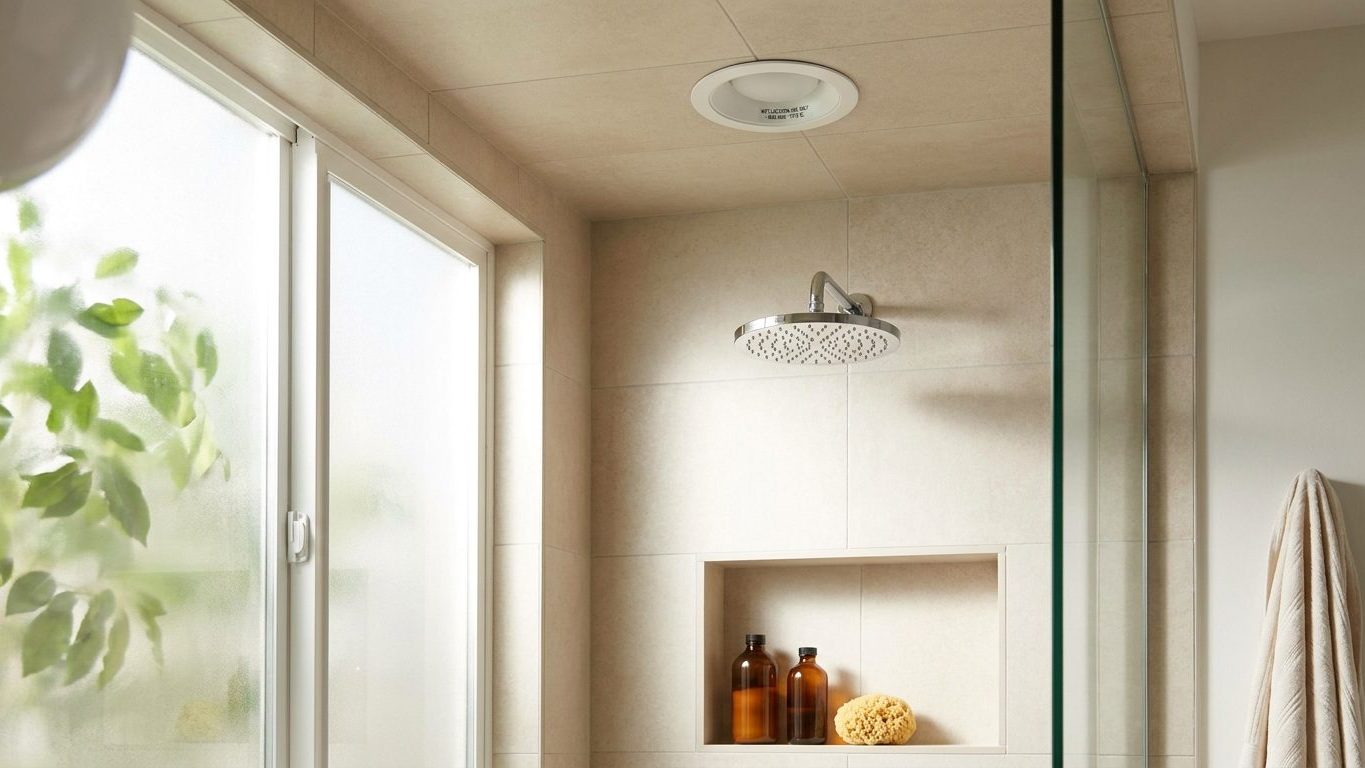

Over a running shower, damp-rated is not the standard that applies. The 2020 National Electrical Code, section 410.10(D), requires any fixture inside the shower or tub zone to be listed for a wet location specifically, because water hits it directly instead of just raising the humidity in the room. Before you buy anything for that ceiling, find the fixture’s label and confirm it says “suitable for wet locations,” not just “damp location.”
Wet-rated, damp-rated, and the label that decides

The 2020 National Electrical Code, section 410.10(D), draws the line at one word: wet. A fixture inside the shower or tub zone has to be listed for a wet location, and a damp-location listing does not satisfy that requirement, no matter how good the fixture looks or how expensive it was. The difference sounds small until you remember what each rating actually tests for.
What “damp” and “wet” actually measure
A damp-location listing means the fixture has been tested to handle condensation and occasional light moisture, the kind of humidity you get from a hot shower steaming up a bathroom mirror ten feet away. A wet-location listing means the fixture has been tested with water sprayed directly onto it, sustained contact, not just moisture in the air. Inside the shower zone, that is exactly what happens every time someone showers, so the code does not leave room for the lesser rating.
This is also where people get tripped up when they shop online. A retailer’s product page will sometimes call a fixture “bathroom rated” or “moisture resistant,” language that means nothing under the code. The only words that count are the ones on the UL or ETL listing label itself, usually printed on a small metal or adhesive tag inside the fixture housing or on the box it shipped in. If that label says “damp location” and the fixture is going inside the zone described below, it is the wrong fixture for that spot, whatever the marketing copy says.
Outside the zone, a damp-rated fixture is often fine, which is one reason vanity lighting above a sink follows different guidance than a shower ceiling. If you are also working out how high to mount the mirror lights over the vanity, the sizing logic there is different enough from shower lighting that it deserves its own answer, covered in How High to Hang a Vanity Light.
The zone: 3 feet out, 8 feet up
The 2020 National Electrical Code, section 410.10(D), defines the shower and tub zone as running 3 feet horizontally and 8 feet vertically from the top of the tub rim or the shower threshold. That is not an arbitrary box drawn on a code diagram. It is a rough model of where water actually travels once it leaves the showerhead: the horizontal reach accounts for spray drift and the arc of someone moving under the water, and the vertical reach accounts for a fixture mounted at typical ceiling height sitting well within range of that spray, plus splash that bounces upward off tile and glass.
Why the measurement starts where it does
The zone is measured from the top of the tub rim or the shower threshold, not from the drain, not from the showerhead, and not from the edge of the tile. That matters because a curbless or low-threshold shower and a deep soaking tub can produce very different zones in the same room, even with the showerhead in a similar position. A tub with a tall rim starts its 8-foot vertical measurement higher up the wall than a curbless shower does, which changes what falls inside the zone on the ceiling above it.
It also explains why a fixture that looks safely off to the side on a floor plan can still be inside the zone. Three feet horizontally is farther than it looks on paper, especially in a small bathroom where the shower, the toilet, and the vanity are all within a few feet of each other. A recessed can that seems to sit “next to” the shower rather than “over” it can still fall inside that 3-foot ring once you actually measure from the threshold rather than eyeballing it.
None of this is really about the fixture itself. It is about water finding the shortest path off a body and a showerhead, then continuing to travel after it leaves the zone everyone assumes it stays inside. The same logic shows up in bathroom design generally, in things like how a floor is sloped to keep water moving toward a drain instead of pooling near a threshold, which is its own set of decisions covered in Wet Room: The Slope, the Drain, and Where the Membrane Stops.
Why a pendant over a freestanding tub is usually not allowed
A pendant hanging over a freestanding soaking tub looks great in a photograph, which is exactly why it keeps coming up as a design idea. The 2020 National Electrical Code, section 410.10(D), does not leave room for it if the pendant falls inside the zone: cord-connected fixtures, pendants, and ceiling fans are not permitted inside the 3-foot, 8-foot zone described above, regardless of how the fixture itself is rated for moisture.
Why rating the fixture correctly isn’t enough
The reason is mechanical, not electrical in the narrow sense. A pendant hangs from a cord or a stem, and that connection point, along with the socket and any exposed wiring above it, is harder to seal against water intrusion than a fixture mounted flush or recessed into the ceiling. A ceiling fan has the same problem plus moving parts and a motor housing that is not designed to run wet. So even a pendant carrying a wet-location listing on its shade does not clear the bar, because the rule in section 410.10(D) excludes the fixture type inside the zone, not just an unrated version of it.
The 2020 National Electrical Code is a model code, and this note applies everywhere the argument is worth making twice: it only governs construction where a state, county, or city has formally adopted that edition, and many jurisdictions amend it before adoption or still enforce an older edition. There is no exception written into this rule for freestanding tubs, decorative fixtures, or historic renovations in the national model. If a bathroom design calls for a pendant near a tub, the tub has to sit far enough away, and low enough, that the fixture falls outside the 3-foot, 8-foot zone entirely, and confirming that distance for a specific room is a job for the local building or permitting office, not a guess from a floor plan.
Finding the rating on a fixture you already own

Before you decide whether an existing fixture needs to move or be replaced, find its listing label. It is usually a small printed tag riveted or adhered inside the fixture housing, sometimes visible only after you drop the trim ring or remove the lens, and it will say either “suitable for damp locations” or “suitable for wet locations” along with a UL or ETL mark. If the fixture still has its original box or instruction sheet, the same wording usually appears there too.
Measuring the zone around it
Once you know the rating, measure where the fixture actually sits relative to the shower or tub. Work through it in this order:
- Find the top of the tub rim or the shower threshold, since that is the reference point the 2020 National Electrical Code uses, not the drain or the showerhead.
- Measure horizontally from that point to the fixture’s position on the ceiling, using a tape measure rather than pacing it off, since 3 feet is easy to misjudge in a small room.
- Measure vertically from that same reference point straight up to the fixture, keeping the tape plumb rather than following the slope of a sloped ceiling.
- Note both numbers together, since the zone is defined by both the 3-foot horizontal reach and the 8-foot vertical reach at once, not by either alone.
The most common measuring mistake is starting from the shower door or the tile line instead of the threshold or rim, which can shift the horizontal measurement by a foot or more in either direction. Write down both numbers and the fixture’s listed rating, and take that information to your local building or permitting office rather than deciding for yourself whether the installation meets code. They apply whatever edition and amendments your jurisdiction has adopted, which may differ from the 2020 National Electrical Code cited here.
The recessed light that lets water into the ceiling
A damp-rated can light installed inside the wet-location zone will usually keep working for a while, which is part of what makes the mistake easy to miss. The housing was not built with a sealed lens gasket rated for direct spray, so water works its way past the trim over months of showers, not all at once. What follows is corrosion on the socket and wiring inside the housing, and eventually moisture tracking into the ceiling cavity above, where it can sit against joists and drywall long after the bathroom itself looks dry.
What shows up at inspection and later
At a permit inspection, this is one of the things an inspector checks by pulling the trim and reading the label, and a damp-rated fixture found inside the 3-foot, 8-foot zone set by section 410.10(D) of the 2020 National Electrical Code is a straightforward fail that has to be corrected before the permit closes. Outside of an inspection, the failure shows up later as a flickering light, a tripped circuit, or in the worst cases a stain spreading across the ceiling in the room below if the bathroom is on an upper floor.
If you are planning new lighting over a shower or tub, or you are unsure about a fixture that is already installed, the next step is a call to a licensed electrician or your local building department, not a guess based on how the fixture looks or how long it has been fine so far. They can confirm the fixture’s listing, check it against the zone as adopted locally, and tell you what has to change before it becomes a problem you can see.
Common questions
Can I put a regular recessed light in the bathroom ceiling if it’s not directly over the shower?
Outside the 3-foot, 8-foot zone set by the 2020 National Electrical Code, section 410.10(D), a fixture does not need the wet-location listing that a shower or tub zone requires. A damp-rated fixture is generally the minimum expected elsewhere in a bathroom because of ambient humidity, but confirm the specific requirement with your local building department since adoption and amendments vary.
Does a bathroom exhaust fan need to be wet-rated if it’s over the shower?
An exhaust fan is a different fixture type than the lighting covered by section 410.10(D), and fan housings are generally designed and listed differently from light fixtures for this reason. Check the fan’s own listing label and talk to your local building department about how the zone rule applies to fans specifically in your jurisdiction.
What if my shower has no curb or threshold at all?
The zone is still measured from the shower threshold as defined by the 2020 National Electrical Code, but a curbless shower may define that reference point differently than a curbed one does. This is exactly the kind of edge case worth bringing to a licensed electrician or your local building department rather than estimating it yourself.
Is a wet-rated fixture more expensive than a damp-rated one?
Cost varies by brand, style, and finish, and this page does not track pricing since it changes constantly. What matters for code compliance is the listing on the label, not what the fixture costs.