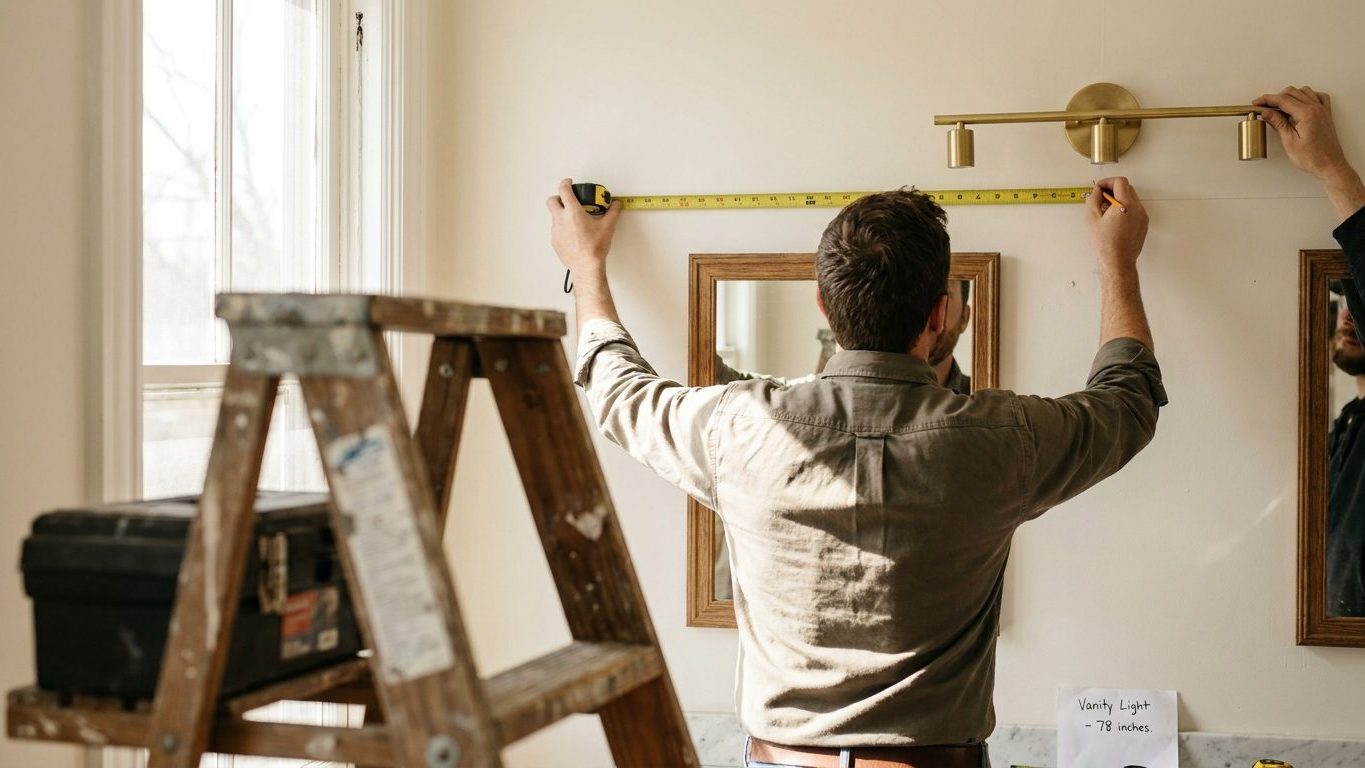

A vanity light centered too high throws every shadow downward, carving lines under the eyes and blacking out the underside of the chin no matter how many bulbs sit in the fixture. The fix is a fixed number. Center a light bar between 75 and 80 inches from the finished floor, or if you’re hanging sconces instead, set them at eye level and let them flank the mirror rather than sit above it. Measure your own eye height at the mirror location before you cut the electrical box, because that decides which of the two layouts actually works in your bathroom.
The height for a bar above the mirror

A light bar mounted above a bathroom mirror sits 75 to 80 inches from the finished floor, according to NKBA guideline 22 from the National Kitchen and Bath Association. That range is measured to the centerline of the fixture, not to its top edge or its bottom edge, and it’s measured from the finished floor, meaning the flooring you’ll actually walk on once tile or vinyl goes down, not the subfloor the framer left behind.
That distinction trips up more installs than any other part of the job. A box roughed in before flooring decisions are final gets measured from whatever surface is underfoot that day, and if the finished floor adds even half an inch of tile and mortar, the fixture ends up sitting lower than the range calls for once everything is installed. Ask your tile setter or flooring contractor for the finished thickness before you commit to a box height, not after.
Why 75 to 80 inches and not a single number
The five-inch spread exists because mirrors vary. A mirror that starts higher on the wall pushes the ideal fixture position up with it, and a shorter household or a powder room with a lower mirror will sit comfortably at the bottom of that range. NKBA guideline 22 gives installers room to center the bar over the actual mirror in front of them rather than forcing every bathroom in the house to the same inch. If you haven’t settled on a mirror yet, it’s worth working out what size mirror you need over the vanity before you finalize the light box, since the two decisions are made together, not one after the other.
Why light from above puts your face in shadow
A single bar mounted directly above the mirror lights the top of your head, your forehead, and the mirror glass itself, but very little of the vertical surface of your face. Light traveling straight down hits the brow ridge, the nose, and the cheekbones and throws the shadow of each one downward, onto the exact places you’re trying to see clearly: under the eyes, along the jaw, under the chin. The higher the fixture sits above that 75 to 80 inch range, the steeper that downward angle gets and the deeper the shadow.
The NKBA guideline 22 range sits as low as it reasonably can while still clearing the top of a standard mirror and keeping the fixture out of the way of anyone leaning in close to the glass. Drop a bar below 75 inches and it starts competing for space with the mirror frame or the person’s reflection. Push it above 80 inches and the light source moves far enough from the face that the downward shadow problem gets worse, not better, even though the fixture is technically still “above the mirror.”
What a bar can’t fix on its own
No amount of wattage corrects for the angle of the light. A brighter bulb in a fixture mounted straight overhead just makes the shadows more defined, the same way a bright overhead porch light makes a face look harsher than a soft one at dusk. This is the physical reason a second light source, placed at the sides rather than above, changes the result more than swapping bulbs ever will. It’s also why bathrooms built around a single overhead bar tend to get a second fixture added later, once someone notices the shadow problem while shaving or applying makeup and starts hunting for a fix.
Sconces: the height and the spacing that work
Side sconces flanking a mirror sit at roughly 60 to 66 inches from the finished floor, which NKBA guideline 22 describes as eye level, and they’re spaced 36 to 40 inches apart, measured center to center across the width of the mirror. At that height, the light source is close to the vertical plane of the face rather than above it, so it fills in the shadows a downward bar leaves behind instead of adding to them.
NKBA guideline 22 is a design recommendation from a trade association, not a building code, so there’s no local adoption process to check the way there would be with electrical or plumbing code. What is locally regulated is the wiring itself, the box type, and any wet-location or GFCI protection requirements near the sink, and those come from whatever electrical code your city or county has adopted and amended. Design guidance and code compliance are two separate checks, and it’s worth confirming both, one against the mirror and the fixture catalog, the other against your local building department.
Spacing matters as much as height with sconces. Set them narrower than 36 inches and they crowd a standard mirror, throwing light across each other instead of across the face. Set them wider than 40 inches and the gap in the middle, directly in front of where a person actually stands, goes underlit again, which defeats the point of moving the light off the top of the mirror in the first place.
Marking the box height before the drywall closes

Once the choice between a bar and a pair of sconces is settled, mark the electrical box centerline on the framing before the drywall goes up, because moving a box afterward means cutting into finished wall. Measure up from where the finished floor will sit, not from the subfloor, and account for the mirror height you’ve already settled on.
The order to check things in
- Confirm the finished floor thickness with your flooring contractor, including tile, mortar bed, or underlayment.
- Mark the top of the finished floor on the framing with a level, working from that line rather than the subfloor.
- Measure up to 75 to 80 inches for a bar centerline, or 60 to 66 inches for sconce centerlines, from that marked line.
- For sconces, mark both box locations before cutting, spaced 36 to 40 inches apart center to center, and check the spacing against the mirror width you’ve chosen.
- Double check the measurement with a second tape before cutting the box hole, since a single misread number is the most common error at this stage.
This is also the point in the job where other rough-in clearances in the room get checked at the same time, since the framing is open and easy to measure. If you’re touching plumbing or fixtures elsewhere in the same bathroom, it’s worth confirming minimum ceiling height over the toilet, tub and shower before the inspector shows up, rather than discovering a clearance issue after the drywall is closed.
Electricians typically rough in the box with a bit of slack in the cable so the fixture can be nudged an inch in either direction once the mirror is actually hung. Use that slack. A box cut dead center on a calculated number, with no room to adjust once the real mirror is in front of you, is harder to fix than a fixture that needed a small shift after the fact.
The fixture that lights the mirror instead of the person
A bar mounted well outside the 75 to 80 inch range, or sconces set outside 60 to 66 inches, doesn’t fail an inspection on its own since NKBA guideline 22 is a design recommendation rather than an adopted code provision. What it does is light the mirror glass and the wall around it while leaving the person standing in front of it in shadow, which is the exact problem the guideline exists to prevent.
The cost shows up later, not at rough-in. It shows up the first morning someone tries to shave close to the jaw or match foundation to their skin tone under a fixture that’s throwing the wrong kind of light, and it shows up again if the fix means opening drywall to relocate a box that was never going to work at that height. Getting the mark right before the wall closes is far cheaper than a second cut later.
For the wiring itself, including box type, cable routing, and any GFCI or wet-location protection required near the sink, check with your local building department or a licensed electrician before rough-in. They’ll know the amendments your city or county has made to the adopted electrical code, which the NKBA design range does not cover and was never meant to.
Common questions
Can I put the light bar lower than 75 inches if my ceiling is short?
NKBA guideline 22 gives a range of 75 to 80 inches with no lower exception written into it. If your ceiling or mirror placement genuinely doesn’t allow for that range, sconces at 60 to 66 inches flanking the mirror are the standard alternative rather than dropping the bar below its recommended height.
Do I need both a bar and sconces?
No, the two are alternative layouts for the same job, not additive. A single bar centered at 75 to 80 inches and a pair of sconces at 60 to 66 inches both aim to light the face evenly, and most vanities use one approach or the other rather than combining them.
What if my mirror is narrower than 36 inches?
Sconce spacing of 36 to 40 inches is measured center to center across the mirror, so a narrower mirror makes that spacing harder to hit without the fixtures overhanging the frame. In that case a bar centered above the mirror, rather than sconces on either side, is usually the simpler layout.
Does the height change for a vessel sink or a taller vanity counter?
The FACTS behind this guideline are all measured from the finished floor to the fixture, not from the counter or sink rim, so a taller vanity or a vessel sink doesn’t change the 75 to 80 inch or 60 to 66 inch figures on its own. It does change where the mirror sits relative to the person’s face, which is worth rechecking before you mark the box.