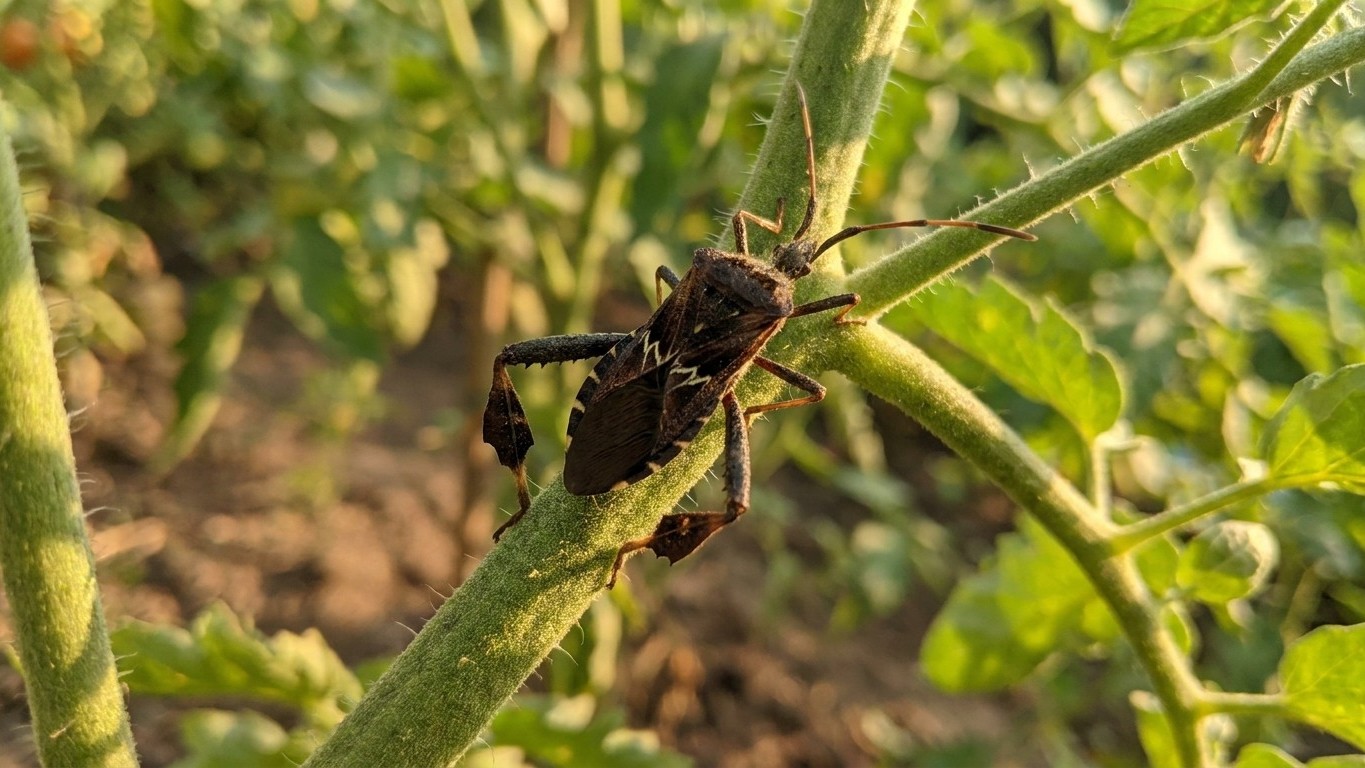

Leaffooted bugs turn up across Texas from early spring through the first hard frost, with the heaviest activity hitting home gardens and orchards in June, July, and August. Two things stop them for good: breaking up their overwintering shelter in fall and hitting nymphs early with contact insecticides before they grow the tough shell that makes adult bugs so hard to kill.
Identifying a Leaffooted Bug in Texas

The name gives it away once you know what to look for. Adult leaffooted bugs measure about three-quarters of an inch to an inch long, with dark brown or grayish-brown bodies and a flattened, leaf-shaped expansion on their hind legs, the trait that separates them from nearly every other true bug in the state. Many adults also carry a thin white or yellow zigzag stripe across the back, right where the wings fold.
Two species dominate in Texas. Leptoglossus phyllopus shows up statewide, especially in East and Central Texas. Leptoglossus zonatus, marked by two pale spots near the head, tends to concentrate in South Texas and the Rio Grande Valley, where mild winters let populations build faster.
Not a Stink Bug
People confuse leaffooted bugs with stink bugs constantly, and it’s an easy mistake since both belong to the same broad group of plant-feeding true bugs and both release an odor when crushed. The giveaway is the leg. Stink bugs have plain, thin legs. Leaffooted bugs have that flared, leaf-like segment on the hind legs that no stink bug species in Texas shares. Nymphs make identification trickier: young leaffooted bugs are bright orange-red with black legs and antennae, wingless, and often mistaken for assassin bug nymphs or even fire ants when they cluster tightly on a stem.
When They Show Up: The Texas Timeline
Adults spend winter tucked into leaf litter, under loose bark, inside dead plant stalks, or in gaps around sheds and house siding. In most of Texas they emerge from that shelter in March or April as temperatures climb into the 70s, then move onto whatever host plants are budding, weeds first, then vegetables and fruit trees.
Egg-laying starts once host plants have set fruit, usually late spring. Females line up rows of eggs along leaf edges and stems, and a single female can produce several hundred eggs across a season. In the warmer two-thirds of the state, Texas summers support two to three generations a year, which is why a garden that looked clean in May can be swarming by August. In the Panhandle and far West Texas, cooler nights typically limit that to one full generation plus a partial second.
Peak damage in home gardens tends to land in July and August, right when tomatoes, peppers, and pomegranates are loaded with fruit and the second generation of nymphs is maturing into feeding adults. Commercial pecan growers watch a slightly later window, since leaffooted bugs shift toward pecan nuts as they fill out in late summer and early fall, piercing the shuck and hull to feed on the developing kernel.
Activity tapers off with the first cool nights in October or November, when adults start searching for winter shelter again. That search-for-shelter phase is actually the best control opportunity of the year, and it’s the one most homeowners skip entirely.
What Actually Stops Leaffooted Bugs
Adult leaffooted bugs are frustratingly tough to kill with soap-based sprays because their shell is thick and their legs let them run or fly the moment they sense a threat. Nymphs are the soft target. Anything you do to intervene works far better in the three to four weeks after eggs hatch than it does once bugs mature.
Cultural Control That Works Before Chemicals Are Needed
Fall cleanup matters more than most people assume. Clearing leaf litter, dead cornstalks, sunflower stems, and brush piles near the garden removes the exact shelter adults need to survive a Texas winter, and fewer overwintering adults in February means fewer egg-laying females in May. Weeds like pigweed and careless weed host early-season nymphs before garden plants are even in the ground, so knocking those back in March cuts off the bug’s first meal of the year.
Trap cropping is one of the more reliable tricks used by Texas vegetable growers and home gardeners alike. Sunflowers, sorghum, and millet planted along a garden’s border pull leaffooted bugs away from tomatoes and peppers, since the bugs strongly prefer those seed heads. Checking trap crops every few days and knocking bugs into a bucket of soapy water keeps the population from building up enough to spill over onto the main crop.
Direct Control Once Bugs Are Present
Hand removal still works on a small home garden. Early morning, when temperatures are cooler and bugs move slower, is the easiest time to knock adults and nymphs into a jar of soapy water. It sounds tedious, and it is, but for a dozen tomato plants it beats spraying.
Insecticidal soap and neem oil kill nymphs on contact if applied directly to the clusters, but they do almost nothing to hardened adults. For heavier infestations, pyrethrin-based sprays or products containing permethrin give faster knockdown on adults, and timing the application to early morning or dusk, when bugs are actively feeding and less likely to have already dispersed, improves results. Kaolin clay sprayed on fruit and pecan shucks creates a physical barrier that many bugs simply avoid landing on, a technique also used against pecan weevil in Texas orchards.
Row covers over young vegetable transplants block egg-laying adults in spring before fruit sets, then come off once plants start flowering and need pollinators. It’s a narrow window, but it lines up well with the March-April emergence period described above.
Which Texas Plants Take the Hit
Tomatoes and pomegranates draw the heaviest feeding pressure in home landscapes, since both produce thin-skinned fruit that’s easy for the bug’s needle-like mouthpart to pierce. Feeding on tomatoes leaves hard, discolored spots under the skin that show up when the fruit ripens, a defect growers call cat-facing when it’s severe.
Citrus growers in South Texas deal with a related problem: leaffooted bug feeding on young fruit causes internal browning that isn’t visible until the fruit is cut open, which makes it one of the trickier pests to scout for on the tree. Pecans get hit differently, with feeding on nuts before the shell hardens causing shriveled, discolored kernels known as “black pit,” a significant issue for commercial growers in Central Texas pecan country. Cotton fields in parts of the state also see periodic pressure, since leaffooted bugs feed on developing bolls alongside stink bugs.
Home gardeners in the Hill Country and North Texas report the heaviest complaints on pomegranate, where the bugs cluster in visible groups of a dozen or more on a single fruit, feeding side by side in a way that looks almost coordinated. That clustering behavior, more than the damage itself, is usually what tips off a gardener that leaffooted bugs, not stink bugs or squash bugs, are the culprit.