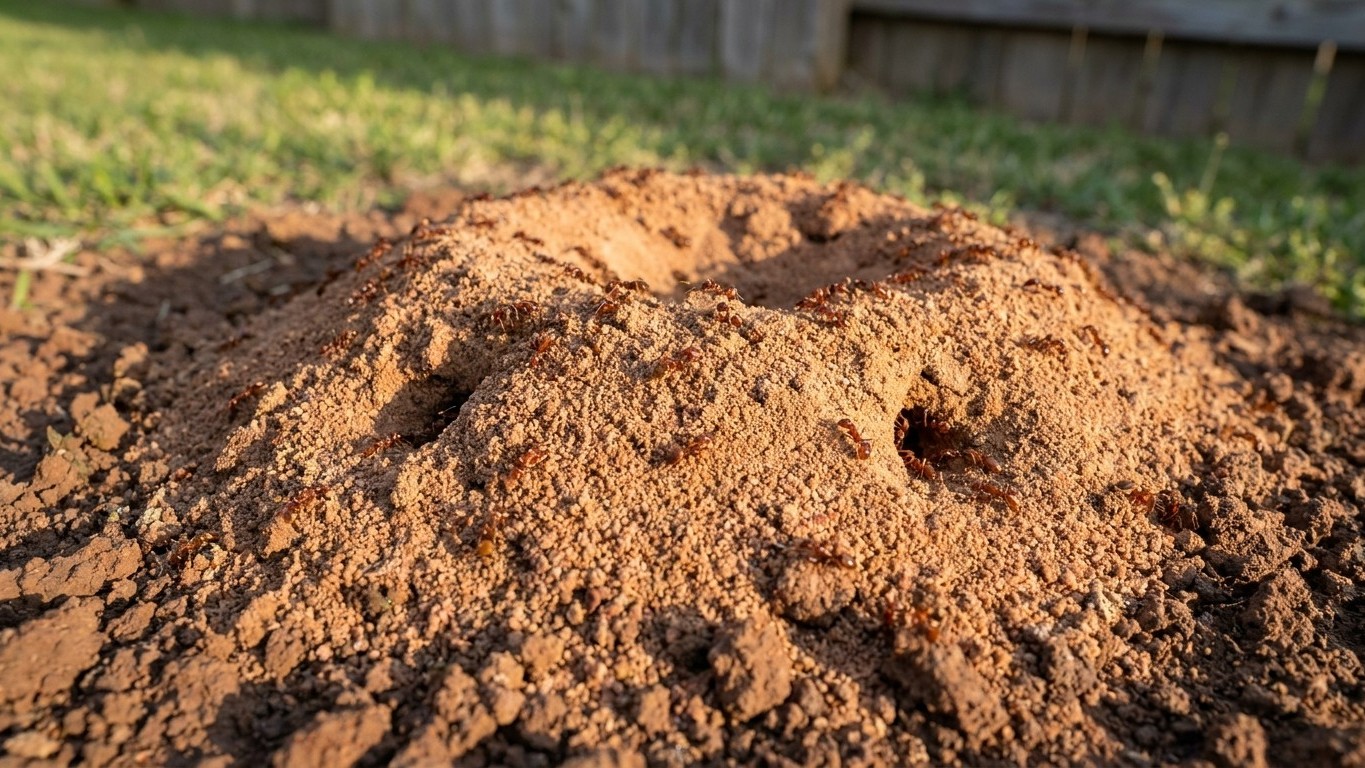

Fire ants show up in Texas soil the moment ground temperatures climb into the mid-70s, typically from March through November across most of the state, and they never fully leave. The red imported fire ant (Solenopsis invicta) has colonized virtually every county east of a line running roughly from Wichita Falls to Del Rio, and colonies simply go dormant deeper underground during cold snaps rather than dying off. What stops them isn’t a single spray. It’s a two-step bait-and-treat system that Texas A&M AgriLife Extension has refined over three decades, combined with knowing when mounds are actively feeding so treatments actually work.
How Fire Ants Took Over Texas

Red imported fire ants aren’t native to North America. They hitched a ride on cargo ships into Mobile, Alabama sometime in the late 1930s, then spread west through soil, sod, and nursery stock. By the 1950s they’d crossed into East Texas, and today the U.S. Department of Agriculture’s quarantine map covers more than 90 Texas counties, restricting the movement of soil, hay, and nursery plants to keep the pest from spreading further into uninfested regions like the Panhandle and West Texas.
The economic toll is bigger than most homeowners realize. Texas A&M AgriLife Extension estimates fire ants cost the state’s economy over $1 billion annually when you add up urban pest control, agricultural losses, livestock veterinary bills, and damage to electrical equipment (mounds love the warmth of transformer boxes and irrigation systems). That figure puts fire ants in the same financial category as some crop diseases, which is why extension offices treat this as more than a nuisance issue.
When Fire Ants Are Most Active
Soil temperature drives everything. Fire ants forage and build mounds most aggressively when soil hits 70 to 90 degrees Fahrenheit, with peak activity around 75 to 85 degrees. In most of Texas, that window opens in March and stays wide through early November, with a brief midsummer lull during the hottest stretches of July and August when ants retreat deeper to escape surface heat.
Rain triggers visible mound-building even when ants have been active underground all along. After a heavy thunderstorm, colonies push soil up to rebuild tunnels flooded by moisture, which is why homeowners often report “new” mounds appearing overnight following a storm system moving through Central or East Texas. This isn’t a new colony. It’s an existing one repairing itself.
Winter doesn’t eliminate fire ants in Texas the way it might in colder states. Colonies survive freezes by moving deep underground, sometimes three feet down, and simply resume surface activity once soil warms back up in late winter. The Gulf Coast and Houston metro area rarely see soil temperatures drop low enough for long enough to meaningfully knock back populations, which is part of why infestations there tend to be denser than in North Texas or the Hill Country.
Flooding and Fire Ant Rafts
One behavior that surprises a lot of Texans: fire ant colonies survive flooding by forming floating rafts. Worker ants link together with the queen and brood in the center, creating a mat that can float for days until it reaches dry ground. This was documented extensively after Hurricane Harvey in 2017, when rafts of thousands of ants were spotted drifting through flooded Houston neighborhoods. It’s a reminder that standing water after a storm isn’t just a mosquito problem.
Identifying a Fire Ant Mound
Fire ant mounds don’t have a visible entrance hole the way many other ant mounds do. Instead, they look like loose, crumbly domes of soil, usually six to eighteen inches wide and up to a foot tall in open, sunny areas like lawns, pastures, and roadsides. Disturb one with a rake or your foot and workers boil out within seconds, which is the fastest way to confirm you’re dealing with fire ants rather than a less aggressive species.
The ants themselves are reddish-brown, about an eighth to a quarter inch long, and workers come in noticeably different sizes within the same colony, a trait called polymorphism. A single mature mound can house 200,000 to 400,000 workers, and a heavily infested acre of Texas pasture can support 40 to 150 mounds.
Their sting is distinctive and worth knowing before you’re standing in the middle of a disturbed mound. Fire ants bite to anchor themselves, then sting repeatedly in a circular pattern, injecting venom that causes an immediate burning sensation followed by a white pustule within 24 hours. According to the American College of Allergy, Asthma and Immunology, roughly 1 percent of people stung experience a systemic allergic reaction that can include difficulty breathing, which is why anyone with a known ant-sting allergy should keep an epinephrine auto-injector on hand in fire ant territory.
What Actually Stops Fire Ants
Texas A&M AgriLife Extension’s recommended approach is called the Two-Step Method, and it’s built around timing rather than brute force. Step one is a broadcast bait treatment applied across the whole yard or property twice a year, generally in spring and again in early fall when ants are actively foraging for food. Bait products use slow-acting active ingredients like hydramethylnon, spinosad, or indoxacarb mixed into a corn grit carrier, and workers carry the bait back to the colony where it eventually reaches and kills the queen. That’s the part that matters. Kill the queen and the colony collapses over the following one to two weeks; leave her alive and the mound simply rebuilds.
Step two targets individual problem mounds, like the one sitting three feet from a swing set or a mailbox, with a faster-acting contact treatment such as a liquid drench or granular product applied directly to the mound. This doesn’t replace the broadcast bait step. It just handles the mounds you want gone immediately rather than waiting the week or two that bait treatments take to work.
Timing the bait application matters more than most people expect. Apply it during the heat of the day or right after mowing when ants are less active and the bait sits too long before being collected, and you’ll waste product. Extension guidance suggests applying bait in late afternoon or early evening when soil temperatures are in that 70 to 90 degree active range and the ground is dry, since ants avoid wet or freshly disturbed soil and will ignore bait scattered right before or after rain.
Methods That Don’t Really Work
Pouring boiling water on a mound kills maybe half the colony at best, according to extension research, and it does nothing for the queen if she’s deep enough underground, which she usually is. Home remedies involving grits, gasoline, or club soda have circulated for years without any real evidence behind them, and gasoline in particular creates a fire and groundwater contamination risk that far outweighs any benefit. Digging out a mound without chemical treatment tends to just relocate the colony a few feet away, and disturbed ants become noticeably more aggressive in the hours afterward.
Regional Patterns Across Texas
Infestation pressure isn’t uniform across the state. East Texas, the Gulf Coast, and the I-35 corridor from Dallas down through San Antonio and into the Rio Grande Valley carry the heaviest fire ant density, largely because humidity and mild winters favor year-round colony survival. West Texas and the Panhandle, by contrast, sit mostly outside the USDA quarantine zone, since colder winters and drier soil limit how far colonies have spread naturally.
Ranchers and hay producers moving equipment or livestock feed from quarantined counties into unaffected areas are legally required to follow USDA APHIS certification rules, since soil clinging to tires or equipment is one of the main ways colonies jump into new territory. Homeowners moving potted plants or bagged soil within the state rarely think about this, but it’s the same mechanism that let fire ants spread from a handful of Gulf ports to nearly two-thirds of Texas in under 70 years.
Suburban lawns irrigated on a regular schedule tend to see more consistent mound activity than dryland pasture, simply because irrigation keeps soil in that ideal moisture and temperature range longer through the summer. If a property has sprinklers running two or three times a week, that’s often the explanation for why mounds seem to multiply faster there than on a neighbor’s unwatered lot a few hundred yards away.