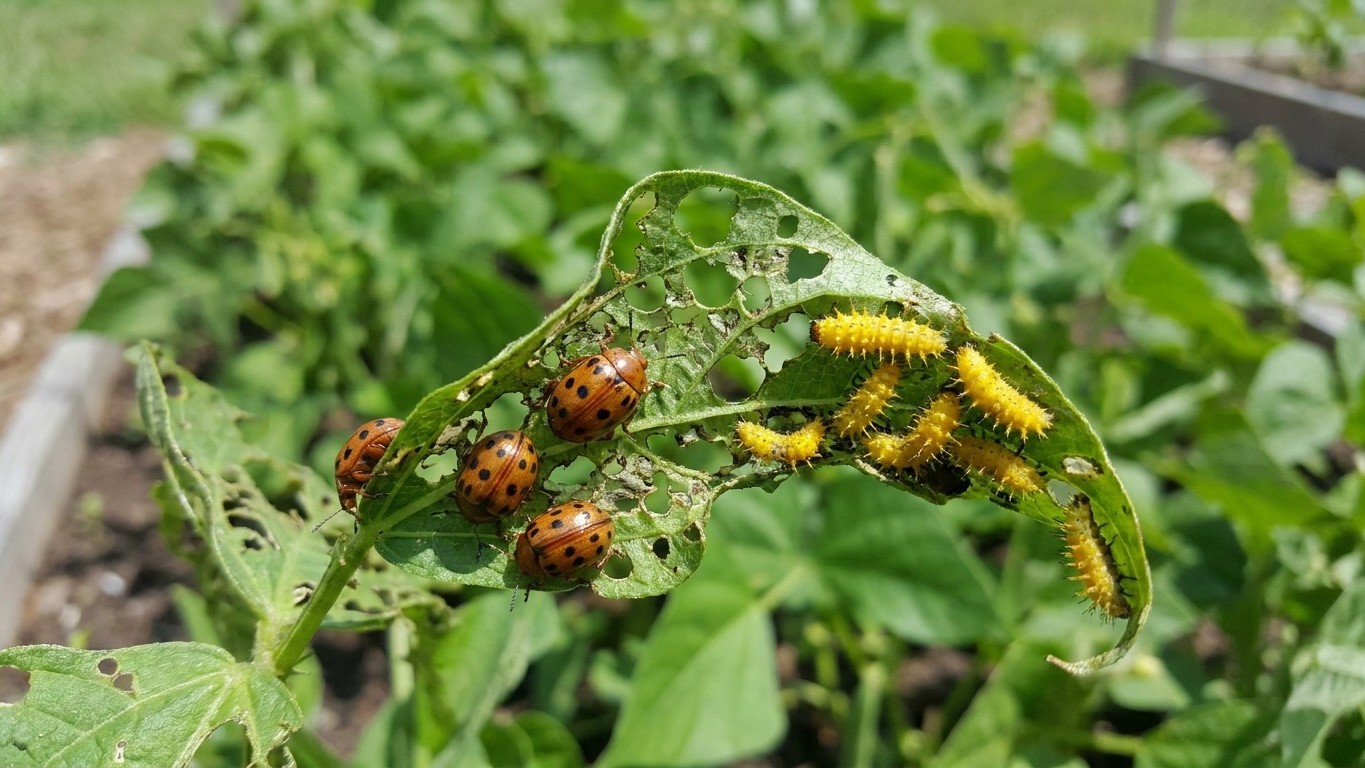

Mexican bean beetle adults overwinter in Massachusetts leaf litter and stone walls, then wake up and start feeding on bean plants sometime between mid-May and mid-June, depending on how quickly the ground warms. Peak damage usually hits in July and August, when both the coppery adults and their spiny yellow larvae are chewing through leaves at the same time. Row covers installed before emergence, handpicking egg clusters, and insecticidal soap applied to larvae remain the most reliable controls for home gardeners across the state.
What the Mexican Bean Beetle Looks Like on Massachusetts Plants

This insect fools a lot of gardeners because it looks almost exactly like a ladybug, just a little larger and a shade more orange. Adults measure around a quarter-inch long, with a coppery-yellow shell marked by sixteen black spots arranged in three rows. That resemblance to a beneficial insect is exactly why so many people leave it alone during the first week or two of an infestation, giving it time to establish before anyone notices the damage.
The larvae are the real giveaway. They’re soft-bodied, bright yellow, and covered in branching spines that make them look almost fuzzy from a distance. You’ll find them clustered on the undersides of bean leaves, usually near the egg masses they hatched from. Those eggs are lemon-yellow, football-shaped, and laid in tight groups of 40 to 60 on the leaf underside, typically on the lower third of the plant where humidity stays higher.
Feeding damage looks distinct too. Adults and larvae both skeletonize leaves, eating everything except the veins, so infested plants end up with a lacy, see-through appearance rather than clean holes. In heavy infestations, entire leaves turn brown and drop, and the beetles will move on to pods once foliage runs short.
Seasonal Timing in Massachusetts Gardens
Massachusetts sits at the northern edge of this pest’s range, which matters for timing. In warmer states, Mexican bean beetle can push out three generations a season. In Massachusetts, gardeners typically see one full generation and a partial second, with the heaviest larval feeding concentrated from mid-July through late August.
Overwintering adults tuck themselves into leaf litter, mulch, and the base of perennial plantings, sometimes traveling into wooded edges bordering the garden. They emerge once soil temperatures climb into the 60s, which in most of the state lines up with late-May bean planting. That timing creates a narrow window where floating row covers, if installed at planting and removed only for pollination once flowers appear, keep the first wave of beetles off young plants entirely.
Eggs laid by those overwintering adults hatch in about five to seven days during warm July weather, and larvae feed for two to five weeks before pupating in the soil near the plant base. A second, smaller generation of adults typically appears in late August or September, feeding briefly before searching out overwintering sites as temperatures drop. This second wave rarely causes serious damage in Massachusetts because most bean crops are near the end of their productive life by then, but it’s the generation responsible for next year’s population, which is why late-season cleanup matters more than most gardeners assume.
Controls That Actually Work in New England Conditions
Handpicking remains the single most effective tactic for home gardens, mainly because populations in Massachusetts rarely reach the overwhelming numbers seen further south. Checking the undersides of leaves twice a week during June and early July, crushing egg clusters and dropping larvae into soapy water, can keep a small planting essentially damage-free without any spraying at all.
Insecticidal soap works well against larvae because their soft bodies lack the waxy cuticle that protects adult beetles. Spray directly on the larvae themselves, since soap has no residual effect and won’t touch anything it doesn’t contact. Neem oil offers a similar mode of action and also disrupts feeding in adults, though it needs reapplication after rain, which is a factor to plan around given how often Massachusetts summers bring afternoon storms.
Pyrethrin-based products give faster knockdown for gardeners dealing with a larger infestation, but they’re broad-spectrum and will kill beneficial insects on contact, including the parasitic wasps that naturally suppress bean beetle populations in the region. Spraying in early evening, after pollinators have finished their daily activity, reduces that collateral damage somewhat.
Biological and Cultural Options
Massachusetts hosts a parasitic wasp, Pediobius foveolatus, that attacks bean beetle larvae and has been used in biological control programs in the Northeast for decades. It doesn’t overwinter reliably in New England’s climate, so it has to be reintroduced each season through commercial suppliers or regional extension programs, and its impact depends heavily on release timing matching larval activity.
Crop rotation helps limit buildup, since overwintering adults emerge near where they fed the previous year and will walk considerable distances to find beans again, but moving plantings even 20 to 30 feet across a yard reduces the odds of immediate reinfestation. Planting resistant bush bean varieties, several of which have been bred with tougher leaf tissue that discourages feeding, gives an added layer of protection without any extra labor once the seeds go in the ground.
Interplanting with strong-smelling herbs like rosemary or savory has some anecdotal support among New England gardeners, though the evidence is thinner than for the mechanical and biological methods above. It’s worth trying alongside other tactics, not as a standalone solution.
Preventing Recurrence Next Season
Fall cleanup does more for next year’s population than almost anything sprayed during summer. Removing bean plant debris promptly after harvest, rather than leaving it to break down over winter, eliminates one of the main overwintering shelters right in the garden bed. Tilling the soil in fall also exposes pupae to predators and freezing temperatures, cutting survival rates before adults ever get the chance to tuck in for winter.
Clearing leaf litter and dense mulch from garden borders through October removes additional overwintering habitat, since adults often move just a few feet from the bean rows into adjacent brush or stone walls rather than traveling far. Massachusetts winters are cold enough to kill a meaningful share of exposed adults, which is part of why populations here stay more manageable than in states with milder winters, but bare debris makes that natural die-off far less effective.
Gardeners who’ve dealt with a heavy infestation one year should expect at least moderate pressure the next season too, since local overwintering populations, not fresh migration from elsewhere, drive most outbreaks in Massachusetts. Starting row covers and handpicking checks by the third week of May, rather than waiting for visible damage, gives the best shot at staying ahead of the beetle before it settles in for another summer.