
Mexican bean beetle typically appears in New Jersey gardens by mid-to-late May, once overwintering adults leave the leaf litter and hedgerows where they’ve spent the cold months. From there, the insect can produce two to three generations before frost, meaning a garden that looks fine in June can be stripped to lace by August. Control works best when it starts early, before the first egg clusters hatch on the undersides of bean leaves.
What the Mexican Bean Beetle Looks Like at Each Stage

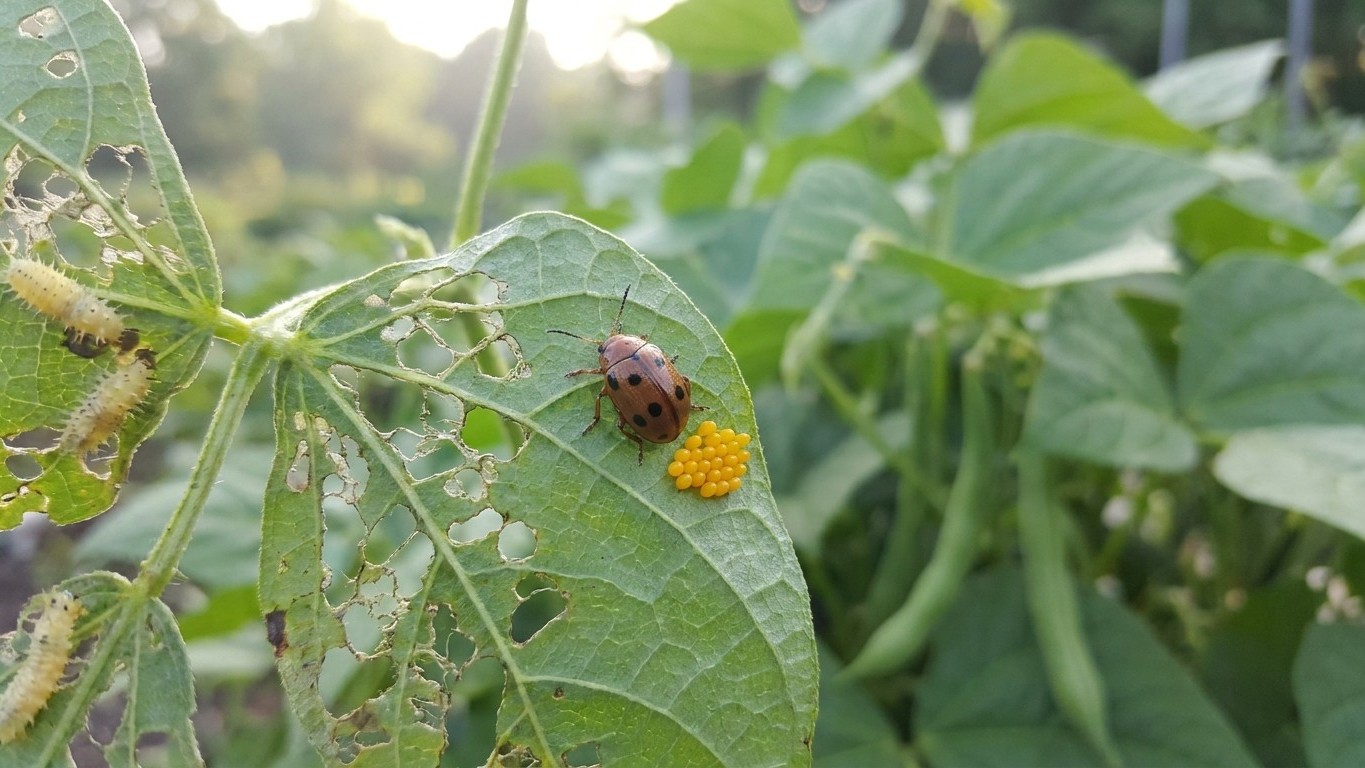
This pest gets mistaken for a beneficial ladybug more often than any other garden insect in the mid-Atlantic, and that confusion costs gardeners weeks of unchecked feeding. The adult is copper to yellowish-brown, oval, about a quarter-inch long, with 16 black spots arranged in rows across its back. Compare that to the common lady beetles gardeners rely on for aphid control, which run more orange-red with fewer, less evenly spaced spots. Flip the beetle over if you’re unsure: Mexican bean beetle larvae and adults feed almost exclusively on bean-family foliage, while true lady beetles are hunting aphids nearby, not chewing holes in your Kentucky Wonders.
The larval stage is where a lot of New Jersey gardeners get caught off guard, because it looks nothing like the adult. Larvae are pale yellow, spiny, and slug-like in shape, clustering on the underside of leaves where they’re easy to miss during a quick walk-through. Eggs are laid in tight groups of 40 to 60, bright yellow-orange, standing upright on the leaf underside like tiny grains of rice glued in place. A single female can lay 500 to 600 eggs over her lifetime, which explains how a handful of overwintering adults can turn into a full-blown infestation by midsummer.
Where Damage Shows Up First
Feeding damage starts as a lacy, skeletonized pattern on leaves, with the tough veins left behind while the tissue between them disappears. Both larvae and adults feed on the underside of leaves initially, so damage often shows up as light patches visible from above before you ever spot the insects themselves. Left unchecked, heavy populations move on to pods, scarring them enough to affect market quality even when the plant survives. Snap beans, lima beans, and soybeans are the primary targets in New Jersey gardens and farm fields, though cowpeas and a handful of other legumes can host the beetle too.
Seasonal Timing in New Jersey
New Jersey’s climate puts the state squarely in Mexican bean beetle territory, and its seasonal pattern follows local soil temperatures closely. Adults overwinter under leaf litter, in wooded edges, and in garden debris left standing over winter, then become active once daytime temperatures consistently climb into the mid-50s and higher. That usually lines up with mid-to-late May across most of the state, though a warm spring can push activity earlier and a cold, wet one can delay it by a couple of weeks.
The first generation feeds through June and into early July, then a second generation typically emerges and feeds heavily through August. In warmer years, or in southern New Jersey counties with a longer growing season, a partial third generation isn’t unusual. That overlapping timeline is exactly why late-summer bean plantings often take the worst damage: by the time a second flush of beans is growing, beetle numbers have already built up from the first generation and there’s no lag before they move in.
Scouting the undersides of leaves starting in late May, and repeating the check weekly through midsummer, catches egg masses before they hatch into the more damaging larval stage. That single habit, checking leaf undersides on a schedule rather than waiting for visible damage, is the difference between squashing a few dozen eggs and fighting an established population.
What Actually Stops Mexican Bean Beetle
No single tactic eliminates this pest for good, but a combination of timing, biology, and physical barriers keeps populations low enough that bean plants outgrow the damage.
Cultural Controls That Reduce Numbers Year to Year
Cleaning up bean plant debris at the end of the season removes one of the main overwintering sites right in the garden. Beetles that would otherwise tuck into old bean foliage or nearby leaf litter lose that shelter, which lowers the number of adults that survive to start the cycle again in spring. Rotating bean crops to a different part of the yard or garden each year also helps, since overwintering adults tend to emerge close to where they fed the previous season and won’t necessarily find a new planting right away.
Staggering plantings can work against you here. Since two generations build through the season, an early-planted crop that’s harvested before the second generation peaks in August often escapes the worst damage, while a late-summer succession planting walks straight into peak beetle pressure. Adjusting planting dates to dodge that overlap, when garden space allows, is a low-effort way to sidestep a chunk of the damage entirely.
Biological Control: A Wasp That Targets This Pest Specifically
One of the more effective tools against Mexican bean beetle is a small parasitic wasp, Pediobius foveolatus, that lays its eggs inside the beetle’s larvae. The wasp doesn’t survive New Jersey winters on its own, so it’s typically released fresh each season, either through university-run programs or commercial suppliers, timed to when the first generation of beetle larvae appears. Once established in a garden or field for the season, it can knock down second-generation populations significantly, since the wasps that emerge from parasitized larvae go on to attack the next wave.
This approach works best on a community or farm scale rather than in a single backyard bed, since the wasp needs a decent population of host larvae to build up its own numbers. Home gardeners with just a few bean rows generally get more practical mileage out of direct monitoring and physical controls, but it’s worth knowing this biological option exists if beetle pressure is a recurring, serious problem across a larger planting.
Direct, Physical Controls for Home Gardens
Handpicking adults and squashing egg masses remains one of the most reliable tactics for small home plantings, especially when done consistently during the May and June scouting window. Floating row covers, installed at planting and removed once flowering starts (bean flowers need pollinator access), keep the earliest overwintering adults from ever reaching the plants in the first place. That window matters: covers left on too long block the pollinators beans need to set pods.
For active infestations, insecticidal soap and neem oil applied directly to the undersides of leaves target both larvae and adults without leaving lasting residue, and they work best when populations are caught early rather than after leaves are already skeletonized. Pyrethrin-based products offer another organic option for heavier infestations, though repeated applications may be needed given the overlapping generations through summer. Whatever product gets used, thorough coverage on leaf undersides matters more than the product choice itself, since that’s where eggs, larvae, and feeding adults spend most of their time.
Resistant Varieties and What They Actually Offer
Plant breeders have identified some lima bean and soybean varieties with a degree of natural resistance to Mexican bean beetle feeding, generally through tougher leaf tissue or compounds that make the foliage less palatable. Resistance in these varieties tends to be partial rather than complete, reducing feeding damage without eliminating the need for other controls. For New Jersey gardeners dealing with recurring beetle pressure, choosing a resistant variety alongside row covers and regular scouting stacks the odds in the plants’ favor rather than relying on any one method to carry the whole load.
Snap bean varieties with strong resistance are less common on the commercial market compared to lima beans and soybeans, so gardeners growing green or wax beans will likely lean more heavily on timing, row covers, and direct treatment. Checking with a local garden center or a university extension office about which varieties perform well in a given county can save a season of trial and error, since resistance levels can vary noticeably between cultivars marketed as “beetle tolerant.”
Related guides
- Mexican bean beetle in Delaware: When It Shows Up and What Stops It
- Mexican bean beetle in Tennessee: When It Shows Up and What Stops It
- Mexican bean beetle in Virginia: When It Shows Up and What Stops It
- Mexican bean beetle in Wyoming: When It Shows Up and What Stops It
- Mexican bean beetle in Alabama: When It Shows Up and What Stops It