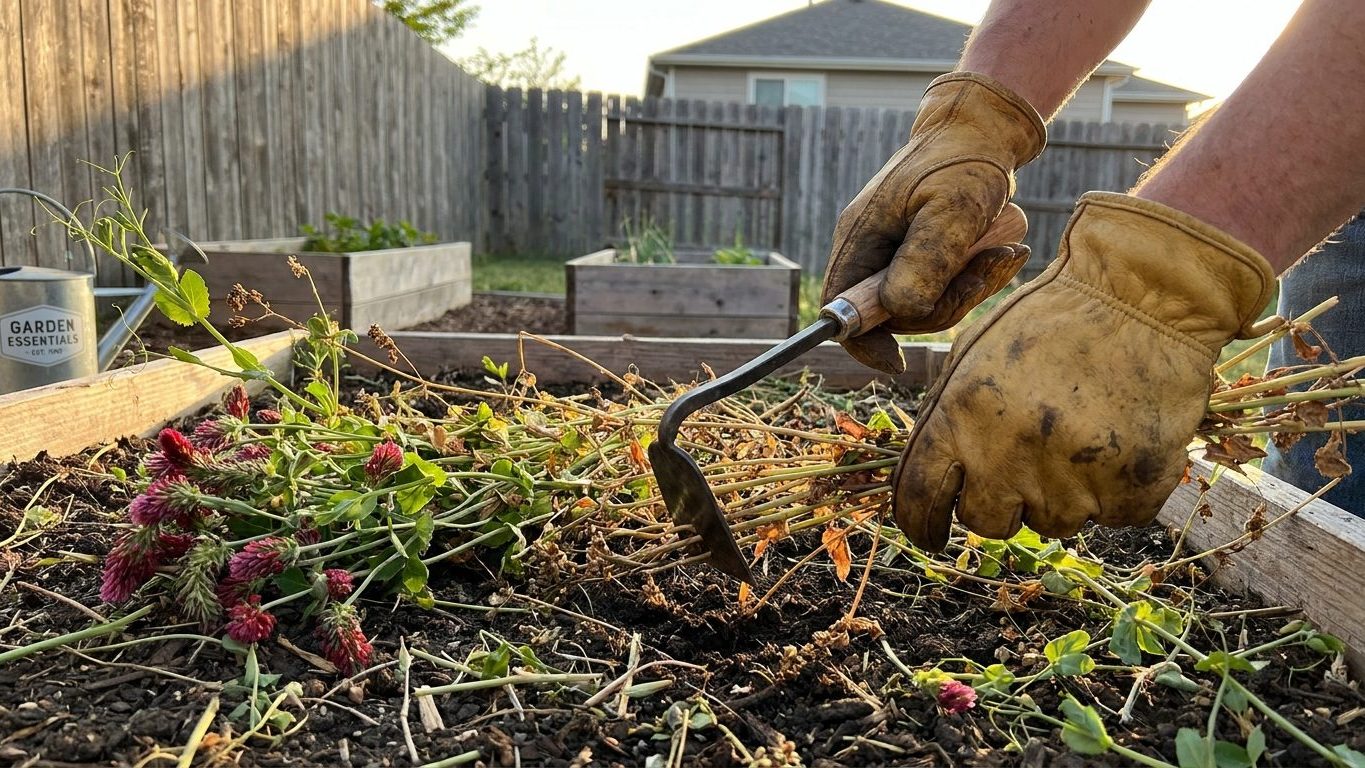

The cover crops that work in a small garden are the ones a person can kill without a tractor: buckwheat, oats, crimson clover, field peas, and daikon radish. They winterkill, they cut easily with hand tools, and none of them build the tangled root mass that turns a raised bed into a wrestling match come spring. Cereal rye, the crop most farm guides push hardest, is usually the wrong choice for four beds and a fence line.
What is actually going on
The thing to understand here is scale. Almost every cover crop recommendation in circulation, from extension bulletins to seed catalogs, was written with a farm field in mind, and a farm field has machinery. A roller-crimper can flatten and kill a six-foot stand of cereal rye in one pass. A no-till drill can plant through matted residue without disturbing the soil underneath. A gardener has none of that. What’s easy for a tractor can be genuinely unmanageable by hand, and that gap is where most of the bad advice comes from.
Cereal rye is the clearest example. Farmers love it because it produces enormous biomass, suppresses weeds hard, and holds nitrogen through winter. But that same biomass, grown in a garden bed, means stems that get tough and fibrous by the time they’re worth killing, and a root system that can go down several feet. Cutting it with a string trimmer or a scythe at The Right Stage is possible, but it takes real timing and real effort, and gardeners who try it on a farm’s schedule often end up fighting rye that’s already gone to seed.
Termination is the second piece of the mechanism, and it’s worth saying plainly: this is about mowing, crimping by hand, cutting, or letting frost do the work. No herbicide enters into it. That constraint actually simplifies species selection, because it rules out anything that needs a chemical kill to be manageable at small scale. A cover crop that dies on its own from cold, or that goes down easily under a pair of loppers, is doing half the gardener’s work already.
Why winterkill matters more in a garden than on a farm
A farm can afford to terminate a hardy cover crop mechanically because the equipment scales with the acreage. A garden benefits more from species that die on schedule without any intervention at all. Oats, for instance, grow fast in fall, build decent root mass, and then collapse on their own once temperatures drop into the teens across much of the country. By spring there’s a mat of dead residue to rake back or till in, and no cutting required. That single trait, dying when the gardener wants it to, is worth more in a small space than almost any other quality a cover crop can offer.
Legumes complicate this slightly. Crimson clover and field peas both fix nitrogen through a relationship with soil bacteria, and the amount they contribute depends on how much biomass they produce and when they’re terminated, not on a number that applies evenly everywhere. What matters for a gardener is timing the kill before seed set and before the stems get woody, not chasing a specific yield.
In the garden
Below is how the common cover crop species behave when someone without a tractor tries to grow and kill them in a bed that’s four feet wide instead of forty acres.
| Species | Growth habit | How it’s terminated by hand | What goes wrong |
|---|---|---|---|
| Buckwheat | Fast, low, dies at first frost | Frost, or cut at flowering with shears | Left too long, it reseeds itself and becomes a weed in the next crop |
| Oats | Upright, moderate biomass | Winterkill in cold climates | In mild-winter regions it doesn’t die and has to be cut, which surprises gardeners expecting automatic kill |
| Crimson clover | Low, spreading, legume | Cut or pulled before flowering | Left past flowering, stems toughen and it’s much harder to pull by hand |
| Field peas | Vining, needs support | Cut at the base with shears | Vines tangle into fencing and neighboring plants if not given room |
| Daikon or tillage radish | Deep taproot, low top growth | Winterkill; root decomposes in place | In mild winters the root survives and resprouts, competing with spring planting |
| Cereal rye | Tall, dense, very hardy | Requires cutting multiple times or crimping by hand at the right growth stage | Missed timing means tough stems, viable seed, and a root mass that resists digging |
A workable sequence for a small garden
- Late summer to early fall: Sow a fast grower like buckwheat or oats in any bed that’s finished producing, while soil is still warm enough for quick germination. Skip this window and the bed sits bare through fall, losing structure to rain instead of gaining it.
- Through fall: Let the cover crop establish enough top growth and root mass to matter, usually a few inches of green cover at minimum. Pull it too early, before it’s rooted in, and a hard freeze can kill it before it’s contributed anything.
- Winter: In cold regions, let frost do the killing on species chosen for that purpose. In mild regions, plan on cutting by hand before flowering. Assume it will winterkill when it won’t, and a gardener finds live plants tangled into spring beds.
- Early spring: Rake off or lightly work in the residue a couple weeks before planting vegetables, giving it time to start breaking down. Till it in too close to planting day, and fresh, undecomposed residue can tie up nitrogen right when seedlings need it.
What it depends on where you are
Everything above is a national pattern, not a local instruction. The species that die on schedule, the ones that need cutting, and the calendar for sowing and killing all shift with regional climate, and this page has no way to know which region a given reader gardens in.
Season length is the first variable. A shorter growing season leaves a narrower fall window to establish a cover crop before dormancy, and a narrower spring window to let residue break down before planting. Summer heat matters too: a species that thrives as a summer cover in a cooler region can bolt to seed and die early somewhere hotter, changing the whole termination calculation. Summer rainfall, or the lack of it, decides whether a cover crop needs supplemental water to germinate at all, which is a very different gardening task in a wet region than in an arid one.
Winter hardiness is where the local piece matters most directly. Oats and field peas winterkill reliably in much of the northern and mountain regions of the country, dying on their own once cold arrives. In the Gulf Coast, the coastal Southwest, and other mild-winter areas, those same species may simply keep growing through winter, meaning a gardener has to cut them by hand instead of waiting on frost. That single difference changes whether a species belongs on the “easy” list or the “extra work” list for a particular reader.
This site’s state-level guides in this cover crop series are built to fill in exactly that gap, matching species and timing to regional patterns rather than a single national calendar. For anything more specific than that, a local Cooperative Extension office is the resource built for it, since extension agents work with the exact soil and climate conditions of their county. The USDA’s Cooperative Extension System directory is the way to find the office covering a specific address.
The mistake that costs the most
The single most expensive mistake is choosing a cover crop for its farm reputation instead of for how it dies. Cereal rye keeps showing up at the top of cover crop lists because it’s genuinely excellent at building soil and suppressing weeds at scale, and that reputation follows it straight into home garden shopping carts. The problem shows up months later, in March, when a gardener is standing over a bed of thigh-high rye with hand pruners, trying to cut through stems that have gone fibrous, root systems that don’t want to let go, and seed heads that are about to shatter and start the whole thing over as a weed problem.
The fix isn’t complicated, but it does mean asking a different question at seed-buying time. Instead of asking what builds the most biomass or fixes the most nitrogen, a gardener planning to terminate by hand should ask what dies on its own, or what cuts easily while it’s still young and soft. That’s the case for oats and buckwheat over rye, and for crimson clover cut before flowering over one left to get woody. It also means checking the sowing rate and timing against a local Cooperative Extension recommendation rather than a farm-scale seed bag, since rates that work for a drilled acre don’t translate cleanly to a hand-broadcast bed.
None of this means cereal rye is off-limits everywhere. A gardener with the patience to crimp it at the right growth stage, using a board or a hand roller instead of a tractor attachment, can manage it in a small space. But that takes deliberate timing that most people don’t plan for when they buy the seed, and the species that ask the least of that kind of precision are the ones that actually get finished on schedule, year after year, instead of turning into a spring cleanup project nobody budgeted time for.