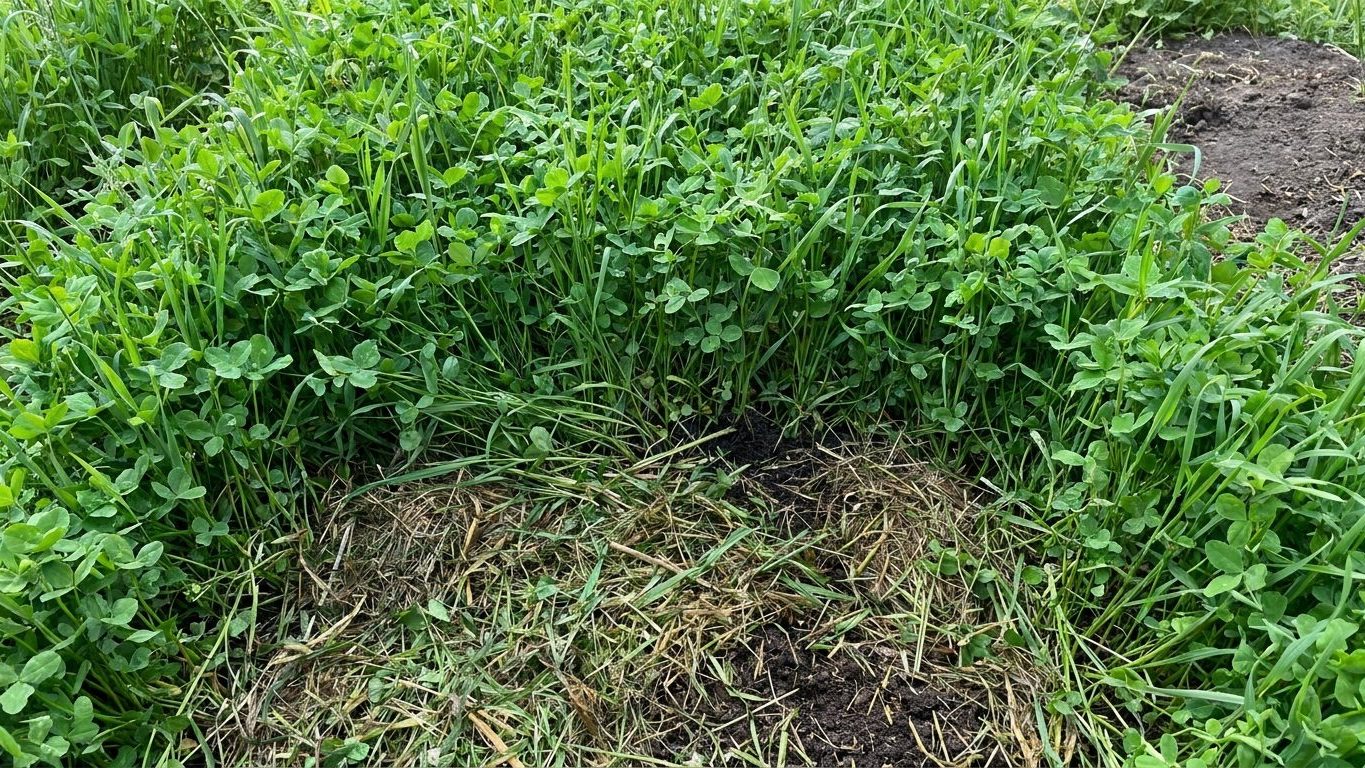

A cover crop suppresses weeds two ways: while it’s alive, dense growth steals the light, water and space that weed seedlings need to establish; after it’s terminated, the leftover residue keeps blocking light and, in some species, releases compounds that slow germination. Which effect dominates depends on species, density and timing.
What is actually going on
The living phase works through straightforward competition. A weed seed needs light to trigger germination and open space to push through the soil surface. A thick stand of any cover crop, grass or legume, closes that canopy fast enough that most annual weed seeds never get the signal to sprout. This is why density matters more than species identity during the growing phase itself. A thin, patchy stand of the “best” weed-suppressing species will lose to weeds every time, while a thick stand of an ordinary one will often win.
The second phase starts the moment the cover crop is terminated, and it’s a completely different mechanism. Once the plant is cut, mowed, crimped or killed by frost, it stops competing and starts decomposing. During that decomposition window, two things can still suppress weeds: the physical mulch layer blocking light from reaching the soil surface, and, in certain species, chemical compounds released as the tissue breaks down that inhibit small seed germination. This second effect, often called allelopathy, is real but temporary and dose-dependent. It fades as the residue breaks down, and it can suppress desirable seeds just as easily as weed seeds if you plant into it too soon.
The timing of termination decides which weeds get controlled. Kill a Cover Crop too early and there’s not enough biomass to build a meaningful mulch layer. Kill it too late and the crop itself may have already dropped seed, creating a new weed problem out of the plant you meant to use for control. Somewhere in between is a window, specific to each species and each region’s season length, where biomass is high enough to matter and seed production hasn’t started.
What this means practically: a cover crop is not a single weed-control event. It’s two overlapping windows, a living-competition phase and a residue phase, and a garden plan needs to account for both rather than treating “planting a cover crop” as one action with one effect.
In the garden
Different plant families lean on different sides of that mechanism. Grasses tend to build dense, fibrous growth that shades well while alive and leave residue that resists breaking down quickly. Legumes are usually slower to close a canopy but contribute a nitrogen benefit as they decompose, through the nitrogen fixed by bacteria in their root nodules being released back into the soil, a mechanism worth understanding even though the actual amount released depends on species, total biomass grown and how the residue is terminated. Brassicas germinate fast and can close a canopy quicker than almost anything else, and some release biofumigant compounds when their tissue is disturbed. A fast-growing warm-season option like buckwheat outcompetes summer annual weeds through sheer speed rather than density.
| Species group | How it suppresses weeds | What goes wrong if mistimed |
|---|---|---|
| Cereal grasses (rye, oats) | Dense living canopy plus slow-to-break-down, allelopathic residue | Left too long, residue can also suppress germination of the vegetable seed planted after it |
| Legumes (crimson clover, hairy vetch) | Moderate living competition, nitrogen contribution as residue decomposes | Grown alone, slow establishment leaves gaps weeds exploit before canopy closes |
| Brassicas (mustard, forage radish) | Fast canopy closure, biofumigant compounds released when tissue is disturbed | If terminated dry rather than chopped and incorporated while green, the compound release is weak or absent |
| Buckwheat | Rapid growth outcompetes summer annuals for light within weeks | Left past flowering, it reseeds itself and becomes the weed it was planted to control |
Mixing a grass with a legume is common for a reason: the grass supplies the density that closes the canopy fast, and the legume adds the nitrogen contribution the grass can’t. Grown alone, each has a gap the other fills.
The honest limit
None of this touches established perennial weeds. Bindweed, quackgrass, Canada thistle and similar species survive underneath a cover crop canopy through root systems that store enough energy to push back up once the cover crop is gone. A dense stand may slow their spread for a season, but it will not starve out a root system that’s already established. Perennial weeds need to be dealt with directly, through repeated cutting, smothering with a longer-term mulch, or physical removal, before a cover crop rotation is worth relying on for suppression.
What it depends on where you are
Everything above is mechanism, and mechanism travels. What doesn’t travel is timing, and timing is where this page has to stop being specific. Season length decides how many weeks a cover crop has to build biomass before it needs to be terminated for the next planting. Summer heat decides whether a cool-season species like crimson clover survives into a second growth flush or burns out early. Summer rainfall decides whether residue breaks down over a few weeks or sits nearly intact for months, which changes how long the mulch-suppression effect actually lasts.
A gardener in a short-season northern climate and a gardener in a long, humid southern one are working with the same plant biology but a completely different calendar. The window for terminating a grass cover crop before it sets seed might fall weeks apart between the two, and a species that reliably winter-kills in one region may need mechanical termination in another because the ground never freezes hard enough.
This is also where soil type quietly changes the outcome. Heavier clay soils hold moisture longer, which slows residue breakdown and stretches the mulch-suppression phase; sandy soils dry and decompose residue faster, shortening it. None of that is something a general guide can specify without guessing.
The practical move is to treat this page as the mechanism and the local Cooperative Extension office as the calendar. Extension agents track first and last frost dates, typical summer rainfall patterns and locally tested termination windows for the exact species being considered, and most offer that guidance free by phone or in person. The state-level guides on this site narrow the mechanism down further, but the final adjustment, this year, this soil, this weather, still belongs to a local source.
The mistake that costs the most
The single most expensive mistake is letting a cover crop run past its termination window because more growth looks like more weed control. It doesn’t work that way. Once a cover crop flowers and sets seed, whatever weed suppression it was providing gets replaced by a new problem: a self-seeding population of the cover crop itself, competing with next season’s plantings the same way the weeds it was meant to control would have.
This is especially costly with fast, aggressive species. Buckwheat left two extra weeks past flowering can drop enough seed to volunteer through an entire bed for the rest of the season. Cereal rye left standing too long hardens and sets seed that survives mowing and resprouts. Even a slower legume like hairy vetch, if left unchecked into its second year in a mild climate, can behave enough like a weed that removing it becomes its own project.
The fix isn’t a fixed calendar date, since that date moves by region and by year’s weather. It’s watching the plant rather than the clock: terminate at first flower, or just before, when biomass is highest but seed hasn’t set. Mechanical methods, mowing, crimping, cutting, or simply letting a hard frost finish a tender species, all work at that stage without needing anything beyond a mower or a pair of loppers.
Growers who track this stage instead of a date on a calendar get the full benefit of both suppression phases, the living competition and the residue mulch, without paying for it with a volunteer population the following spring. The species that suppresses weeds best is the one terminated at the right growth stage, not the one left to grow the longest.