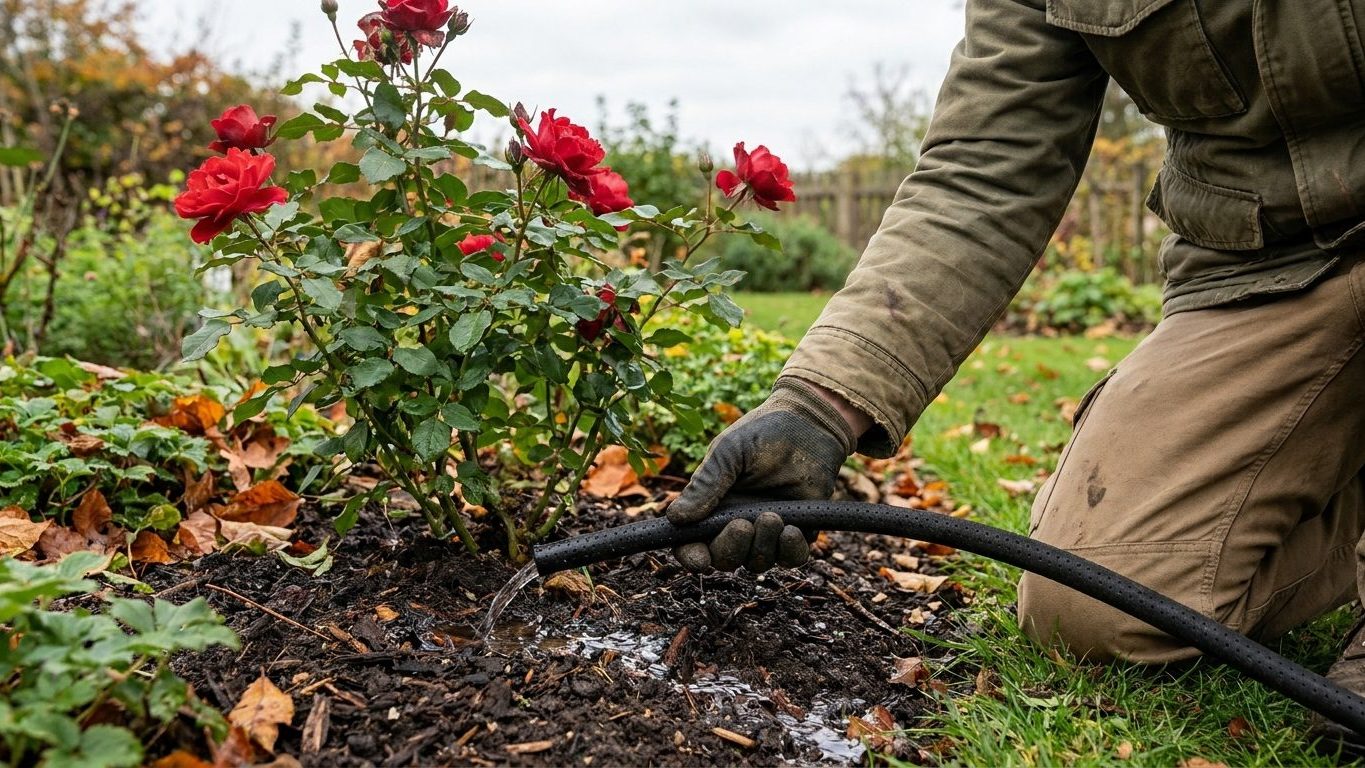

Roses need deep, infrequent water at the soil line, not a daily sprinkle from above. The rule of thumb is about 1 inch of water a week, counting rainfall, delivered slowly enough to soak down 12 to 18 inches. Overhead watering wets the foliage, and wet leaves are exactly what powdery mildew and black spot need to spread.
Why this matters
Water is what pushes a rose’s roots down instead of sideways. A deep, occasional soaking trains roots to chase moisture lower in the soil profile, which is where clay and loam (the soils roses tolerate, per NC State Extension) hold water longest during a dry stretch. Shallow, frequent watering does the opposite: roots stay near the surface, and the plant wilts fast the moment you skip a day.
Skip watering during a bloom flush and petals stay smaller, stems thinner, and the plant drops buds early to conserve itself. Overdo it, especially with water landing on the canopy, and you’re setting up the two diseases NC State Extension names most often on roses: black spot and powdery mildew. Black spot overwinters both in fallen leaves and in lesions on the canes themselves, so a single season of wet foliage can leave spores in place for the next year regardless of how clean you keep the mulch.
When to do it
A newly planted rose needs water more often than an established one, simply because its root system hasn’t spread far enough to draw from surrounding soil. Once the plant has settled in and put out steady new growth, shift to watching the plant rather than the calendar.
The first flush of flowers is the highest-demand period of the growing season. Producing that many blooms, each with flower parts in multiples of five and up to twenty-plus petals on a double variety, costs the plant real moisture, so this is when a missed week shows up fastest as wilted buds or flowers that open small. As hips begin forming later in the season, water use naturally tapers because the plant is no longer pushing constant new shoots.
Check the plant itself before deciding to water: leaves that lose their glossy look and start to hang rather than stand out from the stem are an early sign, well before visible wilting. Push a finger or a trowel 2 inches into the soil near the drip line; if it’s dry at that depth, it’s time. Mulch that looks dry on top but stays cool and damp underneath means the plant doesn’t need water yet, regardless of how many days have passed since the last soaking.
How to do it
Start at the soil, not the plant. A soaker hose or drip line laid in a ring around the base, roughly at the edge of where the canopy spreads, delivers water exactly where the roots are without ever touching a leaf. If you’re watering by hand with a can or hose-end wand, aim the stream at the soil surface and hold it there rather than passing it over the top of the shrub.
For an established rose, a slow soak of 5 to 10 gallons once or twice a week (adjusted up in sandy soil, down in heavier clay that drains slowly) roughly matches the 1-inch-per-week benchmark. That sounds like a lot from a watering can, which is exactly why a soaker hose or drip emitter left running for 30 to 45 minutes is easier to manage than repeated trips with a bucket. The goal isn’t a number on paper, it’s soil that’s moist 12 to 18 inches down when you check it with a trowel, not just damp on the surface.
Timing within the day
Water in the morning if you have a choice. Morning watering gives any incidental splash on lower leaves time to dry before evening, when cooler temperatures and dew would otherwise keep foliage wet overnight, the exact condition that favors botrytis and the leaf spots NC State Extension lists among common rose diseases. Evening watering isn’t disqualifying, but it stacks the odds against you.
Watch the runoff, not the clock. If water starts pooling and running off the surface before it’s had time to soak in, you’re applying it faster than the soil can absorb, especially likely in compacted clay. Pause for ten minutes and resume, or switch to a slower-flow emitter. Done correctly, the soil around the base should look uniformly dark and moist to a depth you can feel with two knuckles pressed in, with no standing puddle left an hour later.
Mulch as part of the method
A 2 to 3 inch layer of mulch around the base, kept a few inches back from the crown, slows evaporation enough to stretch the interval between waterings and buffers soil temperature swings. It’s not a substitute for watering, but it changes how forgiving your schedule can be, particularly useful during the demanding first bloom flush.
What goes wrong
Overhead watering is the single most common mistake, and it often comes from good intentions, someone hosing down the whole plant because it looks refreshing or because it’s a quick way to knock dust off the leaves. That same water sitting on foliage overnight is what lets black spot and powdery mildew establish. If you see dark, ring-shaped spots on leaves or a white powdery coating on new growth, look back at how you’ve been watering before blaming the weather.
Light, frequent sprinkling is the mistake that looks like extra care but isn’t. Watering a little every day feels attentive, but it wets only the top inch or two of soil, which trains roots to stay shallow and leaves the plant far more vulnerable the first time watering is missed. A rose watered deeply twice a week is usually in better shape than one watered lightly every single day.
Underwatering during the first bloom flush shows up as buds that stall half-open or flowers noticeably smaller than the plant produced earlier in the season. Overwatering in heavy clay, on the other hand, shows up as yellowing lower leaves and a general wilted look even though the soil is wet, a sign roots are sitting in waterlogged, oxygen-starved soil rather than actually thirsty.
Doing it differently
Container-grown roses dry out faster than anything in the ground, because pots have far less soil mass to buffer moisture loss and drainage holes let water leave quickly. Expect to check container roses every day in warm weather, watering whenever the top inch of potting mix is dry, rather than following a weekly schedule built for garden beds.
Raised beds sit between containers and open ground: they drain faster than native soil but hold more water than a pot, so they usually need watering somewhat more often than an in-ground bed of the same size, especially if the mix leans sandy.
Greenhouse-grown roses face the opposite problem: the enclosed, humid environment keeps foliage wet longer after any splash, raising the risk of botrytis and powdery mildew even when soil watering is done correctly. Good airflow and watering strictly at the soil line matter more indoors than out.
Drought tolerance also varies by cultivar rather than by group as a whole. Rugosa types are generally known for handling drier soil once established, but that’s a trait to confirm on the specific plant’s tag or cultivar page rather than assume across an entire class of roses.
Common questions
How much water does a rose bush need per week?
Roughly 1 inch of water a week, including any rainfall, applied slowly enough to soak 12 to 18 inches down rather than staying near the surface.
Can you water roses with a sprinkler?
It’s better avoided. A sprinkler wets the foliage, and roses are documented as susceptible to powdery mildew, black spot, and other leaf diseases that spread faster on wet leaves. A soaker hose or drip line at soil level does the same job without that risk.
Do rose thorns get worse with overwatering or stress?
The sharp structures on rose stems are prickles, not true thorns, since they grow from the stem’s outer skin rather than being a modified stem underneath. Watering practices haven’t been documented here as changing how many form; treat them as a fixed trait of the plant rather than a symptom to manage.
Should I water roses differently after deadheading?
Not because of the cut itself. Each deadheading cut pushes new growth, and that new growth has the same water needs as any other actively growing shoot, so keep the same soil-level, deep-and-infrequent approach through the rest of the bloom cycle.