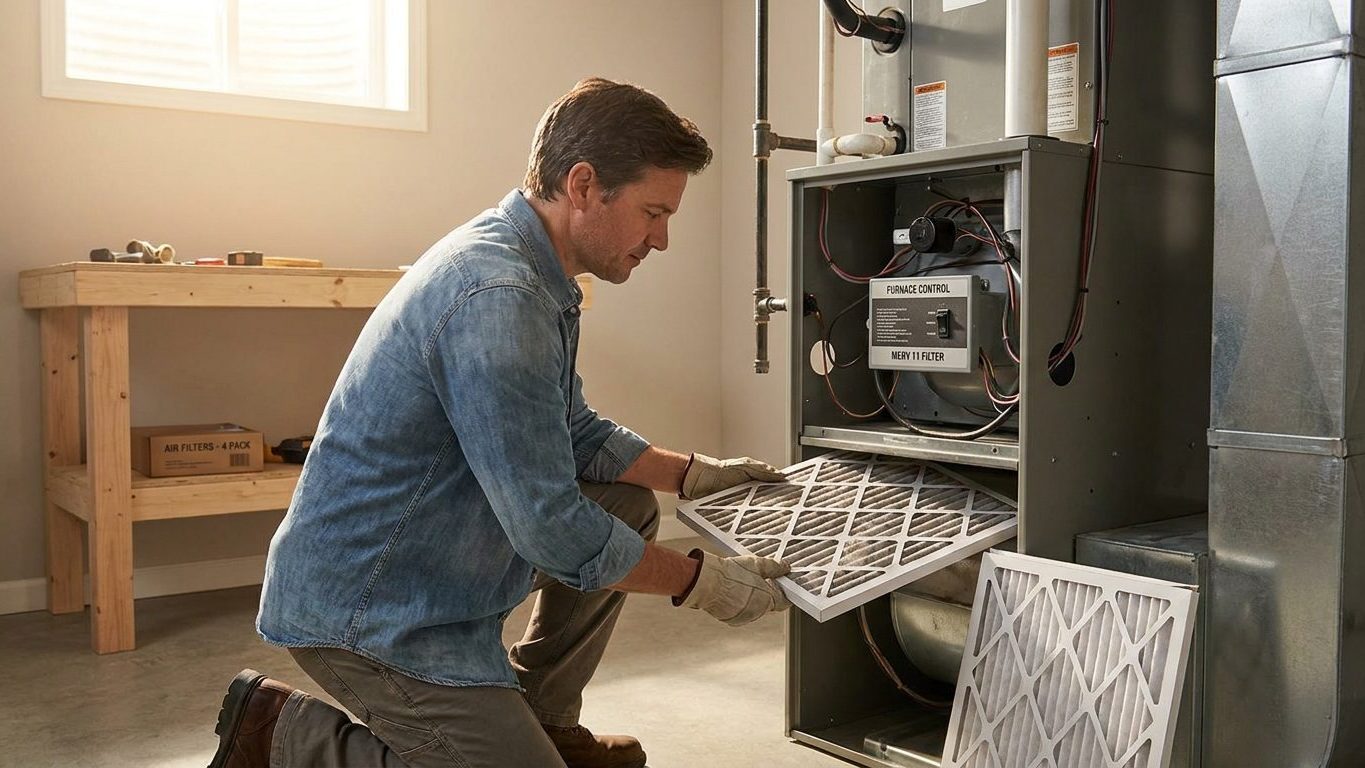

The pass is a single walk-through of your central air system before the first real hot stretch: filter, outdoor coil, and airflow at the vents. It takes under an hour, and doing it now, while the weather is still mild, is what separates a system that holds steady all summer from one that starts fighting itself the first week it actually has to work.
The Pass to Make Before Summer
Central air systems don’t fail in July because of one bad part. They fail because small restrictions pile up over a season of sitting mostly idle, and then get asked to run flat-out the moment the temperature spikes. A furnace filter that’s been catching dust since fall, an outdoor coil half-buried in last season’s leaves, a vent that got covered by a rug over the winter: none of these are dramatic on their own. Together, they change how hard the whole system has to work to move the same amount of air.
Here’s the mechanism worth understanding. A central air system is built around a fixed amount of airflow moving across a coil. When that airflow is unrestricted, the system pulls heat out of your house efficiently and shuts off once it hits the set temperature. When something upstream, like a clogged filter, chokes that airflow, the system has to run longer to move the same volume of air past the coil. Run longer under strain, and the parts that only get exercised seasonally, the compressor, the blower motor, start absorbing stress they weren’t built to handle for extended stretches.
That’s why timing matters as much as the check itself. Doing this pass in mild weather, before the first 90-degree day, means you’re testing a system under low demand. If something’s off, you’ll notice a weak vent or a sluggish start-up when it barely matters. Wait until the heat wave arrives, and the same weak point shows up as a system that can’t keep the house below 80 degrees on the one day everyone in the house is home and irritable.
There’s also a seasonal-transition problem specific to systems that sit unused for months. A blower motor that hasn’t turned since last September, a capacitor that’s been sitting fully charged and unused, an outdoor fan that’s been still while pollen and grass clippings settled onto the coil fins: all of that accumulates quietly during the off-season. None of it announces itself until the system is asked to run continuously for the first time. A system that starts the season clean draws air freely from the first cycle. One that starts the season clogged is already fighting itself before the first genuinely hot day even arrives, and that fight only gets worse as outdoor temperatures climb and the system runs more hours per day.
How to tell, in your own house
The order matters here. Start with what costs nothing and takes five minutes; stop only once you’ve hit the point where the tools or the risk change.
- Check the filter first, tonight. Per U.S. ENERGY STAR guidance: “Inspect, clean, or change air filters once a month in your central air Conditioner, furnace, and/or heat pump.” That’s the standard for all three pieces of equipment together, not just the furnace, which is a common mix-up for anyone whose system is a heat pump or straight central AC with no furnace attached. Hold the filter up to a light; if you can’t see light through it clearly, replace it.
- Walk out to the Outdoor Unit. Clear leaves, grass clippings, mulch, and any plants growing within about two feet of the cabinet. Airflow into that unit is the whole reason it works; anything smothering it forces the system to strain to pull air through.
- Check every supply vent and return in the house. Furniture pushed against a vent, a rug over a floor return, a closed door in a room with no return air, all of these restrict the same airflow the filter check protects, just further downstream.
- Run the system for fifteen minutes and listen. A healthy system has a steady hum. Rattling, grinding, or a hissing sound near the indoor unit are signs something mechanical or refrigerant-related needs attention.
- Look at the indoor coil area and the refrigerant lines for ice. Frost or ice on the lines, even in mild weather, points to a refrigerant or airflow problem that a filter change won’t fix.
The boundary is precise: once the issue involves refrigerant, electrical components inside the condenser cabinet, or the sealed coil itself, that’s licensed-technician territory. Handling refrigerant legally requires EPA certification, and opening the sealed side of the system without it is not just a warranty risk, it’s against federal regulation. Everything before that line, filters, clearance around The Outdoor Unit, vents, is yours to handle. Everything after it belongs to someone with a gauge set and a license.
What it costs you to ignore it
Skip the pass, and the cost shows up in three places, in order.
Comfort goes first. Restricted airflow means uneven cooling: some rooms stay warm no matter what the thermostat says, because the system can’t move enough conditioned air to reach them. You’ll notice it as a house that never quite feels right, not because the AC is broken, but because it’s working against itself.
The equipment goes next, and this is the expensive part. A coil starved of airflow can ice over, and once ice forms, it blocks even more airflow, which makes more ice form. That cycle can escalate quickly, and it can end with the whole system shutting down mid-heatwave, precisely when you need it most and precisely when a technician’s schedule is hardest to get onto. A compressor that runs constantly under strain, rather than cycling normally, also wears down faster than one that’s allowed to breathe.
The bill comes last but lingers longest. A system fighting a dirty filter or a smothered outdoor coil has to run more hours to hit the same set temperature. More runtime, at the same efficiency the system was designed for, means more electricity used to do the same job a clean system does faster. None of that shows up as a dramatic spike overnight. It shows up as a summer that costs more than it should, for a comfort level that’s worse than it should be.