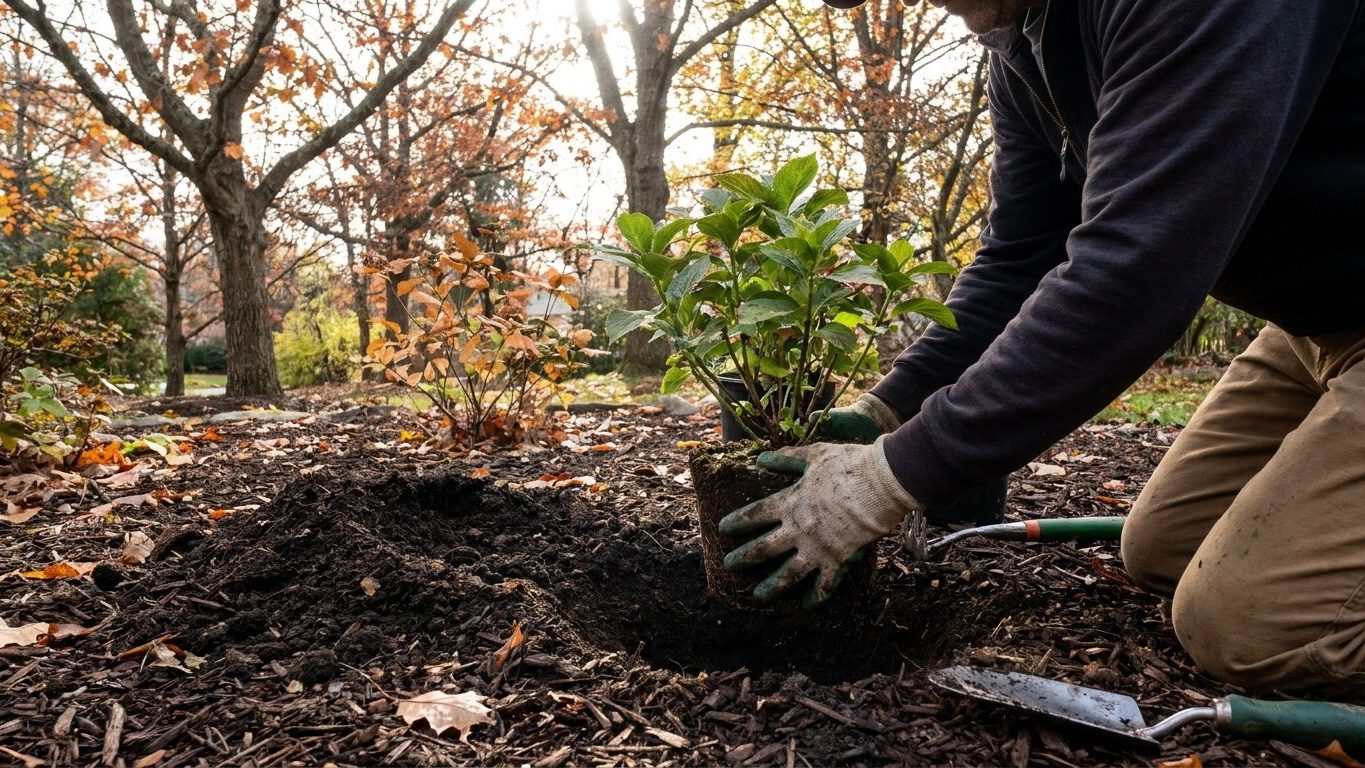

The right spot and depth depend on which hydrangea you’re planting. Shallow-rooted types like bigleaf and panicle hydrangea want the root flare level with the surrounding soil, never buried, and a site matched to their light needs, since a mop-head baked in afternoon sun and a panicle hydrangea buried in shade will both struggle for the same reason: wrong light, not bad soil.
Why this matters
Placement decides how much light the plant gets relative to what its type tolerates, and that single variable controls leaf scorch, flower count and disease pressure for years. Bigleaf hydrangea needs dappled sun or partial to deep shade and resents afternoon sun; panicle hydrangea is the one type in the genus that takes full sun well. Put either in the wrong light and you’re not fixing a planting mistake later with fertilizer or pruning, you’re fighting the site every season.
Depth matters just as much, for a narrower reason: both bigleaf and panicle hydrangea are shallow-rooted. Plant them too deep and the crown sits in soil that stays wetter and cooler than the roots are built for, inviting rot rather than growth. Get placement and depth right at planting and maintenance drops to what the genus is rated for, which NC State Extension Gardener Plant Toolbox classifies as low. Get it wrong and you’re managing a stressed plant indefinitely, no matter how much care follows.
When to do it
Watch the plant, not the calendar. The best window is when it is not actively pushing soft new growth and not in bloom, since transplanting during active leaf-out or flowering diverts energy the roots need to reestablish. Buds still tight and just beginning to swell signal that root activity is resuming underground before top growth catches up, exactly the moment a newly planted or transplanted hydrangea can knit into the surrounding soil with the least shock.
If you’re moving a hydrangea that already flowered, wait until that flush of new growth has ripened and firmed rather than moving it while stems are still soft and green, since soft wood is more easily damaged by root disturbance. For container-grown plants, check the drainage holes: roots visibly circling or emerging there mean the plant is more than ready and shouldn’t sit in its pot any longer, regardless of season.
None of this replaces knowing your local frost timing or your type’s specific pruning window, both of which vary by zone and by whether the plant flowers on old or new wood. That detail belongs on the state-level and type-level pages in this guide; this page only covers the planting act itself.
How to do it
Start by matching the type to the spot, since this decision can’t be corrected later without digging the plant up again.
| Type | Light | Mature size | Flowers on |
|---|---|---|---|
| Bigleaf / mop-head / lacecap | Dappled or partial to deep shade; protect from afternoon sun | 3-6 ft tall and wide | Last year’s wood |
| Panicle / peegee | Full sun (the only type that takes it well) | 8-25 ft | Current season’s growth |
| Smooth (e.g. Annabelle) | Sun to part shade | Shrub-sized, hardiest of the genus | New wood |
| Oakleaf | Sun to part shade | To about 5 ft | Old wood |
| Mountain | Similar to bigleaf | Shrub-sized | Old wood, buds handle late frost better |
| Climbing | Sun to shade, needs a surface to cling to | 15 ft and more | Old wood, slow to first flower |
Once the spot is chosen, dig a hole roughly twice as wide as the root ball but no deeper than it. Hydrangeas accept clay, loam or sand, and tolerate soil from acid to alkaline, so amending the whole bed isn’t necessary; what matters is drainage. The genus tolerates occasional wetness but not a hole that holds standing water like a bowl, so if the sides glaze over and water sits after a test fill, break up the walls or choose a different spot rather than fighting the drainage with amendments.
Loosen the root ball before it goes in the hole. If the plant is pot-bound, tease the outer roots apart with your fingers or make a few shallow vertical cuts with a clean knife; skip this on a climbing hydrangea’s fine aerial-rootlet growth and just settle it gently, since that type is already slow to establish. Set the root ball so its top sits level with, or very slightly above, the surrounding soil grade. This is the number that matters most for a shallow-rooted shrub: bury the crown even an inch too deep and you’re inviting the rot that shallow roots are prone to when drainage is off.
Backfill with the soil you removed, firming it gently by hand, then water in slowly and deeply so the soil settles without leaving air pockets. Finish with a couple of inches of mulch, pulled back a few inches from the stems, since a mulch pile against the stem invites the same rot as planting too deep. If you’re planting a bigleaf or mountain hydrangea and care about flower color, this is also the moment to think about soil pH, since soil under about 5.5 pushes flowers blue and above about 6.5 pushes them pink, with purple in between. That’s a slow-acting decision best made now rather than after the plant is established.
What goes wrong
Planting too deep is the most common failure and the hardest to spot early, because the plant may leaf out normally the first season before decline shows up the next year as stem rot at the soil line, sparse new growth, or a plant that never gains size. If you suspect this, check by brushing soil away from the base to see if the root flare is buried.
The mistake that looks like extra care but isn’t is heavy fertilizing at planting time, especially with a high-phosphorus formula meant to “help the roots establish.” Phosphorus locks up the aluminum that blue-flowered bigleaf and mountain Hydrangeas depend on, so a well-meaning feeding decision shows up months later as flowers drifting pink when you wanted blue. Coffee grounds belong in the same category: they shift soil pH by a negligible amount and do nothing for the available aluminum that actually drives color.
Wrong light for the type is the other frequent error, and it’s a placement mistake rather than a technique one. A bigleaf hydrangea in direct afternoon sun will show scorched, crispy leaf edges by midsummer; a panicle hydrangea stuck in deep shade grows leggy and blooms poorly despite otherwise correct planting. Neither is fixable with better watering or fertilizer, only with moving the plant or accepting the decline.
Piling mulch against the stems, sometimes called mulch volcanoing, deserves its own mention since gardeners do it thinking it protects the base. On a shallow-rooted, rot-prone plant it does the opposite, trapping moisture against tissue that needs to stay relatively dry.
Doing it differently
Container growing works, but the type has to fit the pot for life, not just for the first year. A panicle hydrangea’s 8- to 25-foot mature spread makes it a poor long-term container candidate; a bigleaf or mountain hydrangea, staying in the 3- to 6-foot range, is a more realistic fit. Whatever the type, drainage holes are non-negotiable given the genus’s preference for good drainage even though occasional wetness is tolerated in the ground.
Raised beds earn their keep specifically for bigleaf and mountain hydrangeas where color matters, since a raised bed lets you build and hold a soil chemistry, acid for blue, alkaline for pink, isolated from whatever lime or fertilizer runoff is happening in the surrounding lawn. That isolation is a genuine advantage, because pH drift from neighboring soil is one of the more common reasons color doesn’t hold.
Climbing hydrangea calls for one more adjustment regardless of bed type: since it clings by aerial rootlets and is slow to start flowering, put the support structure, trellis, wall or fence, in place before or at planting rather than after, so the plant can begin attaching itself from its first season instead of sprawling loose while you retrofit support later.
Common questions
How deep should I plant a hydrangea from a container?
No deeper than it was growing in the pot. The top of the root ball should sit level with, or a touch above, the surrounding soil grade, since bigleaf and panicle hydrangea are both shallow-rooted and prone to rot if the crown is buried.
Can I plant a hydrangea in full sun?
Only panicle hydrangea takes full sun well; the source describes it as a substitute for bigleaf hydrangea where that species isn’t winter hardy. Bigleaf, mountain, oakleaf and climbing types do better with dappled light or partial to deep shade, protected from afternoon sun.
Does soil pH at planting affect flower color right away?
It applies only to bigleaf and mountain hydrangeas, and it works gradually, not instantly. Below about pH 5.5 pushes flowers blue, above about 6.5 pushes them pink, and the shift comes from aluminum availability rather than the pH number itself. Panicle, smooth, oakleaf and climbing hydrangeas don’t change color with soil pH at all.
Do I need to stake or support a newly planted hydrangea?
Most types don’t need staking if the root ball is set properly and mulched. Climbing hydrangea is the exception: since it clings by aerial rootlets and grows 15 feet or more, give it a wall, fence or trellis to grow onto from the start rather than waiting for it to sprawl on the ground.