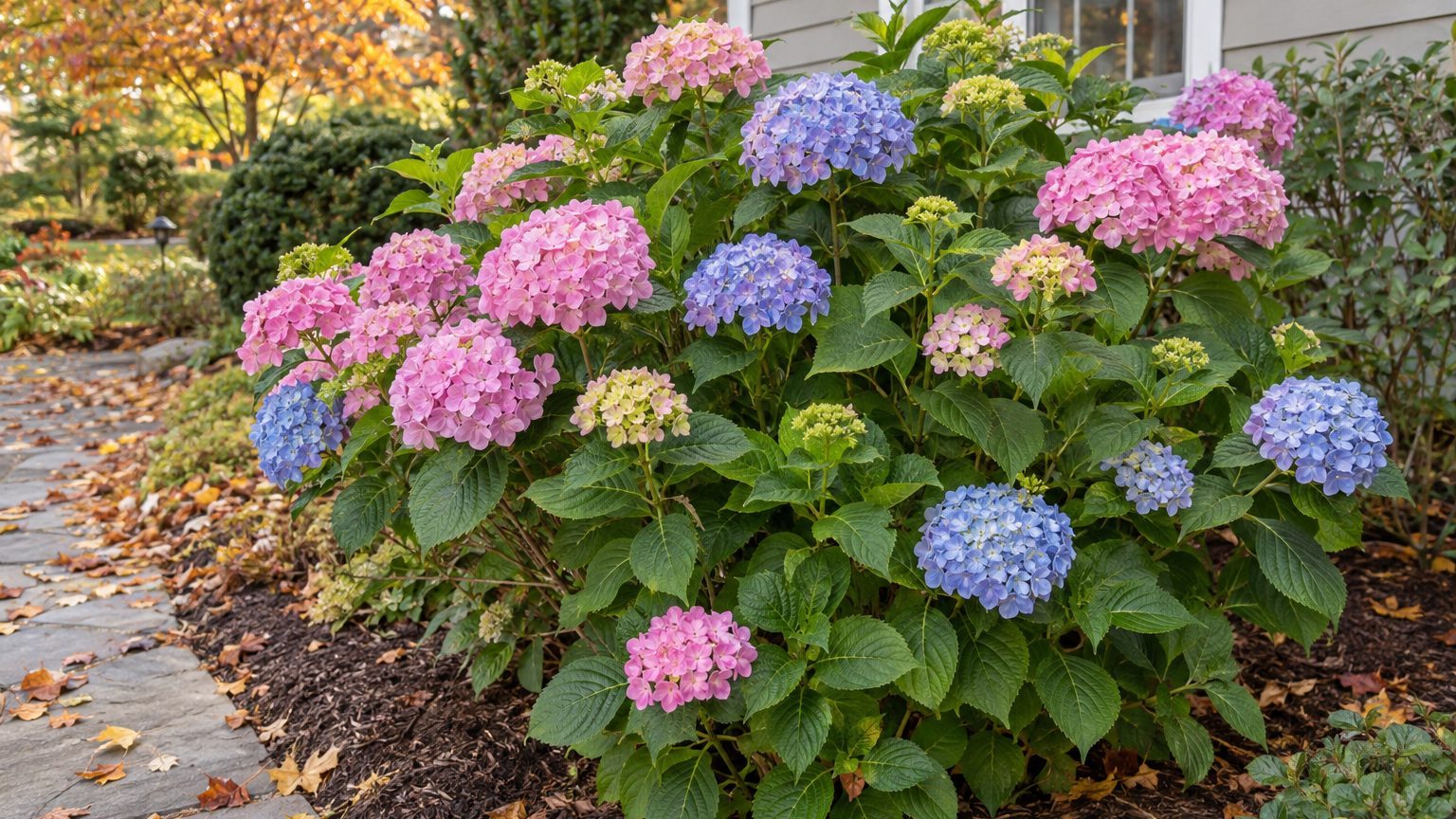

A reblooming hydrangea is usually a bigleaf type bred to set flower buds on new growth as well as on last year’s wood. That buys insurance: a late frost or a badly timed cut no longer wipes out the whole season. It does not buy extra hardiness, a different color rule, or relief from shade and watering needs. Think of it as a bigleaf with a safety net.
Why this matters
A standard bigleaf or mop-head (H. macrophylla) forms its buds the previous summer and carries them through winter on old wood. A hard spring frost or a spring prune removes those buds, and the plant leafs out with no flowers. Rebloomers can also form buds on the current season’s shoots, so the damage costs you the early flush, not the year. If you treat the plant like a standard bigleaf and never encourage new-wood flowering, you pay extra for a trait you never use. If you cut it back hard every spring, you trade the early flush for a later, thinner one.
What stays the same matters just as much. Bigleaf Hydrangeas are listed for USDA zones 6a to 11b, and a rebloomer label does not push that range north. The genus as a whole spans zones 3a to 9b, but that depends entirely on the type. Panicle (H. paniculata, zones 3a to 8b) and smooth hydrangeas (H. arborescens, such as Annabelle) already flower on new wood, so “reblooming” tells you nothing about them. NC State Extension calls panicle a good substitute for mop-head where mop-head is not winter hardy. Your zone and your type decide the details. The state pages in this guide carry the local answers, and the How to Grow Hydrangeas guide covers the basics this page skips.
When to do it
Follow the plant, not the calendar. The first cue is the end of the first flush. When the sepals fade to a papery, greenish or dull tone and the heads stop looking fresh, look below them. Small pairs of leaves, and sometimes a tight cluster at a shoot tip, mean the plant is already building the next round. That is the moment to deadhead.
The second cue comes earlier. Once frost risk has passed where you live, watch for new shoots pushing from the base and from nodes on last year’s stems. Feed then, when growth is active, and not while the plant is dormant. Your zone sets when that happens, so check the state page for local timing.
The third cue is the slowdown. As shoots stop extending and the stem base turns from green and soft to firm and brownish, the wood is ripening and the plant is hardening for cold. From that point, stop feeding and stop cutting. Late pruning or late fertilizer pushes soft growth that frost tends to blacken, and it can take next year’s buds with it.
How to do it

Deadhead to a live node
Use clean bypass hand pruners. Wipe the blades with rubbing alcohol from the medicine cabinet between plants, especially if you have seen leaf spot or powdery mildew. Follow the spent flower stem down until you reach the first pair of plump, healthy buds or full leaves, then cut about a quarter inch above that pair on a slight slant. Done right, you see a clean cut, two visible buds just below it, and no bare stub. Do not chase the cut further down into leafless woody stem, because that is where buds do not reliably wake up.
Feed for the color you want
Use a balanced slow-release fertilizer, following the package for your plant size. Skip anything sold as a high-phosphorus “bloom booster,” since phosphorus ties up aluminum in the soil and pushes blue flowers toward pink. For blue, the plant needs available aluminum, which acidic soil releases. Flowers turn blue below about pH 5.5, pink above about pH 6.5, and purple in between. Aluminum sulfate acidifies the soil, and lime makes it more alkaline. Mix either one in a watering can according to the label instead of guessing by the scoop. Color change applies to bigleaf and mountain hydrangeas only.
Water, mulch, and leave the rest
Bigleaf and panicle hydrangeas are both shallow-rooted, so mulch helps. Spread shredded bark or leaf mold across the root zone and keep it off the stems. Water with a slow soak when the top of the soil dries, and skip daily sprinkling. Occasional wet feet are tolerated, but the soil should drain. Give bigleaf types dappled sun or shade, and protect them from afternoon sun.
Bigleaf trimmings are the only ones documented as toxic, and only when large quantities are eaten (the source lists nausea, stomach pain, vomiting and sweating, and notes cats, dogs and horses). Keep the clippings out of a paddock or a chewing dog’s reach. For flowers you want indoors, the same cut can double as a vase harvest, as covered in Cutting Hydrangeas for the Vase Without Them Collapsing.
What goes wrong

The most common failure is the hard spring prune. The plant comes back leafy and healthy but with few or no early flowers, because the old-wood buds were removed. A second flush may follow later, but the early show is gone.
Deadheading too deep is the next one. Stems cut into bare wood often stay bare, and you see gaps in the shrub the following year.
The mistake that looks like extra care is the bloom-booster feeding. A gardener sees fewer flowers, buys a high-phosphorus fertilizer, and applies it generously. The blue heads go pink or muddy purple the next round, because phosphorus locks up the aluminum the blue color depends on. Nothing on the plant looks sick, which is why the cause goes unnoticed.
Coffee grounds and citrus peel are the kitchen version of the same problem. The source repeats the belief that they acidify soil enough to turn flowers blue, but the pH shift is very small. Since acidity matters mainly because it releases aluminum, a bucket of grounds rarely delivers what soil testing and aluminum sulfate can. Use them as compost, not as a color treatment.
Late feeding or trimming shows up as blackened, soft shoot tips after the first hard frost. Afternoon sun shows up as scorched leaf edges and wilting by mid-day. Deer browse hydrangeas, so a rebloomer’s fresh shoots are just as exposed as any other, and the source’s mixed entries on deer are no reason to count on resistance.
Doing it differently
In containers, the roots sit in less insulating soil and dry out faster, so watering and mulching matter more, and the pot may need extra protection when temperatures fall. Protecting Hydrangeas Over Winter: Which Ones Need It explains which types need it. A pot also gives you direct control over pH, which makes color easier to steer than in native soil.
In cold zones, the better variation is often a different type. A panicle or smooth hydrangea flowers on new wood by nature, so late frost is not a concern and the label is beside the point. The table shows which types the rebloom idea applies to.
| Type | Flowers on | Color follows pH? | Does “reblooming” matter? |
|---|---|---|---|
| Bigleaf / mop-head / lacecap | Old wood (rebloomers also new) | Yes | Yes, this is the target |
| Mountain (H. serrata) | Old wood | Yes | Partly; buds take late frost better than bigleaf |
| Panicle | New wood | No | No, already flowers on new growth |
| Smooth (Annabelle) | New wood | No | No, and it is the hardiest of the genus |
| Oakleaf | Old wood | No | No; wine-red autumn foliage, about 5 feet |
| Climbing | Old wood | No | No; very slow to start flowering |
One more variation is the cut-back for wildlife. On panicle and smooth types, leaving stems 12 to 24 inches tall lets native bees nest in the hollow stems until they disintegrate. Bigleaf rebloomers should not get that hard a cut.
Common questions
Do reblooming hydrangeas bloom all summer?
Not as a rule. They can produce a second flush, but how many flowers and how long they last depends on your zone, the cultivar and your care. This page has no published figure for it, and any promised number would be a guess.
Can I cut a reblooming hydrangea back hard in spring?
You can, but you give up the old-wood flush, which is what most people plant them for. The right pruning window depends on your zone and type, so check the state page.
Will mine turn blue?
Only if it is a bigleaf or mountain hydrangea. Those turn blue below about pH 5.5, pink above about pH 6.5, and purple in between. Panicle, smooth, oakleaf and climbing types do not change with soil pH; they age through white, cream, pink or green.
Are they safe around pets and horses?
Only bigleaf hydrangea is documented as toxic, and only when large quantities are eaten. The compounds are hydracyanosides in the bark, flowers, leaves and stems, and they affect cats, dogs and horses. Ordinary garden contact is not the concern; a chewing animal is.