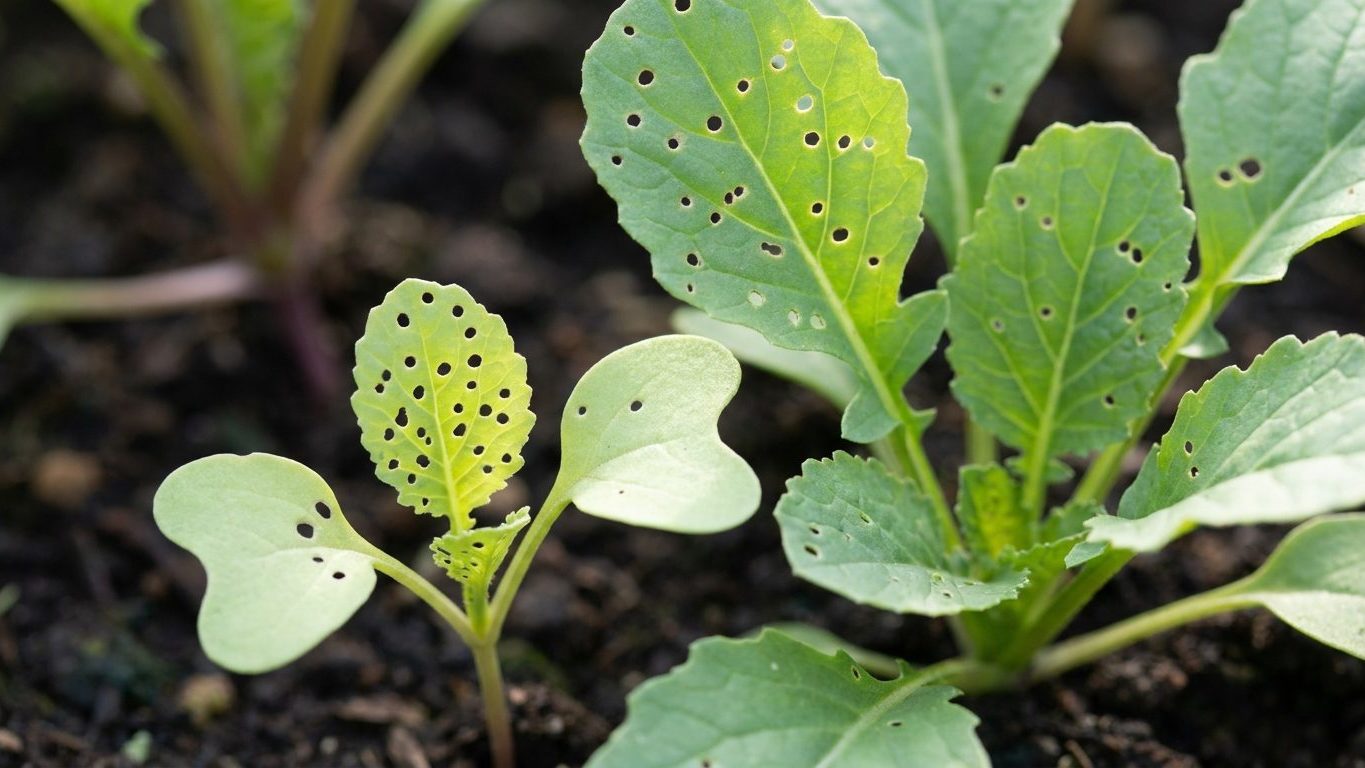

Shot holes in turnip or rutabaga leaves almost always mean flea beetles, small jumping beetles that chew a stippled, buckshot pattern across the leaf surface. On a plant with a dozen leaves, that damage is mostly cosmetic. On a seedling with two leaves, the same beetles can end the crop before it starts.
What is actually going on

The thing to understand here is feeding stage. Adult flea beetles do the visible damage: they chew small round or irregular pits into the leaf surface, and when there are enough of them, those pits merge into the classic lace-and-pepper look. Some species also have larvae that live in the soil and feed on roots or the underground stem, which is a separate, less visible problem from the leaf holes everyone notices first.
Age of the plant changes the stakes completely. A seedling at the cotyledon or first true leaf stage has almost no leaf tissue to spare. Flea beetles chewing on that small a leaf area can damage or destroy the growing point, and a seedling that loses its growing point does not recover, it stalls or dies. A mature plant with a full rosette of leaves and a root already sizing up underground can lose a meaningful percentage of leaf surface to shot holes and keep growing normally, because it has tissue and root reserves to spare that a seedling simply does not have.
Weather drives how bad any given season gets. Flea beetles are most active in warm, dry conditions, and feeding slows sharply during cool, wet stretches. That is why the same garden can have a rough flea beetle year followed by a quiet one with no change in what was planted or where, and why a planting made during a warm dry spell tends to take heavier pressure than one made into cooler, damper soil.
Turnip and rutabaga are brassicas, in the same family as cabbage, kale, and mustard, and they share this pest with all of them. Flea beetles that built up on a mustard cover crop or a nearby cabbage bed will move into a new planting of turnips without hesitation, which is why crop placement matters as much as anything done after the beetles show up. The rotation page covers how to sequence brassica plantings so the same ground, and the same overwintering pest and disease pressure, is not feeding directly into the next crop.
None of this calls for chemical control as a first move. The practices that matter most, exclusion at the vulnerable stage and timing the planting around peak beetle activity, are physical and cultural, not a product decision.
In the garden
Flea beetle pressure is not constant through the life of a turnip or rutabaga crop. It is heaviest at the start and mostly a non-issue by the middle, which is exactly backward from how most gardeners react to it. Here is what changes at each stage, and what tends to go wrong when the response does not match the stage.
| Growth stage | Risk level | What actually works | What happens if skipped |
|---|---|---|---|
| Seeding to cotyledon | High | Floating row cover laid at seeding time, before beetles find the row; clean seedbed free of old brassica residue and flowering weeds like wild mustard nearby | Beetles find bare, undefended seedlings within days; cotyledons get shredded and the stand can fail outright |
| First true leaves | Moderate to high | Row cover kept on through thinning; thinning done gently so remaining seedlings are not stressed and more attractive to beetles | Growth slows, plants fall behind weeds and neighboring crops, and a thin stand rarely catches back up |
| Full rosette, root bulking | Low, cosmetically | Cover can usually come off; scattered shot holes are tolerated, heavy infestations still warrant a look at overall plant vigor | Ignoring a genuinely heavy infestation at this stage can still slow root sizing, though it rarely kills an established plant |
| Root maturing, near harvest | Low from adults, some risk from soil-stage larvae | Brush soil off roots at harvest and check the crown and shoulder area for tunneling or scarring before deciding what goes into storage | A wounded root that goes straight into storage without a check gives rot organisms an entry point that shows up weeks later |
Trap cropping is worth knowing about even for a small garden: a strip of mustard planted slightly ahead of the main crop draws flea beetles away from the turnip or rutabaga row, since beetles generally prefer the more attractive sacrificial planting. It is not a guarantee, but it buys the main crop time during the exact window, seedling emergence, when time is what matters most.
Storage decisions should never rest on how a root looks at a glance. A root that seems sound in the garden can still carry a soft patch, a weeping spot, or the start of a moldy crown that only shows once it has sat in storage for a while. Any root with damage at the crown or shoulder, whether from flea beetle larvae or from a nick during harvest, should be inspected closely and used first rather than stored long term. And because turnip and rutabaga share this pest and its overwintering habits with cabbage, kale, and mustard, planting them where any of those grew the year before compounds the pressure rather than resetting it, which is the exact case the rotation page walks through in more detail.
What it depends on where you are
How much of a flea beetle problem shows up in a given garden depends heavily on things this page cannot know: the length of the growing season, how hot and dry the local summer runs, and how much rainfall interrupts beetle activity during the weeks right after seeding. Warm regions with long, dry stretches tend to support more beetle generations across a season, which means renewed pressure on later plantings even after an early one gets past the seedling stage cleanly. Regions with a shorter season and more variable rainfall often see one strong spring flush of beetles followed by a real decline as summer weather shifts, which changes how much protection a fall-seeded crop actually needs compared to a spring one.
Soil temperature and moisture at planting time also shift the calculation. Beetles are more active in warm, dry soil conditions, so the same row cover strategy that is essential for one planting window might matter less for another simply because conditions on the ground are different. None of that is something a national page can specify without guessing, and guessing here is exactly the kind of advice that leads a gardener to under-protect a vulnerable planting or over-protect one that never needed it.
This is where local information earns its keep. State and regional extension services track flea beetle emergence timing, generation counts, and pressure levels for their own areas, based on real monitoring rather than a general national average. That is also where a gardener can find the turnip and rutabaga varieties that have actually been trialled locally, since some perform more consistently under regional pest pressure than others, and this page is not the place to guess at names it cannot verify for a specific location. The state pages on this site are built to point toward exactly that kind of local detail, and a state extension service is worth a direct call or visit before committing to a planting date in a tough flea beetle year.
The mistake that costs the most
The single most expensive mistake with flea beetles on turnips and rutabagas is treating protection as something to add after the damage shows up. By the time shot holes are visible on a seedling’s first leaves, the beetles have already been feeding for days, and if the growing point took damage in that window, no cover applied afterward brings that seedling back. The plan that fails gardeners over and over is direct-seeding into bare soil, walking away, and only checking back once the true leaves are up, which is precisely the stretch when the plant has the least tissue to spare and the most to lose.
The fix is not a stronger response later, it is a different sequence from the start. Row cover goes down at seeding, not after the first holes appear, and it stays on through the seedling and early true-leaf stages when the plant genuinely cannot afford to lose tissue. Once the rosette is established and the root is sizing up, the same cover usually comes off without consequence, because a mature plant tolerates cosmetic feeding that would have been fatal three weeks earlier. Getting that timing backward, protecting a plant that no longer needs it while leaving a seedling exposed, is the pattern that turns a manageable pest into a lost planting.
Pair that timing with placement. A turnip or rutabaga seeded into ground that grew cabbage, kale, or mustard the season before starts the clock already behind, since the same brassica-feeding pests that overwintered nearby have a head start on finding the new planting. The rotation page lays out how to avoid stacking that pressure season after season. Cover early, remove the cover once the plant has outgrown the risk, and keep brassica plantings from following each other in the same bed. That combination, not a treatment reached for once the leaves already look bad, is what actually protects the crop.