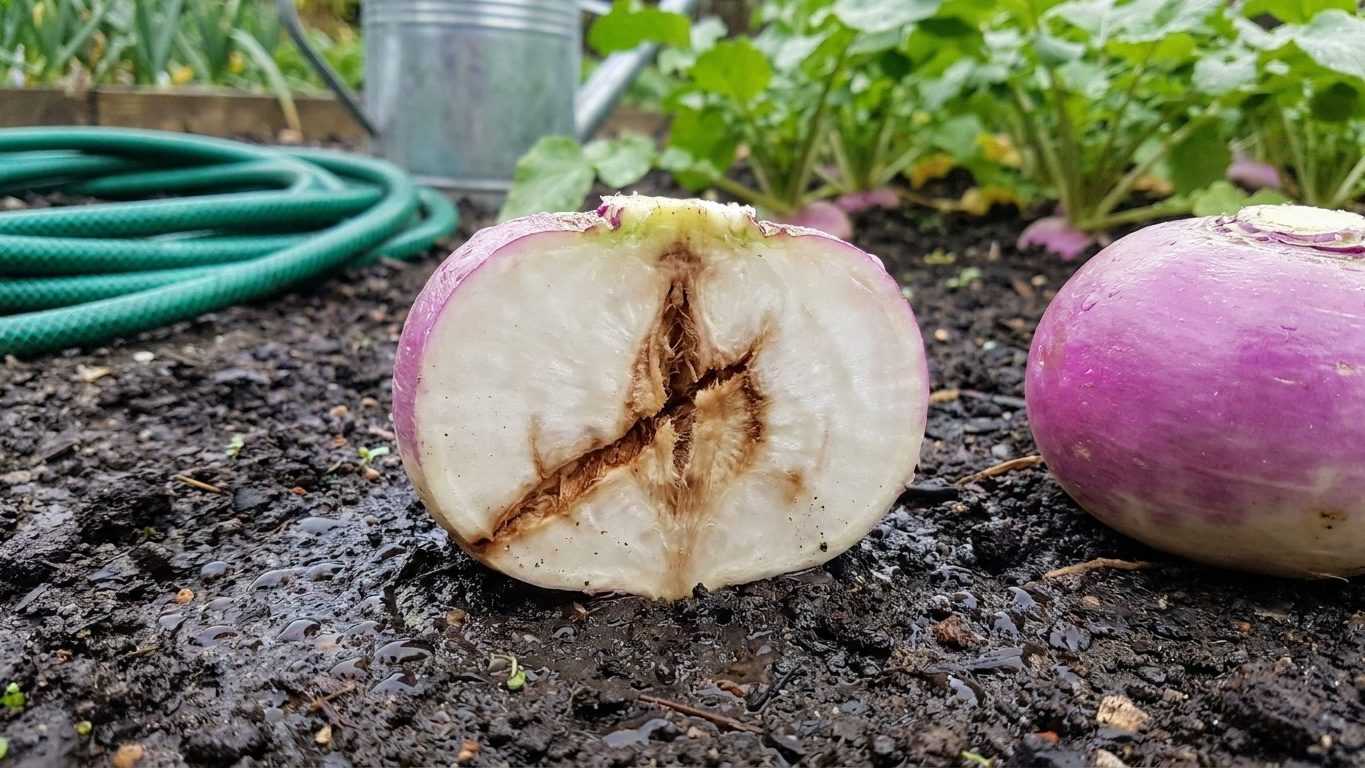

The short answer: Turnips and Rutabaga need even, consistent soil moisture, roughly an inch of water a week from rain or irrigation, because it’s the swings between dry and wet that split roots, not the total amount of water. A root that dries out and then gets soaked splits from the inside out. Consistency matters more than volume.
What is actually going on

The thing to understand here is growth rhythm: a root that stops and restarts grows woody at the pause and splits at the restart. Turnip and rutabaga roots swell by adding new cells in layers, a little like a tree adding rings, except the process runs over weeks instead of years. When soil moisture stays even, those layers form smoothly and the root expands at a steady pace. When the soil dries out, the outer layer of the root toughens and slows down, sometimes stopping growth almost entirely for days. That’s the woody pause. The inside of the root, though, doesn’t always get the same message right away.
Then rain comes, or a gardener finally remembers the hose, and the plant gets a sudden flood of available water. The interior tissue, still primed to grow, takes up water fast and swells. The outer layer, already hardened from the dry stretch, can’t stretch to match. Something has to give. That’s the crack you find when you pull a turnip and see a seam running down one side, or the hollow, corky center that shows up when you slice into a rutabaga that looked fine from the outside.
This isn’t a disease and it isn’t a pest, which is worth saying plainly because a lot of gardeners assume a split root means something got into the bed. It’s a mechanical failure caused by uneven water supply, full stop. That said, a stressed root is a more inviting target for problems that are pest and disease related, and turnip and rutabaga are brassicas, in the same family as cabbage, kale, and mustard. That matters for two reasons. First, they share vulnerabilities with those crops, including soil-borne organisms that build up when brassicas are planted in the same ground too often. Second, if a bed grew cabbage or kale last season, it hasn’t been rotated just because the crop looks different this year. A cracked, stressed root sitting in brassica-fatigued soil is more likely to develop soft rot or other secondary problems on top of the physical split, which turns a cosmetic issue into a real loss. The fix for the splitting itself is watering, but the fix for the bigger picture involves the same rotation planning that any brassica crop needs.
In the garden
Steady watering doesn’t mean watching the forecast obsessively. It means giving the bed a predictable rhythm and not letting long gaps build up between waterings, especially once the roots start to size up. The table below breaks down the common scenarios and what actually happens in each one, because a list of the “right” answer alone doesn’t explain why the wrong one fails.
| Watering pattern | What happens to the root |
|---|---|
| Even moisture, watered on a fixed schedule regardless of small rain events | Growth stays continuous, root layers form smoothly, skin stays smooth and unblemished |
| Long dry stretch followed by a heavy soaking or hard rain | Outer layer hardens during the dry spell, then splits when the interior swells rapidly after the soaking |
| Frequent light sprinkling that never reaches the root zone | Surface stays damp but roots sit dry a few inches down, producing the same woody-then-split pattern as a true dry spell |
| Overwatering with poor drainage | Roots sit in saturated soil, oxygen is limited, and the crop becomes prone to rot rather than splitting |
| Mulched bed with even watering underneath | Soil temperature and moisture both stay steadier, reducing the swings that cause cracking in the first place |
The practical habit worth building is checking soil moisture a few inches down, not just the surface, before deciding to water. A finger pushed into the soil near, but not right against, the row tells you more than a glance at the top crust. If it’s dry at that depth, water deeply enough to reach the root zone rather than giving a quick splash that only wets the surface. That single change, watering less often but more thoroughly and on a consistent interval, prevents most of the light-sprinkling failure mode in the table above.
Mulch helps more than most gardeners expect for this particular problem. A layer of straw or shredded leaves keeps the soil from swinging as hard between wet and dry, which is exactly the swing that causes splitting. It also keeps weeds down, which matters because weeds compete for the same moisture the roots need.
Come harvest, judge each root on what you actually see and feel rather than assuming a good-looking crop is a safe one. A soft patch, a weeping spot, or a moldy crown ends the question regardless of how the rest of the root looks, and that root should not go into storage or onto the table. Splitting itself is a physical flaw, not automatically a food safety issue, but a split root is an open door for organisms that do matter, so it deserves a closer look than an intact one.
What it depends on where you are
How much watering discipline a garden actually needs depends heavily on things this page can’t know: how long the growing season runs where you are, how hot summer gets, and how much rain typically falls during root sizing. A gardener in a region with reliable, evenly spaced rainfall through the fall root-growing window may need to intervene rarely. A gardener in a region prone to summer dry spells followed by sudden downpours is fighting the exact mechanism described above almost by default, and needs a deliberate watering schedule to counteract it.
Soil type shifts the calculation too. Sandy soil dries out fast and needs more frequent, lighter watering to stay even. Heavy clay holds water longer but drains slowly, which raises the risk of the overwatering and rot scenario instead. Neither soil type is wrong for turnips or rutabaga, but each asks for a different watering interval to hit the same goal of steady moisture.
Timing within the season matters as much as geography. Turnips and Rutabaga are typically grown as a fall crop in much of the country, planted in mid to late summer so the roots size up as the weather cools. That means the critical root-swelling window often lands right in the transition from summer heat into fall rain, a period that varies enormously from one state to the next in both timing and rainfall pattern. Rather than guess at a specific date or hardiness zone here, the more useful move is checking the state-level growing guides on this site and consulting your own state extension service, which tracks local rainfall trends and can point you toward the variety types that have performed well in regional trials. Extension offices also track pest and disease pressure by region, which matters given the shared brassica vulnerabilities mentioned earlier.
The mistake that costs the most
The single costliest mistake is letting the bed dry out because the calendar or the forecast said watering wasn’t due, and then compensating with a heavy soaking once the soil is visibly dusty or the leaves start to look tired. That one pattern, dry stretch followed by a big drink, is the exact mechanical trigger described earlier, and it’s the most common reason gardeners lose a chunk of an otherwise healthy crop right at harvest.
It happens gradually and often without the gardener noticing until pulling the roots. The leaves usually don’t wilt dramatically during the dry stretch, since turnip and rutabaga tops are fairly tolerant of short moisture gaps even while the developing root underneath is already hardening at the surface. That gap between what the top of the plant shows and what’s happening underground is exactly why so many split roots come as a surprise at harvest.
The fix isn’t more water overall, it’s more even water. Set a watering interval based on soil check-ins rather than visual cues from the leaves, and stick to it through the root-sizing weeks even when a light rain makes the top of the soil look damp. If a real dry spell does happen, because travel, weather, or a broken hose gets in the way, resist the urge to make up for it with one heavy soaking. Water a normal amount, then return to the regular schedule and give the roots a few days to resume steady growth before judging whether more water is needed. That patience is the difference between a bed of smooth, storable roots and one where half the harvest gets set aside because of a seam running down the side.