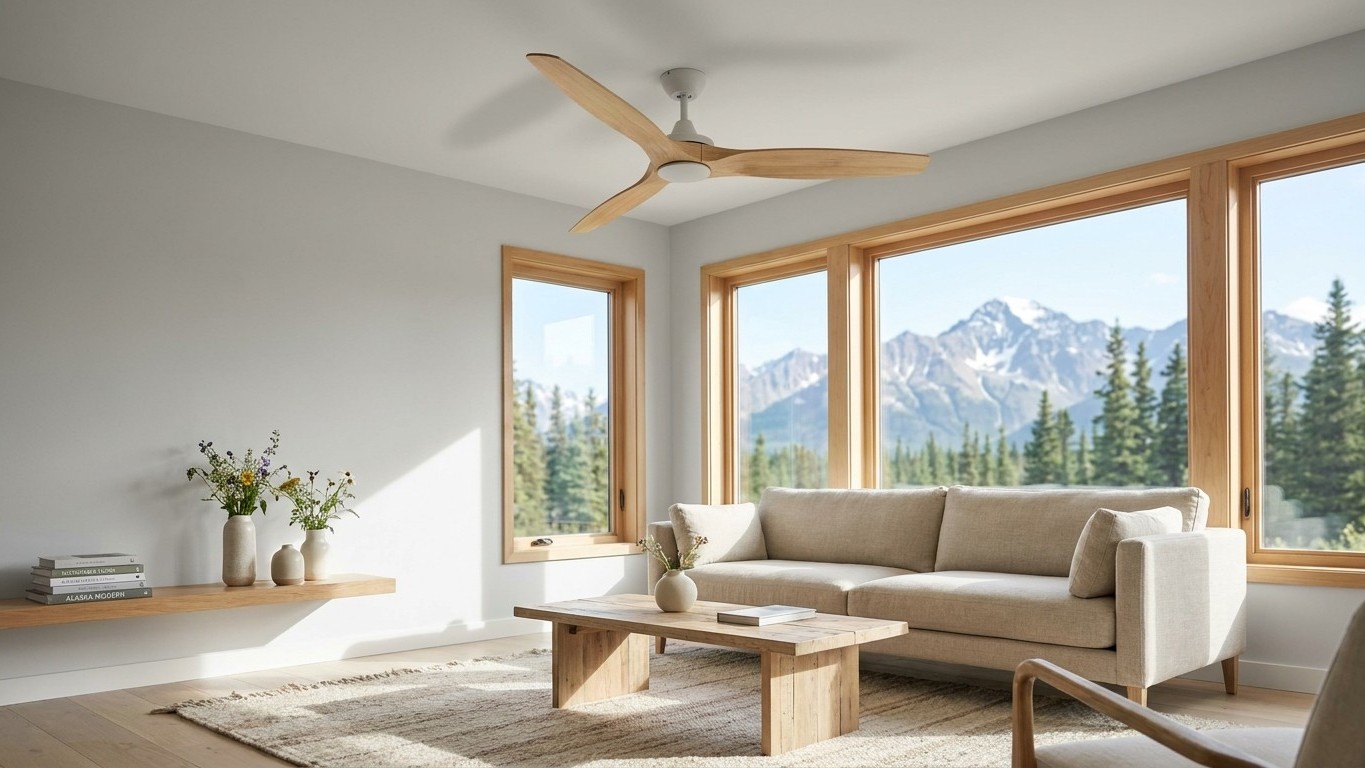

Arizona homes cool almost entirely with air conditioning, and most of it runs through central systems rather than window units or mini-splits. That single fact shapes how a household here budgets for cooling season, what breaks first, and what actually needs a monthly look.
What homes in Arizona actually cool with

According to the U.S. Energy Information Administration’s Residential Energy Consumption Survey, 94% of Arizona homes use air-conditioning equipment of some kind. Of those, 86% run a central air-conditioning unit, and 12% rely on an individual unit, a ductless mini-split, a window or wall unit, or a portable. Separately, 86% of homes also use ceiling fans alongside whatever AC they have.
Those numbers tell a fairly clean story compared to other states. In Connecticut, 90% of homes have air conditioning but only 34% run it through a central system. Alabama sits closer to Arizona’s pattern, with 94% having AC and 81% on central. Arizona’s gap between having air conditioning at all and having it centrally installed is small; central cooling is close to the default here, filling in a much smaller slice than it does in states with older housing stock or homes never built with ductwork.
It’s worth being precise about what these percentages measure. They describe what’s installed, not what performs best or what a new buyer should choose. A home built in the 1970s with ducts already in the walls almost certainly kept a central system when it was time to replace one. A converted space, an addition, or a rental unit without ductwork is far more likely to end up with a window unit or a mini-split, regardless of climate.
One more note on reading this kind of state data: when a value is marked “Q” in the EIA tables, the sample size was too small to publish a reliable figure. That is not the same as zero. Arizona’s numbers above are all published values, not estimates filling a gap.
How much cooling the year actually asks for
NOAA’s Climate Normals for the 1991-2020 period put Phoenix, the reference station for the state, at a mean of 168.9 days a year reaching 90 F or higher. That’s a count of days at one weather station, not a statewide average and not a summer temperature reading. It’s the closest thing to a heat-load number available, and it’s a useful stand-in for how hard a cooling system has to work over a year, since 90-degree days drive equipment run time, water demand, and stress on anything mechanical outdoors.
What makes this figure worth pairing with the equipment data above is that the two don’t always line up in every state. A place can post a brutal heat-load number and still lean heavily on individual units, simply because its housing stock skews older or its climate turned hot more recently than its houses were built. Conversely, a mild state can be almost entirely central if its homes were built when ducted systems were standard and cheap to install. The equipment mix follows construction history as much as it follows climate.
Arizona is one of the states where the two figures actually agree. Nearly 169 days a year above 90 F is one of the higher heat-load counts a reference station in this dataset will show, and the equipment data backs it up directly: 86% of homes here run central air, the highest share of any cooling method by a wide margin. This isn’t a state where the climate outran the housing stock, or where a legacy of un-ducted older homes forced people onto window units. Arizona’s building boom happened largely after central air conditioning was already the standard choice, and the heat load has stayed high enough, consistently enough, that central systems remain the default replacement whenever an old one fails.
That alignment matters here because it means the maintenance and sizing advice further down doesn’t need much hedging. A state where the numbers disagree, hot but individually-cooled, or mild but heavily ducted, requires more caveats. Arizona doesn’t.
Wet heat or dry heat, and what it changes
Summer rainfall at the same reference station averages about 1.9 inches across June, July, and August combined, out of roughly 7.2 inches for the entire year. June is the driest month at just 0.02 inches, while July brings 0.91 inches and August 0.93, both arriving with the summer monsoon pattern that gives the state its brief burst of rain after a nearly bone-dry spring. That’s a rainfall measurement, and nothing else; it says nothing about relative humidity or dew point on any given afternoon.
The reason this matters for cooling comes down to how an air conditioner actually works. Every unit does two jobs at once: it lowers air temperature, and it pulls moisture out of the air as that air passes over a cold coil. Removing moisture takes time, so dehumidification is a function of run time, not just raw cooling capacity. In a wet-summer climate, a large share of a system’s total workload is that drying process. In a dry-summer climate like Arizona’s, the job is almost entirely about pulling temperature down, since there’s much less moisture in the air to begin with.
This is also why an oversized unit causes different problems in different places. In a humid state, an oversized system cools fast, shuts off, and never runs long enough to dry the air, leaving a house that feels cold and clammy at once. In a dry state, that same oversizing mistake still wastes energy and shortens equipment life through short-cycling, but it doesn’t leave the same damp feeling behind, since there wasn’t much moisture to remove in the first place.
Given Arizona’s dry-summer profile, a few priorities follow naturally:
- Sizing accuracy matters more here for efficiency and equipment longevity than for comfort, since there’s little humidity to strip out even when a unit is right-sized.
- Fan settings can favor circulation over long, slow dehumidification cycles, since indoor air rarely holds much moisture to begin with.
- Run time can be shorter on a well-sized unit without leaving the house feeling damp, unlike in wetter climates.
None of this changes month to month without checking an actual rain gauge on the property; these are 30-year normals for one reference station, not a forecast for any single yard, roof, or neighborhood.
Sizing a room unit, from the published chart
ENERGY STAR publishes a straightforward chart matching room size to the cooling capacity a portable, window, or wall unit needs, built around square footage and BTUs per hour. It applies only to individual room units, not to a central system, which requires a proper load calculation rather than a lookup table.
| Area to be cooled (sq ft) | Capacity needed (BTU/hr) |
|---|---|
| 100 up to 150 | 5,000 |
| 150 up to 250 | 6,000 |
| 250 up to 300 | 7,000 |
| 300 up to 350 | 8,000 |
| 350 up to 400 | 9,000 |
| 400 up to 450 | 10,000 |
| 450 up to 550 | 12,000 |
| 550 up to 700 | 14,000 |
| 700 up to 1,000 | 18,000 |
| 1,000 up to 1,200 | 21,000 |
| 1,200 up to 1,400 | 23,000 |
This chart is a starting point, not a substitute for measuring the actual room, checking ceiling height, or accounting for sun exposure. Nothing here should be stretched past the last row or interpolated between rows to invent a figure the chart doesn’t give.
Given that 86% of Arizona homes are on central systems, this chart is directly useful mainly to the smaller share, the 12% running an individual unit, whether that’s a casita, a garage conversion, a workshop, or any room without its own ducted supply. For those spaces, going a size up “just in case” is the wrong instinct: an oversized room unit cools fast, cycles off, and never runs long enough to do its full job properly, wasting energy and shortening the compressor’s life for no comfort benefit.
What actually needs looking after here
Since central air is the dominant system in Arizona homes, the maintenance that matters most here starts with the parts that keep a ducted system running efficiently through months of near-constant use. ENERGY STAR is direct on the single easiest fix: “Inspect, clean, or change air filters once a month in your central air conditioner, furnace, and/or heat pump.” That’s a monthly task, and it applies across all three types of equipment, which matters for anyone who assumes filter care is only a furnace concern.
Skipping that filter check has a measurable cost. ENERGY STAR notes that “airflow problems can reduce your system’s efficiency by up to 15 percent,” meaning a unit can be running and cooling while still quietly losing a meaningful share of its output to a dirty filter or blocked vent. In a state posting close to 169 days a year above 90 F, that efficiency loss compounds fast over a full cooling season.
For the roughly 86% of Arizona homes running ducted central systems, there’s a second maintenance item worth knowing about, since it doesn’t apply to window or mini-split setups at all: duct condition. ENERGY STAR states that “in a typical house, however, about 20 to 30 percent of the air that moves through the duct system is lost due to leaks, holes, and poorly connected ducts.” That’s air conditioned at real cost and then never reaching the room it was meant for, often escaping into an attic or crawlspace instead. A house on window units skips this problem entirely, but for the large majority of Arizona homes on central air, it’s one of the most common reasons a system runs constantly without ever quite catching up.
A practical seasonal pass before peak heat sets in:
- Check or replace filters on the monthly schedule ENERGY STAR recommends, for the AC, furnace, and heat pump alike.
- Have ductwork inspected for leaks and poor connections if the system is central, since that loss runs 20 to 30 percent in a typical house.
- Clear vents and returns of dust and debris to avoid the airflow losses that quietly cut into efficiency.
- Confirm ceiling fans are set to push air downward in summer, given how common they are alongside AC in Arizona homes.
For equipment-specific steps, this site’s guides on central air conditioners, ductless mini-splits, and window units under the state’s heating and cooling hub go deeper into each system without repeating what’s already covered here.