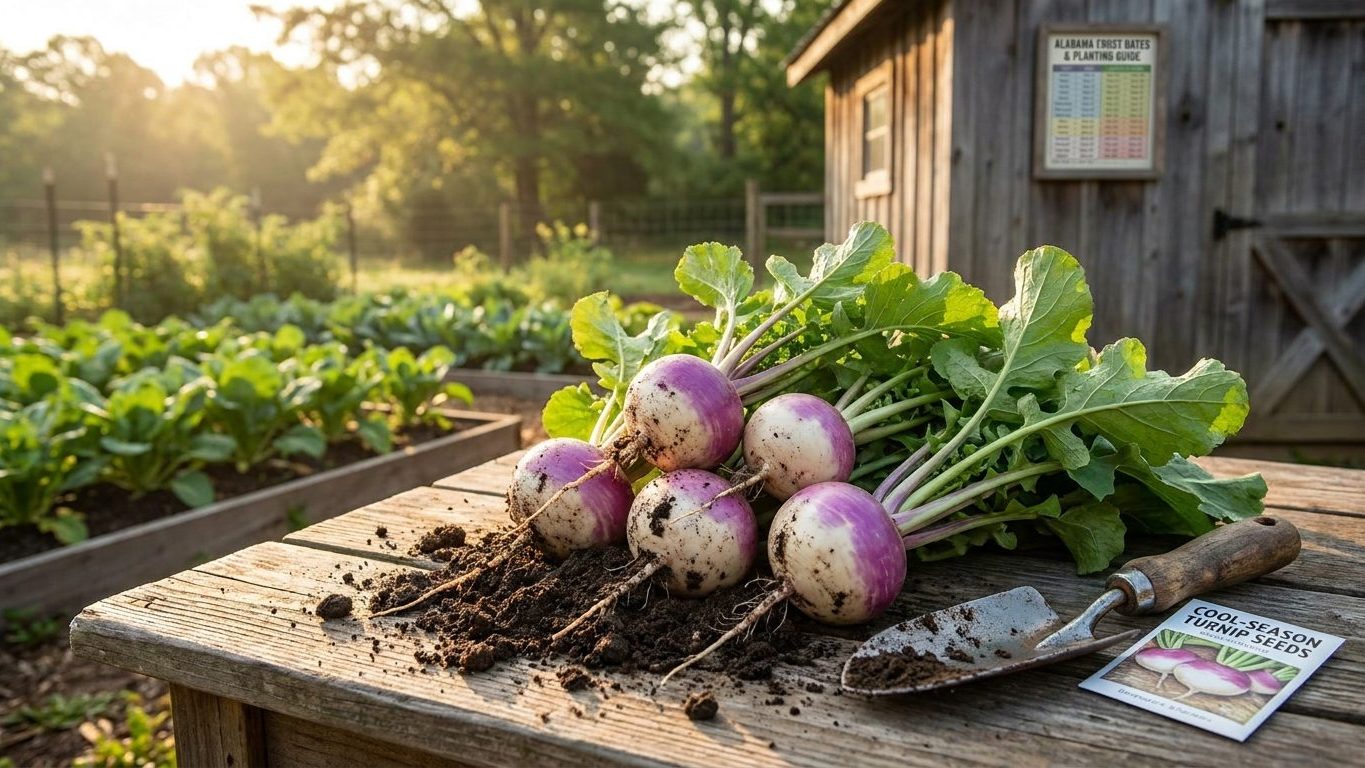

Connecticut gardeners get two shots at turnips each year: a quick spring crop tucked in right after the last frost, and a fall crop that most growers here treat as the real harvest. The fall sowing window runs roughly from mid-July into early August, timed to finish before the first hard freeze.
The short answer for Connecticut
Turnips are a cool-season root that size up in 30 to 60 days depending on variety, and they hate finishing in heat. That single fact decides the whole calendar. In Connecticut, using the Bridgeport-area station (USW00094702) as the state’s reference point, the last spring frost falls between April 2 and April 12, and the first fall frost falls between October 28 and November 10. Those dates come from NOAA’s 1991-2020 Climate Normals and represent a 30 to 70 percent probability band, meaning frost is a real possibility on either side of those dates, not a hard line.
Work backward from the fall frost date and the math is straightforward. A 45-day turnip sown on August 5 finishes around September 19, well inside the safe window even for an early frost year. Push sowing past the first week of August and a slower variety risks running into that October 28 date before the roots have bulked up. That’s why the reliable planting window for fall turnips in Connecticut sits between July 15 and August 5, giving even the 60-day varieties enough runway.
The spring option is real but smaller. Turnip seed germinates once soil temperatures climb into the 40s Fahrenheit, so direct-seeding two to three weeks before the April frost window closes is standard practice. The catch is that Connecticut summers warm up fast after that, and turnips bolt or turn woody once daytime highs push into the mid-80s for a stretch. A spring crop sown too late, say early May instead of April, often gets caught by early-summer heat before it’s worth pulling. That’s the reason most Connecticut vegetable gardeners lean on the fall sowing as the dependable crop and treat spring turnips as a bonus, not the main event.
Rutabaga, the turnip’s slower cousin, changes this math further, which the next section covers directly.
What will not work here

The single most common mistake is treating turnip and rutabaga sowing dates as interchangeable. Rutabaga needs closer to 90 to 100 days to mature, and it wants a long, slow, cool finish rather than a quick sprint. Counting back from the October 28 first-frost date, a rutabaga sown any later than early July is gambling on a mild fall. Sow it in late July, the way a gardener might with a fast turnip, and there’s a real chance the roots stay undersized when the first freeze shuts things down. The safe cutoff for rutabaga in Connecticut is no later than the first week of July, a full month earlier than the turnip fall window.
Heat is the second failure point, and it hits the spring planting hardest. Connecticut’s coastal areas moderate summer temperatures somewhat, but inland valleys regularly see stretches of 85-plus-degree days by mid-June. A turnip crop sown in early May and left to mature through June bolts, sending up a flower stalk and pulling sugar out of the root, which turns the flesh pithy and bitter. Gardeners who’ve had good luck with spring radishes sometimes assume turnips behave the same way and stretch the spring sowing into May. They don’t, and the roots show it.
Humidity and spacing
Connecticut summers run humid, especially inland and away from the immediate coastline, and that humidity punishes tight spacing. Turnip greens planted at close intervals to maximize a small bed trap moisture between the leaves, which is exactly the setup that favors downy mildew and other foliar diseases in a humid Northeast summer. Wider spacing that would feel wasteful in a drier climate is a practical necessity here, since disease pressure builds fast once leaves stay damp overnight. A gardener trying to squeeze a dense fall planting into a raised bed by late July is fighting both the calendar and the local air.
Finally, weekly watering schedules that work fine for tomatoes or squash don’t suit turnips well during a dry August stretch. Turnip roots crack and go woody under moisture stress, and Connecticut’s late-summer rainfall can be spotty enough that a once-a-week soak leaves the soil swinging between soggy and bone-dry, which is worse for root quality than steady, lighter watering.
What changes across Connecticut
Connecticut isn’t one climate zone, and the USDA Plant Hardiness Zone Map puts the state across a 6a to 7b range. That’s a wide spread for a state this size, and it matters more for perennials than for a fast annual like turnips, but it still shifts the practical calendar. The coastal strip near Long Island Sound, including the Bridgeport reference station used above, sits at the milder end of that range. Inland valleys and the northwest corner, including the hill towns near the Massachusetts and New York borders, run noticeably colder.
The coldest month’s average daily minimum at the coastal reference point is 24.4°F, and that number climbs colder moving inland and with elevation. Practically, that means frost arrives earlier in fall and lingers later in spring away from the coast. A gardener in the Litchfield hills or the northeastern uplands should expect both the spring and fall frost windows to shift by roughly two to three weeks compared with the Bridgeport dates, meaning an earlier fall sowing cutoff and a later spring start.
There’s no single sowing date that covers the whole state, and that spread is the point of citing a range instead of pretending Connecticut has one climate. A reader gardening at higher elevation or well north of the Sound should treat the July 15 to August 5 fall window as running earlier, not later, and should be cautious about pushing rutabaga sowing all the way to the first week of July.
Figuring out which side of that range a given garden falls on isn’t something this page can answer, since it depends on exact location, elevation, and local cold-air drainage. That’s a job for a zone map, not a guess based on county name alone.
Where to check this for your own county
Connecticut’s land-grant university extension service is the right next stop for anything more specific than a statewide window. The UConn Extension site is the official channel, run through the USDA’s Land-Grant University Extension network, and it’s where county-level planting calendars and variety trial results actually live.
What’s worth looking for there specifically: a vegetable planting calendar broken out by county or region rather than a single statewide table, and any variety trial results showing which turnip and rutabaga cultivars have performed well in Connecticut conditions specifically, as opposed to generic seed-catalog claims. Extension offices often publish these based on local Master Gardener trials or research farm results, and that data reflects actual soil, humidity, and frost patterns in a way a statewide average can’t.
A county-level recommendation from a local extension office will always beat a state-level page like this one, because it accounts for microclimate details this article can’t: whether a given county trends toward the coastal end of the frost range or the inland end, which local pests or diseases show up most, and which specific varieties extension agents have watched perform in nearby gardens. This page describes Connecticut broadly, using the coastal Bridgeport station as the most complete public dataset available, but a garden forty miles inland or two hundred feet higher in elevation is going to run on a different clock. The single most useful step a Connecticut gardener can take beyond reading this page is to contact their county extension office directly and ask for the local vegetable planting guide by name.
Some gardeners also time this by the Moon: when to plant turnips by the moon, as almanac tradition rather than fact.
Checking this against your own garden
Every date on this page is built from long-term averages, and averages describe a typical year, not this year. The garden itself gives better information than a calendar once the season actually starts, and none of it requires equipment beyond a gardener’s own hands and eyes.
Soil warmth by feel is the first check. Turnip seed wants soil that’s no longer cold to the touch, roughly in the 40s Fahrenheit and rising, before it germinates reliably. Reaching a hand into the top couple inches of a fall or spring bed and feeling actual coolness, not just dampness, is a sign to wait, regardless of what the calendar says.
Germination speed is the second signal. In properly warmed soil, turnip seed sprouts in 5 to 10 days. A planting that sits for two weeks with nothing showing usually means the soil was still too cold when the seed went in, which is common information for gauging how a specific garden’s microclimate compares to the regional average used throughout this page.
The third check applies mainly to a spring crop: watching for the first flower stalk pushing up from the center of the plant. That’s the plant bolting, and it’s the clearest possible signal that heat has arrived and the spring window has effectively closed for that bed, whatever the date on the calendar says. Seeing it early is useful information for next year, since it marks, better than any regional frost date can, exactly when this particular garden’s heat arrives.