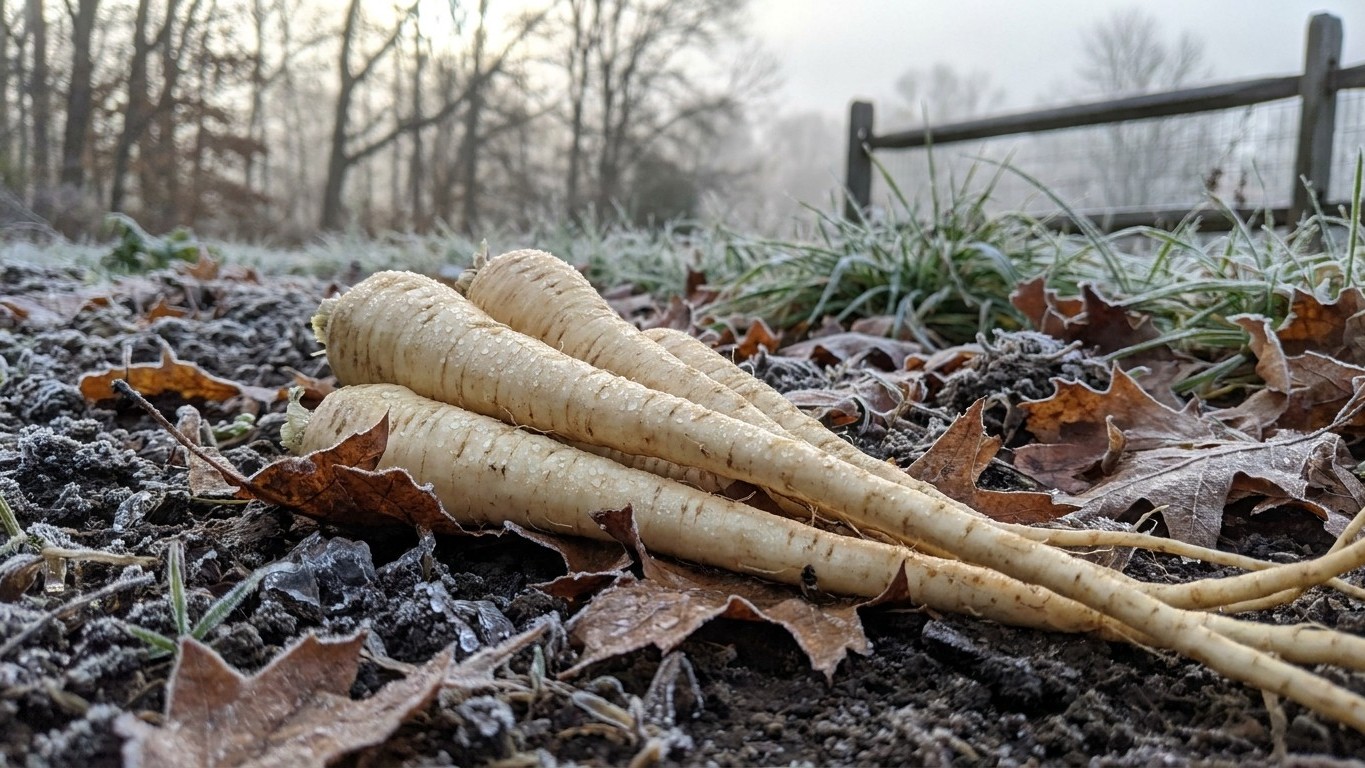

Vermont gardeners lose parsnip roots and seedlings to three main insects: flea beetles, white grubs, and dark-winged fungus gnats. Flea beetles chew seedling leaves right after germination, white grubs tunnel into the storage root over the growing season, and fungus gnat larvae attack roots in wet, high-organic soil. Timing your sowing and watching soil moisture handles most of the risk.
Which pests attack parsnip in Vermont

University of Vermont Extension documents twelve garden and landscape pests for the state: Asian jumping worms, boxelder bug, Colorado potato beetle, dark-winged fungus gnats, European chafer, flea beetles, green stink bug, leek moth, spongy moth, spotted wing drosophila, swede midge, and white grubs. That’s the full documented list for this territory, and most of it has nothing to do with a row of parsnips.
Colorado potato beetle targets nightshades, potatoes, tomatoes, eggplant, not the carrot family that parsnip belongs to. Leek moth and swede midge are specialists too, onions and leeks for one, cabbage-family crops for the other. Boxelder bug and spongy moth feed on tree tissue (boxelder and maple seed pods, oak and hardwood foliage), not vegetable beds. Spotted wing drosophila targets soft ripening fruit like berries, and green stink bug feeds mainly on fruiting crops and pods by piercing them, not on root vegetable foliage. Asian jumping worms don’t chew plant tissue at all; they disturb soil structure and nutrient cycling, a different kind of problem entirely. European chafer is primarily a turfgrass pest as an adult and larva, feeding on lawn roots rather than garden vegetable roots.
That leaves three species with a real reason to show up in a parsnip bed: flea beetles, which chew seedling foliage across many vegetable families including carrot relatives; white grubs, the soil-dwelling larval stage that feeds on roots including root vegetables; and dark-winged fungus gnats, whose larvae feed on organic matter and tender roots in consistently moist soil. The list stays short on purpose, because the mistake that costs a season is treating for a pest that was never documented on this crop in the first place.
When each one shows up, and what it does first
Parsnip is sown directly in place, typically two to three weeks before the last spring frost, which NOAA climate normals put at April 30 to May 10 for the Burlington area (the Green Mountains and Northeast Kingdom run colder and later). Germination takes 14 to 21 days, according to Utah State University Extension, and that stretch of bare-looking soil is exactly when gardeners assume a failed sowing and dig it up. Don’t; the seed is just slow.
Flea beetles arrive almost as soon as the first true leaves unfold. The first sign is a scatter of small, round shot-holes across the leaf surface, sometimes enough to make the whole leaf look like it went through a hole punch. Damage concentrates on young seedlings because the plant tissue is still soft.
Dark-winged fungus gnats show up in that same seedling window, but only where soil stays consistently wet, heavy ground, overwatered beds, or soil heavy in organic matter. The first sign isn’t the adult gnat (a small dark fly you’ll notice hovering near the soil surface) but a seedling that wilts or stalls despite damp soil, because the larvae are feeding on the fine roots underground.
White grubs work on a longer clock. They feed on the developing root through the growing season, with root-feeding intensifying from mid-summer onward as the larvae grow before moving deeper to overwinter. The first visible sign usually isn’t foliage stress at all, it’s a chewed, tunneled, or hollowed patch discovered on the root itself at harvest, which for parsnip comes after several weeks of fall frost exposure once the first frost (October 3 to 13 near Burlington) has passed.
Telling the damage apart from everything else
A parsnip root that comes up forked or branched is one of the most common complaints, and it has two separate possible causes on this crop, not one. Utah State University Extension notes that heavy or stony soil deflects the taproot as it grows downward, forcing it to split around obstructions; separately, overwatering can also produce forked roots by encouraging shallow, branching growth instead of one straight taproot. Those are two distinct causes, and a gardener who blames the soil when the real problem is a hose left running too long will fix nothing.
| What you see | Possible non-insect cause | What points to an insect instead |
|---|---|---|
| Shot-holes in young leaves | Hail or mechanical scuffing | Holes are round, numerous, and clustered on the newest leaves only |
| Wilting seedling in damp soil | Damping-off fungal disease | Fine larvae visible in the top inch of soil near the stem base |
| Forked or branched root | Heavy, stony, or compacted ground | No chewing marks on the root surface itself |
| Forked or branched root | Overwatering | Bed stays wet days after rain with no drainage |
| Tunnels or holes in the harvested root | Mechanical injury from a fork or spade | Tunnel edges are smooth and rounded, sometimes with a grub still inside |
None of this replaces an on-the-ground look. Pale, evenly yellowed foliage across a whole row points toward a nutrient issue rather than a pest, but confirming that calls for a soil test, not a guess from a photo.
What actually works here, and what is a waste of time
On a growing season built around a short frost-free window, timing beats any product. A lightweight floating row cover laid over the bed right at sowing, and kept on until seedlings have their first true leaves, blocks flea beetle adults from ever reaching the tender foliage. The cover has to go on before the beetles find the row, not after the shot-holes already show, because once adults are established under the cover it traps them with the plants.
For fungus gnat larvae, the fix isn’t a spray, it’s drainage. Letting the soil surface dry between waterings breaks the larvae’s moist habitat far more reliably than any topical treatment, and it costs nothing.
White grubs are harder to manage mid-season because they’re underground and out of reach. Turning the soil before sowing, in spring, exposes grubs to birds and to weather, and crop rotation (not putting parsnip or other root crops in the same bed year after year) reduces the buildup of a resident grub population over time.
What doesn’t work: broad insecticide applications made without identifying the pest first, since Vermont’s list shows plainly that most garden insects here have no business on a parsnip row, and treating for the wrong one wastes a product application and the growing days lost to it. Vermont’s extension service is the only authority for what’s legally labeled for use on vegetable crops in the state, so any product decision belongs with them, not with a general internet search.
Where to check this for your own county
University of Vermont Extension is the source for every pest named on this page, and its county-based offices are the right next stop for anything specific to a particular garden. A pest documented at the state level doesn’t mean it’s present in every county, or every backyard; presence varies with soil, moisture, nearby plantings, and elevation. What UVM Extension confirms for the state as a whole is not a diagnosis for one raised bed, and a county office or a local Master Gardener helpline can look at an actual sample or photo in a way a statewide list never can.
The Champlain Valley around Burlington runs milder and with a longer frost-free stretch than the Green Mountains or the Northeast Kingdom, which shifts sowing dates, harvest timing, and even which pests get a second generation in before frost. Anyone gardening outside the Champlain Valley should treat the frost dates on this page as a starting reference, not a local forecast, and check current dates with their county office before planning a sowing date.
Common questions
Do parsnip seeds need to be replaced if nothing comes up after two weeks?
Not yet. Germination takes 14 to 21 days per Utah State University Extension, so bare-looking soil at two weeks is normal, not a failed sowing.
Does a mild winter mean sweeter parsnips?
No. Sweetening comes from several weeks of exposure to actual frost after the root matures, not from how comfortable the winter hardiness zone is. A mild-winter area can grow a fine parsnip that never develops the same sweetness.
Is a forked parsnip root always a soil problem?
Not always. Heavy or stony ground is one cause, but overwatering is a separate one; both produce forked roots and neither involves an insect.
Should I spray if I see holes in parsnip leaves?
Only after confirming the cause with the county extension office. Not every leaf hole comes from an insect, and Vermont’s own documented pest list shows most garden insects here have no reason to feed on parsnip at all.