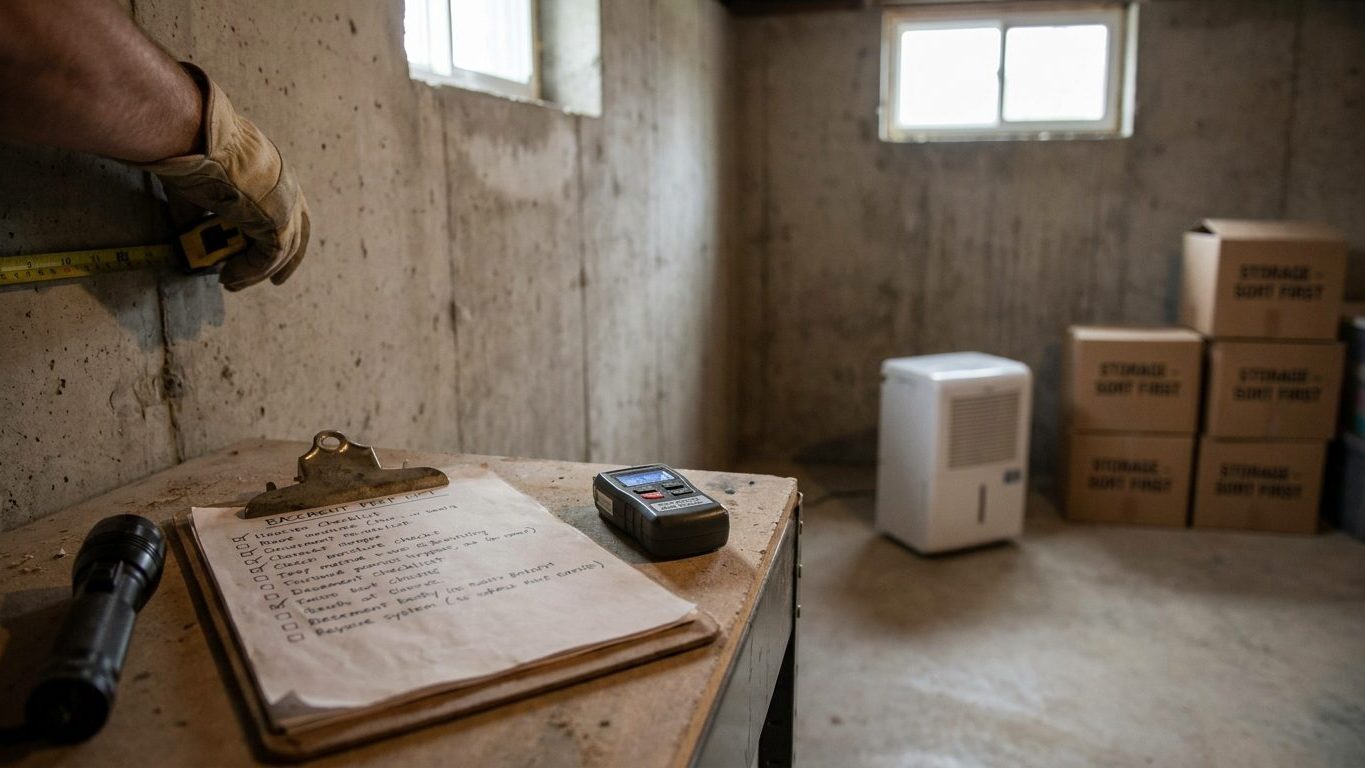

Framing and drywall don’t fix a wet basement, they just cover the wall where you’d see it happening. That’s the one decision that determines everything else here: whether the water problem gets solved before the studs go up, or gets sealed inside them until it isn’t hidden anymore. Test for radon and settle drainage before you frame anything.
What is actually going on

The thing to understand about a basement before you finish it is concealment. Framing, batt insulation and drywall create a cavity against the foundation wall, and that cavity is exactly where evidence of a water problem shows up first: efflorescence, staining, a musty smell, soft drywall paper. Once the wall is closed, none of that is visible until it’s bad enough to smell from the next room. The framing lumber and the paper facing on drywall are also organic material, and organic material sitting against a damp concrete or block wall is food for mold, whether or not anyone ever sees it.
This is why the order of work matters more in a basement than almost anywhere else in the house. Sealing the inside of a foundation wall does not stop water that’s arriving under pressure from the outside. An interior coating or a membrane can manage surface humidity and hide old staining, but if the water table or storm runoff is pushing against the wall from outside, it will find another path, usually the seam between the wall and the slab, or a lower crack you haven’t found yet. Drainage has to be addressed at the source before any interior finish goes on, not instead of it.
On mold, there is no number that settles it
There is no federal standard for how much indoor mold is acceptable, no home test kit that gives a reliable reading, and no square footage below which a patch is officially fine to ignore. Anyone who tells you a specific number is the safe threshold is guessing. What’s not in dispute is that people react to mold very differently: some notice nothing, others get significant respiratory symptoms from a small amount. Anyone with asthma, allergies or another respiratory condition should not be the one removing or disturbing mold, and the practical answer this site gives is the same one every time: remove the water source, then deal with the material, not the other way around.
Basements, crawl spaces and slabs all carry the same additional issue: radon. The EPA and the U.S. Surgeon General recommend testing every home, regardless of age, foundation type or what the house next door tested at. Radon concentrates in the lowest occupied level of a building, which is precisely the space you’re about to finish and spend more time in. The EPA’s action level is 4 pCi/L, and it recommends homeowners consider action even between 2 and 4 pCi/L. No level of radon is known to be safe. A neighbor’s clean test result tells you nothing about your own house, and geology alone can’t predict it either. Testing is the only way to know, and if a result comes back high, mitigation is a job for a certified radon professional, not a weekend project. For the current guidance and how to find a tester, the four sources that actually get a basement wet are worth understanding before you decide the water problem is solved at all.
What to look at, and in what order
Run the cheapest, least invasive checks first, and don’t cover anything until you’ve watched it through at least one full wet season if you can manage it. A single dry week tells you far less than a season that includes heavy rain and snowmelt.
| Check | What to do | What a clear result tells you |
|---|---|---|
| Visual walkthrough after rain | Walk the basement within a day of a heavy storm, looking at wall-floor joints, low corners and any old stains | Rules out obvious active seepage on that occasion, but not slow or seasonal intrusion |
| Grading and downspout check | Confirm the ground slopes away from the foundation and downspouts discharge well clear of the wall | If already correct, rules out surface runoff as the cause; if not, it’s a likely contributor |
| Interior humidity monitoring | Leave a hygrometer in the space for several weeks across different weather | Persistent high readings suggest moisture moving through the slab or walls even with no visible water |
| Radon test | Place a short-term or long-term test kit in the lowest level, following the kit’s instructions | A result at or above the EPA’s action level of 4 pCi/L means mitigation, not a wait-and-see approach |
| Structural review | Bring in a structural engineer to look at any cracking, bowing or uneven floors | Rules in or out a foundation movement issue that no surface fix will address |
Each step either rules something out or narrows down what you’re dealing with, and skipping ahead defeats the point. A homeowner who paints the walls before checking the grading has treated a symptom without ever finding out whether the cause was ever addressed. The visual walkthrough and the grading check cost nothing but time, so there’s no reason to skip them even if you’re confident the basement is dry. Humidity monitoring takes patience because a single reading on a single day means very little. A basement can read dry on a sunny afternoon in a month with no rain and still be pulling moisture through the slab all summer. The radon test is the one step that has a defined threshold to act on, and it’s worth running regardless of what the other checks turn up, since radon and water intrusion come from entirely separate mechanisms.
Watch it, or get someone in
Some things in a basement are reasonable to keep an eye on yourself. A hairline cosmetic crack in a poured wall that hasn’t changed size or length over a season, seasonal condensation on a cold water pipe, or a faint patch of efflorescence that stays the same size are all things a homeowner can reasonably track with a photo and a date written on the wall next to it.
What needs a call now
- Active water entering during or after rain, not just dampness
- A crack that is visibly widening, or a new crack appearing where there wasn’t one
- A wall that bows or leans inward
- Stair-step cracking in a block wall, or a sloping, uneven floor
- A sump pump running almost continuously, or a basement that has needed one for the first time this year
- Mold covering a large area, not a small isolated spot
- A radon result at or above 4 pCi/L, or anywhere in the 2 to 4 pCi/L range the EPA flags as worth considering action on
These call for three different professionals, and they are not interchangeable. A structural engineer assesses the foundation and its movement without selling you a repair, which makes their opinion the most disinterested one you can get on whether a crack is cosmetic or structural. A drainage contractor deals with grading, gutters, downspout extensions and exterior drain systems, which is the outside-first work that has to happen before any interior fix means anything. A waterproofing salesman, usually representing a specific interior system, has a financial interest in recommending that system, and their walkthrough is a sales visit even when it’s framed as an inspection. None of these professionals should be doing excavation work near the foundation without proper engineering oversight, since digging alongside a foundation wall carries real risk of destabilizing it.
What has to happen first
The single most common way money gets wasted in this project is doing the steps out of order. Drainage outside the foundation comes before any waterproofing coating inside it. Water management, meaning the sump pump, any interior drain, and confirmation the space stays dry through a season, comes before framing. Diagnosis, meaning the checks above and a radon test, comes before repair of any kind, because you can’t fix what you haven’t identified.
Once the water and radon questions are actually settled, the rest of the finishing sequence follows the same logic used elsewhere in the house. Roof drainage still matters here even though the basement is the lowest point in the house, since a gutter dumping water at the foundation corner is often the reason the basement has a problem at all. A working sump pump and a discharge line that carries water well away from the foundation are worth confirming before insulation goes against the wall, since insulation over a damp wall traps moisture against it rather than letting it dry. Whatever goes on the slab afterward, from subfloor to finished flooring, should assume the slab can still carry some moisture vapor even after the wall issues are fixed. And before you plan a bedroom or a rec room people will actually spend time in down there, confirm the space has “/foundations/egress/”>a legal way out in an emergency, since a finished basement without proper egress isn’t a finished basement at all, it’s a code problem waiting to be found. For the fuller picture of how these pieces fit together before framing starts, the broader look at foundations and basement moisture is the place to start.
Common questions
Can I just paint the walls with a waterproof sealant and skip the drainage work?
No. An interior sealant can hide old staining and reduce surface dampness, but it does nothing about water under pressure coming from outside the wall. If the outside source isn’t addressed, the water usually finds a new path, often lower down or at the floor joint, and you’ve spent money hiding the same problem instead of solving it.
How long should I wait after fixing a leak before I frame the wall?
Watch it through at least one full season that includes heavy rain, if your timeline allows it. A basement that stays dry through one storm can still leak during snowmelt or a longer rainy stretch, and framing over a wall you’ve only watched for a few dry weeks is the same mistake as not checking at all.
If I already have a sump pump, do I still need to test for radon?
Yes. A sump pump manages groundwater, and radon is a gas that enters through cracks, gaps and the sump pit itself, so one has nothing to do with the other. The EPA recommends testing every home regardless of what water management is already in place.
I finished my basement years ago and never checked any of this. Is it too late?
It’s not too late, but it means the checks now happen from behind a finished wall instead of before one goes up. A radon test can still be run today regardless of when the basement was finished, and any staining, odor or soft drywall you notice now is worth opening the wall to look at rather than covering over again.