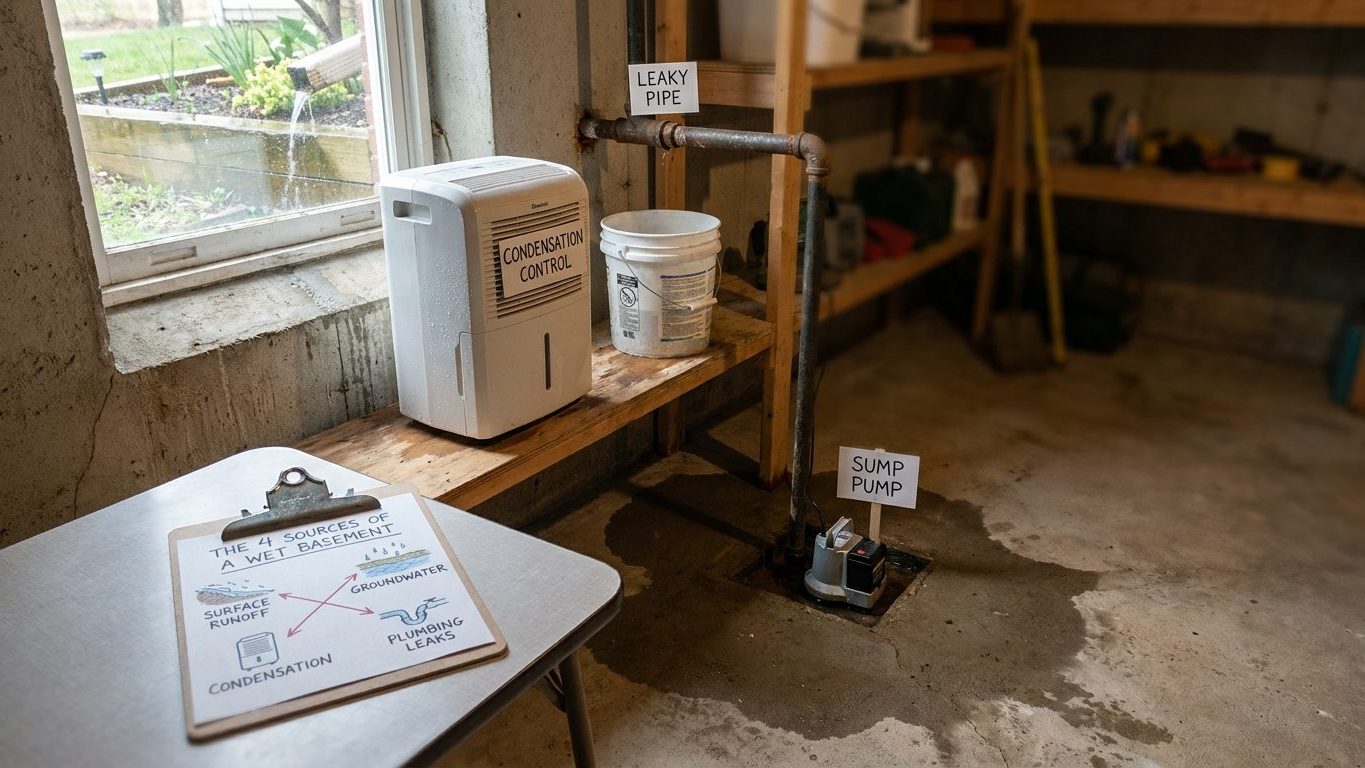

That crack running down the basement wall is probably not what’s letting water in. Water in a basement comes from one of four separate sources: surface runoff, groundwater pressure, a plumbing leak, or condensation, and each one leaves its own kind of evidence behind. Look at when the water shows up and what it looks like before you spend anything on that crack.
What is actually going on

Four routes account for nearly all basement water, and they behave differently enough that the same fix rarely works for two of them. Surface water is rain or snowmelt that never made it away from the house: it pools against the foundation and works its way in through the top of the wall, through window wells, or along the slab edge, usually within an hour or two of a storm. Groundwater is different. It rises from below, pushed by hydrostatic pressure once the soil around the foundation saturates, and it shows up as seepage through the lowest points, floor cracks, or the cove joint where the wall meets the slab, sometimes days after the rain has stopped.
Plumbing is the third route, and it is the easiest to rule in or out because it does not care about weather. A supply line, a water heater, or a drain running behind a finished wall can leak steadily regardless of what is happening outside, and the stain pattern tends to trace back to a fixture rather than to a wall or floor joint. Condensation is the fourth, and it is not a leak at all. Warm, humid air meets a cold pipe, a cold slab, or a cold foundation wall and drops its moisture right there, which is why condensation shows up as a film or as damp masonry rather than as a stream, and tends to track with humidity rather than with rainfall. Telling condensation apart from actual seepage is its own small diagnostic exercise, and it’s worth working through before assuming a wall is leaking.
Why the order of work matters here
Interior coatings, paints, and injected sealants deal with humidity and with the stains water leaves, but they do nothing to stop water that is arriving under pressure from outside. Sealing a wall from the inside can hide a groundwater or surface-water problem for a season and then fail all at once, because the water simply finds the next weak point. Drainage has to be addressed before anything interior gets touched, and that ordering holds regardless of which of the four sources turns out to be the cause.
None of this is optional to check, and none of it is about the water itself. A basement, a crawl space, or a slab is also the place radon collects, because it enters from the soil and concentrates in the lowest level of a building. The EPA and the U.S. Surgeon General recommend testing every home, regardless of foundation type, age, or what the water situation looks like. The action level is 4 pCi/L, the EPA recommends considering action for results between 2 and 4 pCi/L as well, and no level of radon is considered safe at any concentration. A basement moisture problem and a radon problem are unrelated conditions that happen to occupy the same room, and neither one tells you anything about the other.
What to look at, and in what order
Work from the cheapest and least invasive check to the most involved, because three of the four causes above will rule themselves out fast if you look in the right place first.
The checks, in sequence
- Look outside during or right after a storm. Water pooling against the foundation, downspouts discharging within a few feet of the wall, or grading that slopes toward the house instead of away from it points to surface water. If the ground is dry against the foundation and the basement still gets wet, this rules out surface runoff as the sole cause.
- Check the timing against the weather, not just the presence of it. Seepage that appears a day or more after rain, or that appears during a spring thaw with no rain at all, points to groundwater rising rather than runoff pooling. This does not rule out surface water contributing too, but it tells you drainage work needs to go deeper than regrading and gutters alone.
- Trace any wet area back toward a fixture, pipe run, or appliance. A leak that shows up regardless of weather, that follows a pipe chase, or that pools near a water heater or washing machine points to plumbing. This rules out both surface water and groundwater, and it means the fix is a plumber’s job, not a drainage job.
- Tape a small square of plastic sheeting directly to the wall or floor and check it after a day or two. Moisture on the outside face of the plastic means humid air is condensing on a cold surface. Moisture on the wall side, under the plastic, means water is actually coming through the material. This single check separates condensation from true seepage more reliably than eyeballing a damp patch.
- If the floor itself is damp with no visible crack or joint involved, the water may be coming up through the slab rather than in through the walls, which is a distinct problem with its own set of causes worth reading up on separately at moisture coming up through a slab.
Run a radon test regardless of what these checks turn up, since radon has no relationship to any of the four water sources above and won’t show itself through staining, smell, or timing with weather. A short-term test kit or a continuous monitor placed in the lowest lived-in level, per EPA guidance, is the only way to know where a given house stands.
Watch it, or get someone in
Some basement water is fine to monitor for a season. Some needs a phone call this week, and the professional to call depends entirely on what the checks above turned up.
What a homeowner can reasonably track
Minor condensation on a cold pipe or a section of foundation wall, especially in summer, is something to manage with ventilation or a dehumidifier and monitor over a few weeks. Light surface water after unusually heavy storms, if the grading and downspouts otherwise look fine, is also reasonable to watch through a couple more rain events before deciding it needs work. What changes the calculation is any water that appears with a horizontal crack, a bulging wall, a wall that has shifted out of plane, or a floor that has visibly heaved. None of that is a waterproofing question anymore.
Who to actually call
A structural engineer assesses the foundation and tells you what is happening to it without selling you the repair, which makes an engineer the right first call whenever the wall itself, not just the water, looks like it has moved. A drainage contractor is the right call once the source has been narrowed to surface water or groundwater and the work needed is grading, gutters, or a drainage system around the foundation. A waterproofing company that shows up, inspects, and immediately quotes an interior sealing package without asking about grading, downspouts, or the age of any exterior drainage is trying to sell the fastest job, not necessarily the right one, since interior sealing does nothing for water arriving under pressure from outside.
Radon sits outside this decision tree entirely. If a test comes back at or above the EPA’s action level of 4 pCi/L, or even in the 2 to 4 pCi/L range the EPA says is worth considering, the response is a radon mitigation contractor certified for that work, not a waterproofer and not a guess based on how old the house is or what a neighbor’s test showed. Testing is the only reliable way to know, and it has no bearing on which of the four water sources a house has, if any.
What has to happen first
The most common way money gets wasted on a wet basement is doing the interior work before the exterior water management is sorted out. Drainage always comes before finishing, because a beautifully sealed and painted wall behind which water is still pooling will fail again, just more expensively the second time.
The practical order looks like this: fix what’s directing water toward the house before anything else, which for most homes means the roofing guide’s coverage of gutters and downspouts and making sure they discharge well away from the foundation. Once surface water is under control, groundwater is the next layer, and for a basement that stays wet after storms have been ruled out, that’s a job for whatever drainage or sump system a professional recommends, covered in more detail in the plumbing guide’s section on sump pumps. Only after the water itself has somewhere to go does it make sense to think about interior wall treatments, insulation, or a finished floor. Basement wall insulation has its own guide, and slab flooring choices have theirs, because both depend on the moisture situation being resolved first rather than being asked to hide it.
Radon testing does not need to wait for any of this. It runs on its own timeline, independent of whatever is happening with water, and there’s no reason to put it off until the drainage work is finished. For the fuller picture of how these four issues interact with everything else that can go wrong below grade, the overview of foundation and basement problems is the place to start before tackling any one of them in isolation.
Common questions
Can a wet basement fix itself if I just wait out a dry summer?
No. A dry stretch just means the source isn’t currently active, not that it’s gone. Surface water and groundwater problems come back with the next heavy rain or the next wet spring, usually leaving a bit more damage than before.
Does a dehumidifier count as fixing the problem?
Only if the problem is condensation. A dehumidifier lowers humidity in the air, which helps with musty smells and mold risk, but it does nothing for water entering through a wall or floor under pressure. Running the plastic sheeting test described above will tell you which situation you’re actually in.
Is it normal for a new house to have a wet basement?
Age doesn’t determine it either way. New construction can have poor exterior grading or an undersized drainage system just as easily as an older house can, and neither age nor newness is a reason to skip testing for radon or checking the four sources described here.
My basement smells musty but I can’t find any wet spot. What’s that?
A musty smell with no visible water usually points to humidity and condensation rather than active seepage, often from an unvented area or a damp crawl space connected to the basement. It’s still worth running the plastic sheeting test on a few surfaces before assuming it’s only an air quality issue, since minor seepage can evaporate before it’s ever seen as standing water.