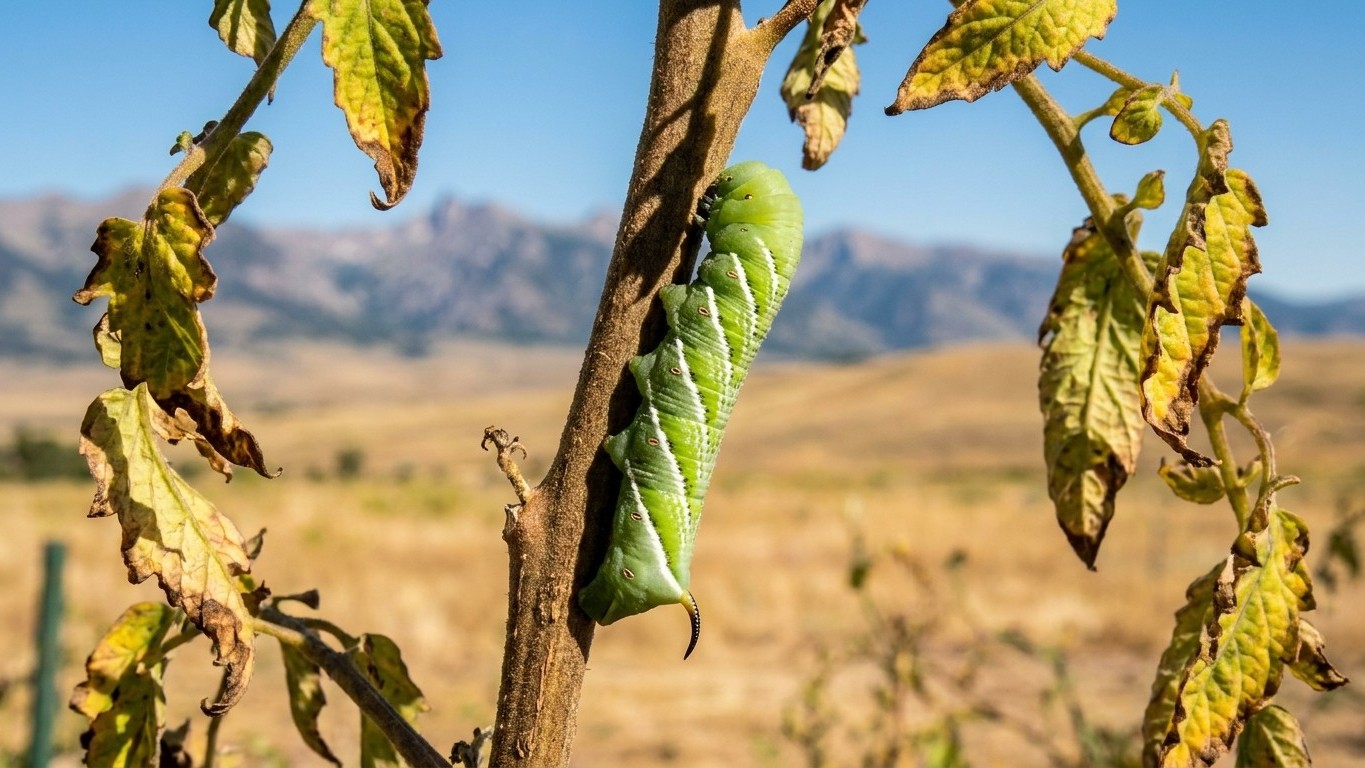

Tomato hornworms show up in Wyoming later than almost anywhere else in the country, typically from mid-July through early September, and the state’s short growing season combined with cold nights actually knocks back their population every single year without any help from a gardener. That’s the good news. The bad news: when they do arrive, a single caterpillar can strip a young tomato plant bare in 48 hours, and Wyoming’s intense summer sun means a defoliated plant sunburns fast, killing it even quicker than the hornworm would on its own.
Wyoming’s Climate Shapes the Hornworm’s Calendar
Manduca quinquemaculata, the five-spotted hawk moth that produces the tomato hornworm, needs soil temperatures above 50°F to break pupal diapause and consistent warmth to complete a life cycle. In Cheyenne or Laramie, that threshold often isn’t reliably crossed until late May or early June, weeks behind Colorado’s Front Range just a few hours south. That lag pushes the entire breeding schedule later. Where a Kansas garden might see hornworm damage by late June, most Wyoming growers don’t spot the first chewed leaf until closer to the Fourth of July.
Elevation matters just as much as latitude here. A garden in Cheyenne sits around 6,100 feet; one in the Bighorn Basin near Worland drops closer to 4,000 feet and runs noticeably warmer. That difference of a couple thousand feet can shift hornworm activity by two to three weeks. Growers in lower, irrigated valleys along the North Platte or the Bighorn River tend to see two generations some years, while high-altitude gardens in places like Jackson or Pinedale often get away with just one partial generation, if any, because the moths simply run out of warm days before they can complete a second cycle.
Wyoming’s brutal winters also do a lot of the pest control work for free. Hornworm pupae overwinter two to four inches down in the soil, and repeated hard freezes without reliable snow cover, common on the windswept plains around Casper and Rawlins, kill off a meaningful share of that buried population before spring. Extension entomologists across the northern Rockies have long noted that pest pressure from soil-overwintering caterpillars runs lower in high, dry, cold regions than in milder ones, which is one reason Wyoming gardeners generally deal with fewer hornworms per season than growers in Nebraska or Utah’s warmer valleys.
Spotting an Infestation Before It Guts Your Plants
The caterpillar itself is the easy part to identify once you know what you’re looking for: a thick green body up to four inches long, diagonal white stripes down each side, and a curved horn-like spike at the tail end that looks menacing but is harmless. What throws most gardeners off is that the coloring matches tomato foliage almost perfectly, so the bug hides in plain sight.
Skip the search for the caterpillar itself and look for the evidence instead. Frass, the dark green-black droppings that resemble small pellets, collects on leaves and on the soil directly beneath an infested branch. Stems stripped clean of leaves overnight, sometimes with just a woody skeleton left standing, are a dead giveaway. So are chewed, notched holes in green tomatoes themselves, since hornworms will eat fruit once foliage runs short. In a Wyoming garden, where every plant has already fought through a short season and cool nights to produce fruit at all, that kind of damage in August feels particularly unfair.
One detail worth knowing before reaching for a spray: if you find a hornworm covered in small white rice-shaped cocoons, leave it alone. Those are the pupal cases of parasitic braconid wasps, and that caterpillar is already dying while doing double duty as a wasp nursery. Killing it kills next season’s natural predator supply along with it.
What Actually Stops Hornworms in Wyoming Gardens
Hand-picking remains the single most reliable method for the backyard scale most Wyoming vegetable gardens operate at. Because the state rarely sees the heavy, overlapping generations that plague warmer regions, a weekly evening check of tomato plants, running a hand along stems and checking the undersides of leaves, is usually enough to keep populations from spiraling. Drop what you find into a bucket of soapy water. It’s unglamorous but effective, and it costs nothing.
Biological and Bt-based Control
For gardeners who want a treatment beyond hand-picking, Bacillus thuringiensis var. kurstaki (Bt) remains the standard organic option and works well against hornworms specifically. It’s a naturally occurring soil bacterium that disrupts the gut of caterpillars after they eat treated leaves, and it leaves bees, birds, and beneficial insects unharmed. The catch in Wyoming: intense UV exposure at altitude breaks down Bt residue faster than at lower elevations, so reapplication every five to seven days during an active outbreak, rather than the ten-day window suggested on some product labels, gives more consistent results.
Encouraging natural predators does more long-term work than any spray. Parasitic wasps, as mentioned above, are already present across most of the state and hunt hornworms on their own. Planting dill, fennel, or yarrow near tomato beds gives those wasps nectar sources and keeps them working the garden through the season. Birds, especially the state’s abundant population of robins and sparrows, will also pick off smaller larvae if given cover nearby, like a shrub row or a brush pile at the garden’s edge.
Fall Tillage: Wyoming’s Underused Advantage
This is the step most gardeners skip and shouldn’t. Tilling the soil in tomato and pepper beds after the first hard frost, going down four to six inches, exposes overwintering pupae to the surface where cold temperatures and predators finish them off before spring. Because Wyoming’s winters are already harsh, this single fall task can meaningfully cut next year’s hornworm numbers, more so than in milder climates where insulating snow cover protects buried pupae all winter. Skip fall tillage in a mild, snow-covered winter around Sheridan or Buffalo, and you’re essentially banking a healthier hornworm population for July.
Crop rotation adds another layer. Moving tomatoes, peppers, and eggplant to a different bed each year, even a modest 10-foot shift, makes it harder for emerging moths to find host plants right where they pupated. In a small home garden this can feel like a token gesture, but paired with fall tillage it measurably reduces the odds of a repeat infestation on the same patch of ground.
Regional Differences Worth Knowing
Southeastern Wyoming, around Cheyenne, Laramie, and the Nebraska border, sees the most consistent hornworm pressure in the state because irrigation is common and the growing season, while still short, is the state’s longest outside the Bighorn Basin. Gardeners there should start weekly checks by the first week of July.
The Bighorn Basin, including Worland, Powell, and Cody, runs hotter and drier, and irrigated alfalfa and sugar beet fields nearby can host early-season moths that later find their way into garden tomatoes. Watch for activity starting in late June here, earlier than almost anywhere else in the state.
Mountain valleys and high-altitude towns, Jackson, Pinedale, Dubois, rarely see heavy hornworm damage at all. The growing season is often too compressed for the moth to complete even one full cycle before fall frost arrives, and many gardeners in these areas report going years without a single hornworm sighting. If you garden above 7,000 feet in Wyoming, hornworms are worth watching for but rarely worth losing sleep over.
The wind itself plays an underappreciated role too. Wyoming’s persistent, often relentless wind interferes with the adult moth’s flight and mating behavior more than in calmer states, which some entomologists believe contributes to the generally lower hornworm densities reported across the state compared to similar-latitude regions with less wind exposure. It’s not a control method anyone can rely on, but it’s one more reason Wyoming gardeners tend to face a lighter hornworm season than their counterparts one state over.