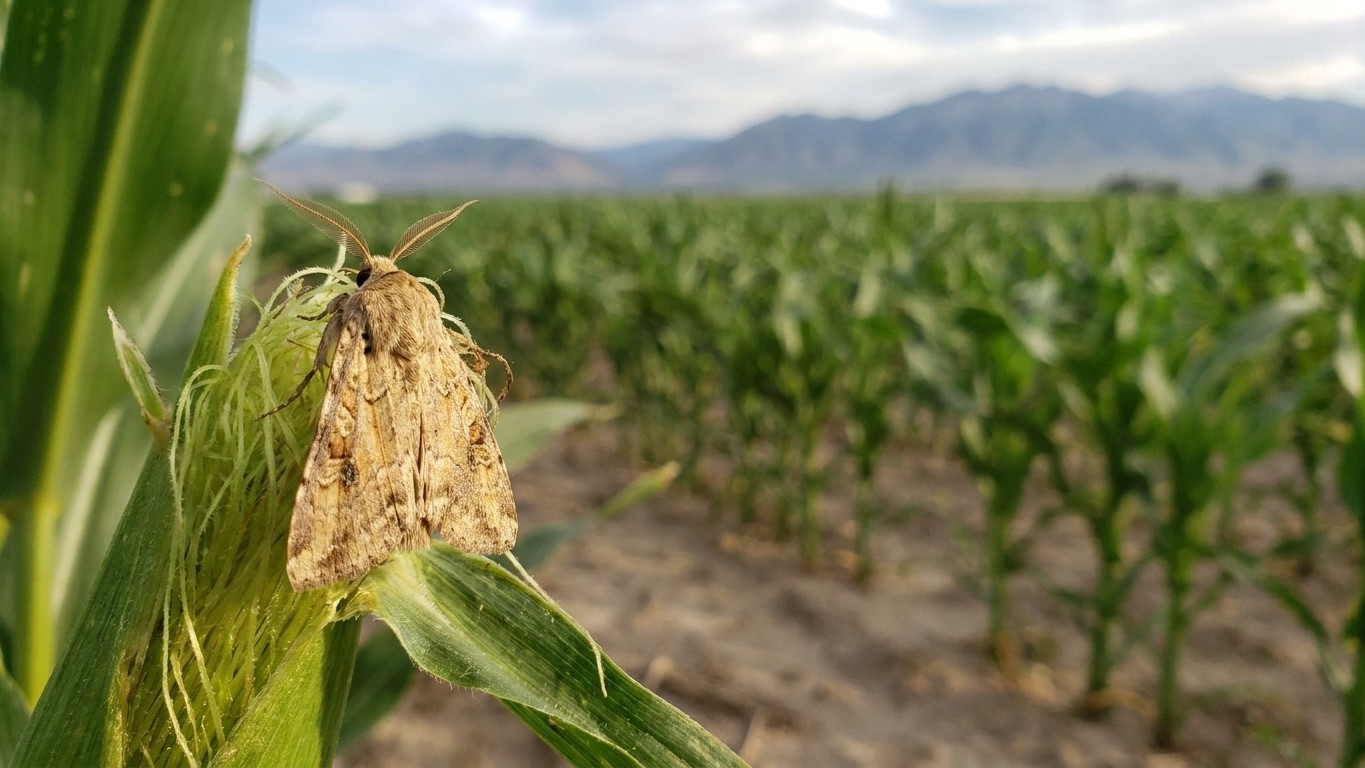

Corn earworm moths start showing up in Utah fields anywhere from late May in the warmer southern valleys to mid-July along the Wasatch Front, and the insect rarely survives a Utah winter on its own. Almost every population that damages sweet corn, tomatoes, and beans here blew in on storm systems from Texas, New Mexico, and Arizona. Once they arrive, though, they breed fast, and stopping them comes down to timing, physical barriers, and a short list of treatments that actually work against a caterpillar that spends most of its life hidden inside the plant.
The weeks to watch

Winter is the corn earworm’s biggest enemy in Utah, and that’s good news for growers. The pupae that overwinter in soil need relatively mild conditions to survive, something northern Utah’s hard freezes rarely allow. In Cache Valley, the Wasatch Front, and most of the state above 4,500 feet, local overwintering populations are minimal to nonexistent. Southern Utah, particularly the St. George and Dixie corridor, sits closer to the edge of the moth’s permanent range and sees somewhat higher odds of a few pupae making it through a mild winter.
That distinction matters less than you’d think, because the real driver of Utah infestations is migration. Corn earworm moths are strong fliers and can travel hundreds of miles on prevailing wind currents, riding storm fronts up from the Southwest and Mexico. Utah State University Extension entomologists track this with pheromone trap networks placed in agricultural counties, and the pattern is consistent year to year: moth counts stay near zero through early spring, then spike suddenly when a weather system pushes populations north.
In southern Utah counties like Washington and Iron, that spike often lands in late May or early June. Along the Wasatch Front and in Utah County, growers typically see the first meaningful moth flights in mid-to-late June. Cache Valley and other higher-elevation growing regions lag another one to three weeks behind that, with peak activity commonly falling in mid-July. A late, cool spring can push all these windows back further, while a warm, dry May tends to pull them earlier.
Multiple Generations in a Single Season
Once moths establish in a field, Utah’s growing season is long enough to support two full generations in most years, and southern Utah’s warmer, longer season can sometimes squeeze in a partial third. Each generation takes roughly four to six weeks from egg to adult moth, depending on temperature. That means an August planting of sweet corn in Washington County can face pressure from both the original migrant population and its offspring, which is exactly why late-planted corn in the warmer parts of the state often shows the worst ear damage of the year.
Why Utah’s Climate Complicates Control Timing
Elevation creates a patchwork of pest calendars across a state that spans from 2,180 feet near the Nevada border to mountain valleys above 6,000 feet. A control strategy timed for corn earworm flights near St. George will be weeks too early for Cache Valley, and vice versa. This is one reason generic pest-control advice from national gardening sites falls short for Utah growers: the moth doesn’t read a calendar, it reads degree days and wind patterns specific to each region.
Degree-day accumulation models, which extension services use to predict insect development based on daily temperatures, are the most reliable way to anticipate when local corn earworm pressure will build. Rather than marking a fixed date on the calendar, growers who track accumulated heat units for their specific valley get a much sharper window for when to start scouting silks and setting traps. Home gardeners without access to formal degree-day tracking can approximate this by watching for the first hot stretch of consistent 85-degree-plus days in early summer, which tends to precede moth activity by one to two weeks.
Dry, windy years also tend to bring heavier infestations, since the same weather patterns that carry dust and smoke into Utah from the Southwest carry moths along with them. Growers who remember a particularly bad corn earworm year often trace it back to a summer with repeated southerly wind events, not just warm temperatures alone.
What Actually Stops Corn Earworm in Utah
The caterpillar’s biggest advantage is also its biggest weakness: it tunnels straight into the ear tip and feeds hidden from view, which means sprays applied after damage starts rarely reach it. Effective control in Utah leans on hitting the insect before it burrows in, or choosing corn that resists it from the start.
Planting Choices That Reduce Pressure
Timing the crop to mature before peak moth flight is the single most effective free tool available to Utah growers. Along the Wasatch Front, sweet corn planted early enough to silk before late June often escapes the worst of the pressure, since it matures and gets harvested before the first big moth wave arrives. In southern Utah, where flights start earlier, this window shifts accordingly and favors either very early spring plantings or accepting that a fall crop will need active management.
Hybrid selection matters too. Sweet corn varieties bred with tighter husks and longer silk channels give the larvae a harder path to the kernels, and some commercial hybrids incorporate Bt (Bacillus thuringiensis) traits that produce a protein toxic to caterpillars feeding on the plant tissue. Bt sweet corn varieties, sold under several brand names at garden centers and through seed catalogs, have shown strong reductions in ear damage in university trials across the western United States, though they don’t eliminate the need for scouting entirely.
Direct Treatments That Work
For home gardeners growing conventional sweet corn, the most reliable low-tech method is applying a small amount of mineral oil or vegetable oil, sometimes mixed with a Bt spray, directly into the silk channel at the tip of each ear once silks begin to brown. This is done by hand with a squeeze bottle or eyedropper, roughly three to seven days after silk emergence, and it works by smothering eggs and small larvae before they tunnel past the first inch of the ear. Reapplying isn’t usually necessary if timed correctly, since the oil barrier lasts through the vulnerable window.
Bacillus thuringiensis sprays, particularly formulations containing the kurstaki or aizawai strains, remain a solid organic option when applied at the first sign of moth activity and repeated every five to seven days through the silking period. Spinosad, another biologically derived insecticide accepted for organic use, offers similar control and is often easier to find at Utah garden centers. Synthetic pyrethroids provide faster knockdown for larger plantings but require careful timing since they break down within days and won’t reach larvae already inside the ear.
Pheromone traps, the same tool extension services use for regional monitoring, are available to home gardeners and give a direct, local read on when moths are actually active in a specific yard or field rather than relying on general regional averages. Checking traps twice weekly starting in late May in southern Utah, or mid-June farther north, lets a grower time silk-stage sprays to the days when moths are actually laying eggs instead of spraying on a fixed schedule that might miss the real pressure window entirely.
Beyond Sweet Corn: Tomatoes and Other Utah Crops
Corn earworm and tomato fruitworm are the same insect, just named differently depending on which crop it’s damaging. Utah tomato growers see this caterpillar bore into fruit near the stem end, often after the moth has already laid eggs on corn silks nearby and the larvae wander to adjacent plants once the ears mature past their preference. Gardens that grow both sweet corn and tomatoes in close proximity sometimes see worse tomato damage in years following heavy corn earworm flights, simply because the moth population built up on the corn first.
Beans, peppers, and even alfalfa can host this same species in smaller numbers, though corn remains its preferred target throughout Utah. Rotating sweet corn away from tomato beds each season, and cleaning up old corn stalks and debris after harvest, removes some of the pupation sites that could otherwise support a second generation later in the same summer.
One detail that surprises a lot of home gardeners: the caterpillar responsible for a ruined ear of corn at the farmers market and the one found chewing into a backyard tomato in August are very likely genetically identical, separated only by which plant the moth happened to land on first.