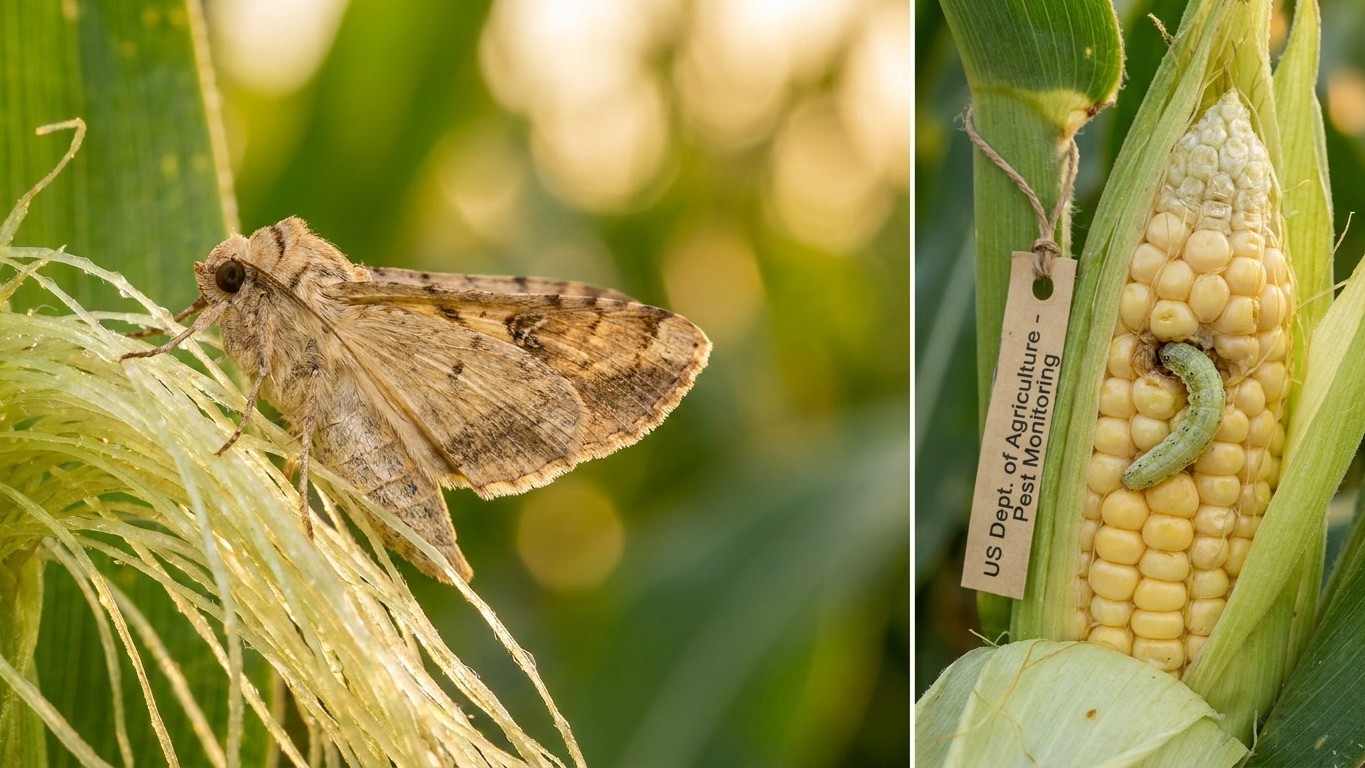

Corn earworm moths reach southern New Mexico’s low desert valleys, places like Las Cruces, Deming, and Artesia, as early as April because some pupae survive mild winters in the top few inches of soil there. Farther north and at higher elevations, from Santa Fe up to Farmington, the insect doesn’t overwinter at all. Growers there wait for migrating moths riding warm air currents up from Texas and Mexico, usually not showing up in numbers until late June. Once corn starts to silk anywhere in the state, that’s the trigger. Females lay eggs directly on fresh silk, and the larvae tunnel down toward the kernels within days.
Where Corn Earworm Actually Survives New Mexico Winters

Diapause, the dormant pupal stage that gets the insect through cold months, needs soil that doesn’t freeze solid for extended stretches. The Mesilla Valley and the Pecos Valley around Roswell and Artesia sit low enough in elevation, generally under 4,500 feet, that winter soil temperatures stay survivable for a portion of the overwintering population. New Mexico State University entomologists have long treated the southern third of the state as a zone with partial local survival, not full annual reinfestation from scratch.
Everything above about 6,000 feet works differently. Santa Fe, Taos, and the high plains around Farmington get cold enough, often with sustained nights well below freezing and less soil insulation, that local pupae rarely make it through. Growers in those areas are essentially dealing with a fresh invasion each year, which means their earworm pressure depends heavily on how strong the spring flight was farther south and how the wind behaved. A mild winter in the Mesilla Valley followed by a windy spring can mean more moths reaching Albuquerque’s East Mountains by June than in a year when a hard freeze wiped out the southern holdouts.
The New Mexico Timeline: Corn, Chile, and Monsoon Timing
Corn earworm in New Mexico isn’t just a corn pest. It’s the same insect that growers and home gardeners know as the pod borer or fruitworm in chile peppers, and New Mexico grows a lot of chile. Hatch and the broader Rincon Valley produce the state’s signature Big Jim and Sandia varieties, and pod damage from this insect has been a documented headache for the industry for decades. The moth doesn’t care whether it’s laying eggs on corn silk or chile pods, it just needs fresh green tissue and warmth.
Field corn in New Mexico typically silks somewhere between mid-June and early August depending on planting date and elevation, and that silking window lines up almost exactly with the first heavy moth flight of the season. A second, often larger flight tends to build through the monsoon in late July and August, when humidity climbs and temperatures stay warm overnight. Southern New Mexico can see two to four generations in a single growing season; the shorter, cooler season up north usually limits it to one or two. That difference matters for anyone deciding when to plant sweet corn for a Labor Day harvest versus one timed for the Fourth of July, since dodging the monsoon flight entirely by planting early is a real strategy some growers use.
In chile fields, the pattern shifts slightly. Moths lay eggs on the calyx end of the pod once fruit starts setting, and larvae bore in near the stem, often before any visible rot shows up on the outside. By the time a grower notices sunken, discolored tissue at the pod’s shoulder, the larva has usually already done its damage and moved on. This is part of why NMSU’s chile pepper research programs have spent years testing pheromone trap thresholds specifically for New Mexico growing conditions rather than borrowing numbers from Texas or California.
Spotting the Damage Before It Spreads
In sweet corn, the giveaway is frass, a crumbly, sawdust-like residue, pushed out of the tip of the ear where the larva entered through the silk channel. Peel back the husk and you’ll usually find chewed kernels concentrated at that tip, sometimes with the larva still there. Because the entry point is almost always the silk end, damage rarely reaches more than the top inch or two of a well-pollinated ear, which is why commercial growers often just trim and sell rather than scrap the whole crop.
Chile pods tell a different story since the entry point is hidden. Growers scouting for damage look for slight discoloration or a soft spot near where the pod attaches to the stem, and a gentle squeeze there sometimes reveals a give that a healthy pod wouldn’t have. Home gardeners growing tomatoes should also watch for the same insect under the name tomato fruitworm; it’s identical biologically and goes after green tomatoes with the same tunnel-and-hide approach.
What Actually Reduces Corn Earworm Damage in New Mexico
Commercial Field Strategies
Bt corn hybrids, varieties genetically modified to express a protein toxic to caterpillar pests, have cut earworm damage substantially in field corn across the Southwest, though resistance in some earworm populations has started showing up in parts of the country and is something New Mexico State’s extension entomologists monitor. Growers who don’t plant Bt varieties rely on timed insecticide applications, usually pyrethroids or spinosad-based products, sprayed right around the point when 10 percent of plants are silking and repeated every few days through the vulnerable window. Waiting for visible damage means spraying too late, since the larva is already inside the husk by then.
Trichogramma wasps, tiny parasitic insects that lay their own eggs inside earworm eggs before they hatch, have been released successfully in some New Mexico chile and corn operations as a biological control that avoids broad-spectrum insecticide use. Pheromone traps, meanwhile, give growers an early warning system: catching moths in a trap a week or two before silking starts is the signal to prep for spray timing rather than waiting to see damage in the field.
Post-harvest tillage matters more in southern New Mexico than people might expect. Disking a field after harvest disrupts pupae sitting in the soil, cutting into the population that would otherwise overwinter and emerge the following spring in the Mesilla and Pecos Valleys. It’s a low-cost step that doesn’t help in areas where the pest doesn’t overwinter anyway, but it’s one of the more effective tools available in the state’s warmer growing regions.
Home Garden Approach
For backyard sweet corn, the mineral oil trick remains one of the most reliable low-tech fixes. Once an ear has been pollinated (wait until the silks start browning at the tip, usually five to seven days after silk emergence), a few drops of mineral oil applied directly into the silk channel smothers eggs and small larvae without harming the developing kernels. Some gardeners mix in a small amount of Bt (Bacillus thuringiensis) for extra protection, though on a home scale the oil alone does most of the work. Applying it too early, before pollination finishes, can interfere with kernel development, so timing that step to the silk color change matters.
Row covers work early in the season before silking begins but have to come off once ears start forming, since pollination requires open access. Choosing shorter-season sweet corn varieties and staggering plantings so silking doesn’t line up with the peak monsoon flight in late July is another practical move for New Mexico backyard growers, particularly in Albuquerque, Las Cruces, and other lower-elevation areas where that second generation hits hardest.
Chile growers, whether commercial or home-scale, benefit from the same pheromone trap monitoring used in corn, since the moth flight patterns overlap. A trap catch spike in a corn field a mile away is a useful early warning for a chile patch too, even if the two crops are grown separately.
Related guides
- Corn earworm in Utah: When It Shows Up and What Stops It
- Corn earworm in Colorado: When It Shows Up and What Stops It
- Corn earworm in North Carolina: When It Shows Up and What Stops It
- Corn earworm in North Dakota: When It Shows Up and What Stops It