
Corn earworm shows up in Alabama as early as March along the Gulf Coast and keeps breeding all the way into November, which makes it one of the longest-running pest problems in the state. Unlike pests that hit once and disappear, this moth cycles through six or seven generations a year in south Alabama, meaning gardeners and farmers face repeated waves rather than a single window of risk.
When Corn Earworm Season Peaks in Alabama

The corn earworm (Helicoverpa zea) doesn’t survive Alabama winters everywhere in the state, but it doesn’t need to. Moths overwinter as pupae in the soil across the southern third of Alabama, particularly in Mobile, Baldwin, and the Wiregrass counties, then emerge in early spring to start the cycle. Farther north, near Huntsville and the Tennessee Valley, populations mostly arrive later in the season, carried in by migrating moths riding warm fronts up from the Gulf.
That difference in overwintering explains why pest pressure timing varies so much depending on where you garden. South Alabama growers can see damaging larvae by late April on early corn. Central Alabama, around Montgomery and Birmingham, typically sees the first serious pressure in May and June. North Alabama often doesn’t see heavy populations until July, once moths have had time to migrate and multiply through a couple of southern generations first.
Gulf Coast vs North Alabama Timing
Coastal counties get hit hardest and longest, sometimes with active larvae feeding into early December during mild years. That’s a stretch of eight or nine months where corn earworm can realistically be doing damage somewhere in the region. Inland and northern counties get a shorter window, roughly June through October, but the late-summer generations there tend to be just as dense as anything on the coast, since populations have had all season to build.
Sweet corn planted for a late summer harvest in Alabama runs directly into the worst of this pressure. Extension entomologists have long flagged silking corn in July and August as the highest-risk stage statewide, because that’s when moth numbers and corn phenology line up most consistently across the state.
How to Spot Corn Earworm Damage
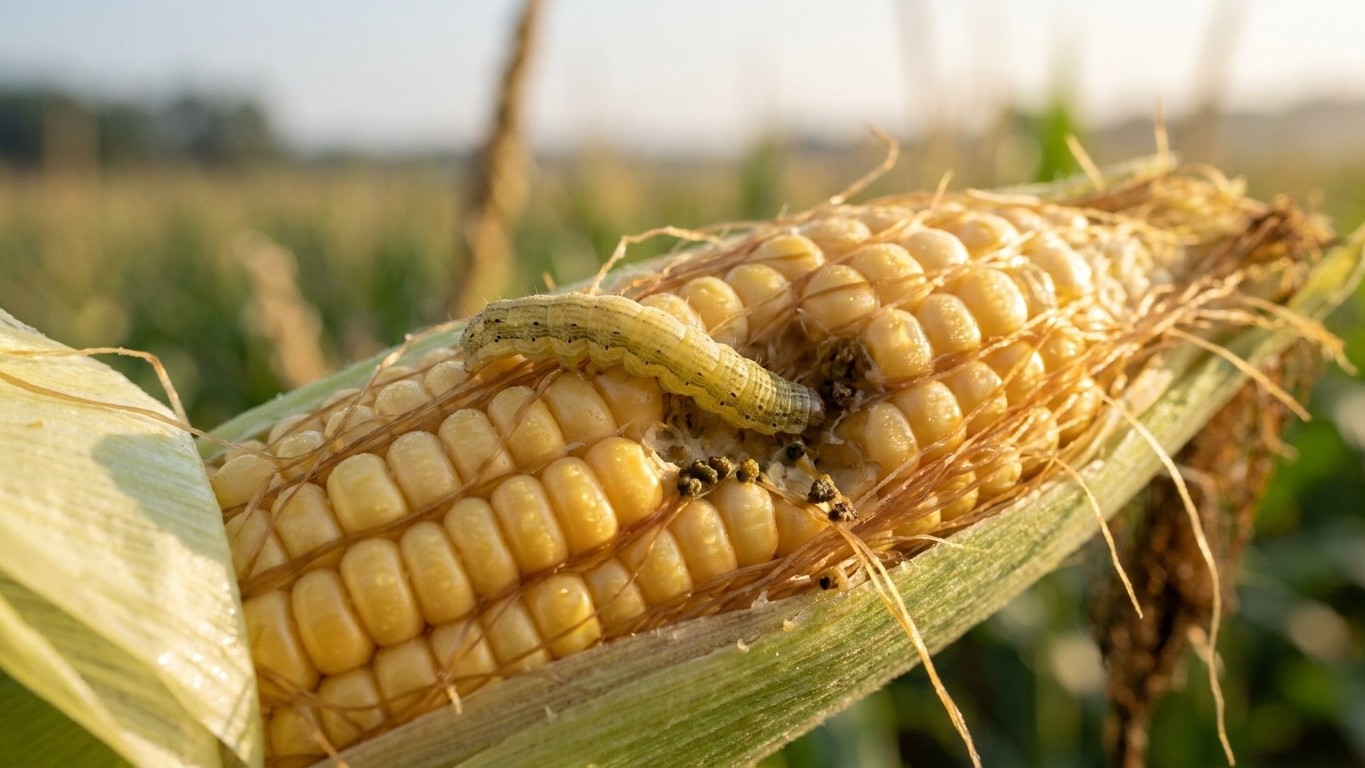
The tip-off is almost always at the ear tip. Larvae hatch from eggs laid on fresh corn silk, then tunnel straight down into the ear, feeding on kernels as they go. A damaged ear usually shows chewed, discolored kernels at the top few inches, sometimes with a trail of moist frass (insect excrement) marking the tunnel. Peel back the husk on a suspect ear and you’ll often find the culprit still inside, a caterpillar ranging from pale green to almost black depending on its age and diet.
That color variation trips up a lot of home gardeners who assume they’re dealing with two different pests. It’s one species, but larvae shift shades as they molt and as they feed on different plant tissue. What stays consistent is the pattern: light and dark alternating stripes running the length of the body, and a preference for feeding near the ear tip rather than boring through the husk from the side.
Corn isn’t the only host. The same insect attacks tomatoes (where it’s usually called tomato fruitworm) and cotton (where it goes by cotton bollworm), plus peppers, sorghum, and soybeans. A garden with tomatoes and sweet corn planted near each other can see the pest move between the two, since a female moth laying eggs doesn’t discriminate much once either crop is in a susceptible stage.
What Actually Stops Corn Earworm in Alabama Gardens and Fields
Nothing eliminates corn earworm for a whole season, since new moths keep arriving. The realistic goal is protecting the crop stages that matter most, which for sweet corn means the silk-to-harvest window.
Home Garden Tactics
Timing the planting date is the cheapest tool available. Getting sweet corn to silk before late June, when possible in your part of the state, lets a lot of gardeners dodge the heaviest mid-summer moth flights. It’s not foolproof, but it shifts the odds.
Bacillus thuringiensis, sold widely as Bt spray, remains one of the more reliable options for home gardens because it targets caterpillars specifically and spares most beneficial insects. It works best applied every three to five days starting right when silks emerge, since the larvae are most vulnerable in their first day or two after hatching, before they’ve tunneled deep into the ear where sprays can’t reach.
A low-tech trick still used by a lot of Alabama gardeners: a few drops of mineral oil applied to the silk tip a few days after pollination. It smothers small larvae trying to enter through the silk channel without harming the plant. It’s not a fix for heavy infestations, but paired with Bt applications it covers a gap that sprays alone sometimes miss.
Choosing corn varieties bred with tighter husks or longer silk channels can also reduce entry points, though no variety on the home garden market is immune.
Larger Plantings and Commercial Fields
Field-scale corn growers in Alabama lean more heavily on scouting and pheromone trap counts to time insecticide applications rather than spraying on a fixed calendar. Trap data helps identify when local moth flights spike, which lets applications target the actual egg-laying and hatching window instead of guessing.
Bt corn hybrids, which express the same bacterial protein used in Bt sprays but built into the plant itself, have cut earworm damage significantly on large acreage. But resistance has become a real concern. Populations in parts of the Southeast, including areas of Alabama, have shown reduced susceptibility to some Bt traits over the past decade, which is why entomologists recommend rotating control tactics rather than relying on a single Bt trait season after season.
Natural enemies matter more than most growers realize. Parasitic wasps in the genus Trichogramma attack earworm eggs, and general predators like lady beetles and lacewings pick off small larvae before they tunnel in. Broad-spectrum insecticide applications timed poorly can wipe out these predators along with the pest, which sometimes makes the next generation’s outbreak worse rather than better. That’s part of why blanket spraying on a fixed schedule has fallen out of favor among agronomists in favor of threshold-based decisions tied to trap counts and scouting.
A Regional Pest, Not a One-Time Problem
Corn earworm in Alabama isn’t a pest you treat once and move past. It’s closer to a recurring feature of the growing season, one that behaves differently depending on whether your garden sits near Mobile Bay or up near the Tennessee line. Coastal growers deal with earlier arrivals and a longer season; northern growers get a shorter window but often face the same intensity once moth populations catch up by midsummer.
Alabama Cooperative Extension System agents in individual counties track local trap counts and can offer more specific timing guidance than any statewide estimate, since a few weeks’ difference in planting or a warm spring can shift the whole risk window earlier or later than the regional average.
Related guides
- Corn earworm in Tennessee: When It Shows Up and What Stops It
- Corn earworm in Georgia: When It Shows Up and What Stops It
- Corn earworm in California: When It Shows Up and What Stops It
- Corn earworm in Colorado: When It Shows Up and What Stops It
- Corn earworm in New Mexico: When It Shows Up and What Stops It
- Corn earworm in North Dakota: When It Shows Up and What Stops It