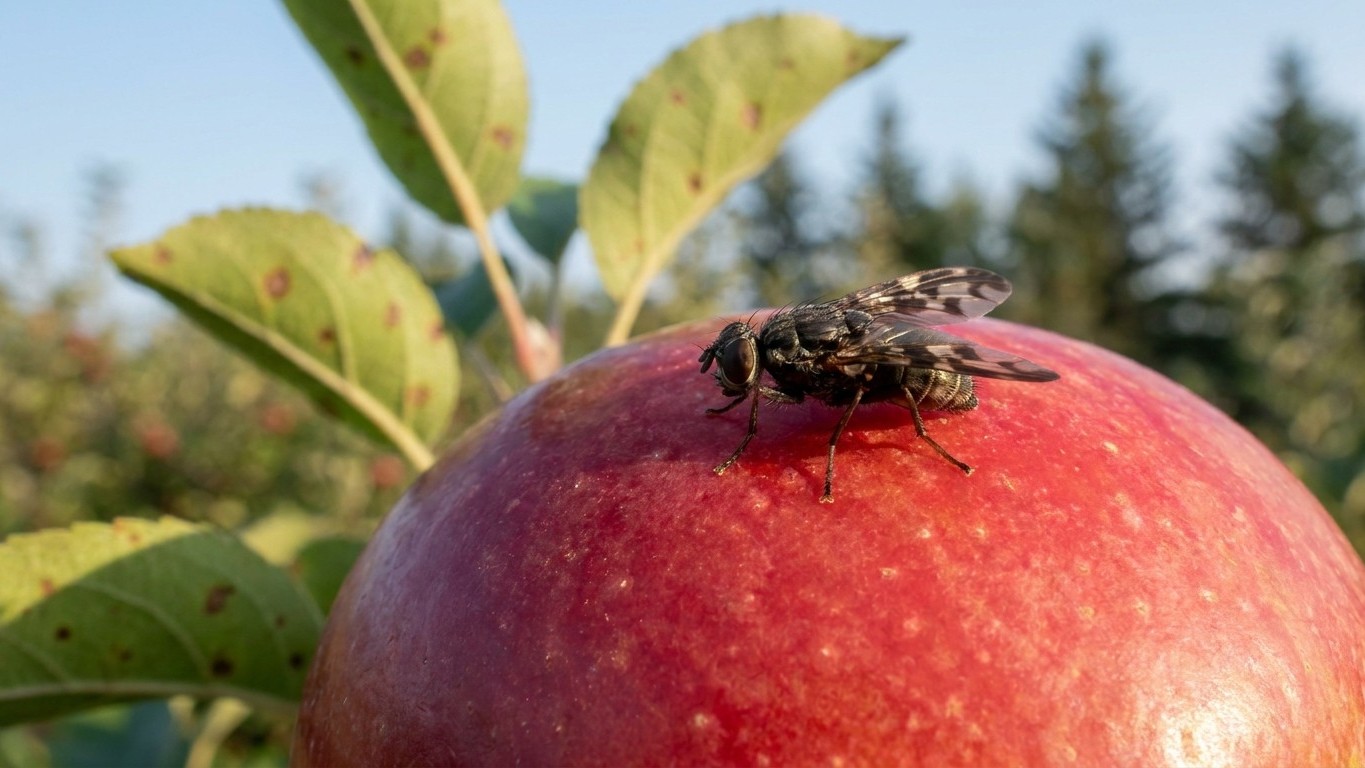

Saskatchewan sits outside the confirmed range of apple maggot (Rhagoletis pomonella). The province’s short summers and cold, often lightly-insulated winter soils make it difficult for the fly to complete a full yearly cycle, and no self-sustaining population has been documented in commercial or backyard orchards. That doesn’t make the risk zero. Nursery stock and fruit moved in from infested regions, plus wild hawthorn growing along river valleys and shelterbelts, keep a narrow door open. When the fly does turn up on the prairies, the window runs roughly early July through late August, and stopping it comes down to three things: fruit sanitation, trap monitoring, and controlling what host material crosses the border into the province.
Is Apple Maggot Actually Established in Saskatchewan?

The honest answer is no, not in the way it’s established in Ontario, Nova Scotia, or the northeastern United States, where the pest has been a standing problem for commercial apple growers for decades. Saskatchewan’s growing season runs somewhere around 100 to 120 frost-free days, compared to well over 150 in the apple belts of eastern Canada. That gap matters because apple maggot needs a certain amount of accumulated warmth, tracked by entomologists as growing degree-days above 50°F, before pupae in the soil finish developing and adults emerge. Fewer warm days simply means less opportunity for the insect to finish its cycle and build up numbers year after year.
The second limiting factor is what happens underground in January. Apple maggot overwinters as a pupa a few inches below the soil surface. In regions with heavy, consistent snow cover, that insulation can be enough to get pupae through brutal cold snaps. Saskatchewan winters bring both extreme cold and, in many years, thin or inconsistent snow cover away from windbreaks, a combination that’s rough on soil-dwelling insects that haven’t evolved for it specifically. This is one reason the pest hasn’t taken hold the way it has farther south and east, even though individual flies or infested fruit occasionally make their way north.
Where the picture gets more complicated is hawthorn. Before European settlers planted apple orchards across North America, apple maggot’s original host was wild hawthorn, and several native hawthorn species, including roundleaf hawthorn, still grow in Saskatchewan’s river valleys, coulees, and older shelterbelts. That matters because a population doesn’t need a commercial orchard to survive. It just needs host fruit and enough warm days to finish a generation. Hawthorn thickets near old farmsteads or river bottoms represent the more realistic entry point for a hidden population, rather than large-scale commercial spread.
When the Fly Shows Up: The Life Cycle on a Prairie Timeline
In places where apple maggot is common, adult flies start emerging from the soil in late June or early July and keep emerging in waves for four to six weeks. Given Saskatchewan’s slower degree-day accumulation, any local emergence would likely run later and more compressed, probably concentrated from mid-July into August rather than spread across ten weeks the way it can in Michigan or Nova Scotia orchards.
Newly emerged flies aren’t an immediate threat. Females need a preoviposition period, generally seven to ten days of feeding on bacteria, pollen, and honeydew on leaves, before their eggs mature enough to lay. Only after that maturation does a female use her ovipositor to puncture the apple skin and insert an egg, leaving a small dimple or scar on the surface. Each female can lay dozens of eggs across her three-to-four-week adult lifespan, distributing them among multiple fruit rather than concentrating damage in one place.
Eggs hatch within about a week, and the maggot stage does the real damage, tunneling through the flesh for two to three weeks and leaving winding, brown trails visible when the fruit is cut open. Mature larvae then chew their way out, drop to the ground, and burrow a few inches into the soil to pupate. In warmer climates that pupa might emerge the following summer as an adult, but a portion of any population can also stay in extended diapause, skipping a year or two before emerging, which is one reason low-density populations are so hard to eradicate once established.
Host Plants That Matter on the Prairies
Commercial and hobby apple growing in Saskatchewan relies heavily on cold-hardy apple and crabapple cultivars bred specifically for prairie conditions, since standard eastern varieties often can’t survive the winters. Crabapples, ornamental and fruiting, are common in yards and shelterbelts across the province, and they’re just as attractive to apple maggot as full-sized apples. Add wild hawthorn and the occasional plum, and there’s more potential host material scattered across Saskatchewan than most homeowners realize, even without a formal orchard nearby.
Spotting the Damage Before It Spreads
Adult apple maggot flies are small, roughly a quarter inch long, black-bodied, with a distinct white band across the top of the abdomen and dark, F-shaped markings on otherwise clear wings. They’re easy to mistake for a small housefly at a glance, which is exactly why sticky trap monitoring works better than relying on visual sightings alone.
On the fruit itself, early damage shows up as small dimples or slightly sunken spots where a female has inserted eggs, sometimes with a faint discoloration around the puncture. As larvae feed, the internal tunneling causes the flesh to turn brown and mushy in winding trails, and heavily infested fruit often drops from the tree early, weeks ahead of a normal harvest. Fruit that looks fine on the outside can still be riddled with tunnels inside, which is why cutting open a sample of dropped or suspect fruit is the most reliable field check available to a home grower.
Monitoring and Controls That Actually Work
Because Saskatchewan doesn’t have an established population to spray against on a calendar, the smarter approach for home growers is detection first, chemical control only if warranted. Two trap types dominate apple maggot monitoring across North America:
- Red sticky spheres, roughly the size and color of an apple, baited with an ammonium-based lure that mimics the smell of ripening fruit
- Yellow sticky panels, which attract flies through visual cues similar to foliage before they start seeking fruit to lay eggs on
Hanging two or three traps per tree, positioned at eye level on the sunny side of the canopy, gives a reasonable early warning system starting in late June. Checking traps weekly through August catches the flight window even if it arrives later or more compressed than in warmer regions.
Sanitation does most of the heavy lifting where the pest hasn’t established a foothold. Picking up and destroying dropped fruit promptly, rather than letting it sit under the tree, removes the larvae’s path back into the soil to pupate. Clearing out wild hawthorn near a home orchard, or at least monitoring it the same way as fruit trees, closes off the alternate host that could otherwise sustain a low-level population unnoticed. For growers who buy bare-root or potted fruit trees, sourcing stock from reputable nurseries that comply with pest-free movement standards reduces the odds of introducing infested material along with the plant itself.
What Actually Stops Spread Into Saskatchewan
Movement control matters more here than spraying. Nursery stock, used fruit-picking bins, and homegrown fruit brought across provincial or international borders from infested regions are the most plausible way apple maggot could establish a new foothold on the prairies. Anyone bringing in trees or fruit from Ontario, the Maritimes, British Columbia’s lower mainland, or infested parts of the United States should check current movement requirements with the Saskatchewan Ministry of Agriculture or the Canadian Food Inspection Agency before transporting host material into the province.
At the backyard level, the combination of trap monitoring, fast fruit cleanup, and keeping an eye on nearby hawthorn does more to prevent a foothold than any insecticide schedule would. If a grower does catch flies in a trap or finds larval tunneling in dropped fruit, reporting the find to the provincial agriculture ministry helps track whether it’s an isolated hitchhiker or the start of something that needs a coordinated response.
One detail worth keeping in mind: because hawthorn was apple maggot’s original host long before apple orchards existed, a population could theoretically survive for years in a river valley thicket without ever touching a cultivated apple tree, only showing up in an orchard once flies wander far enough to find one. That’s the scenario prairie growers should watch for, not a sudden outbreak in a commercial block, but a quiet buildup in overlooked wild fruit nearby.